
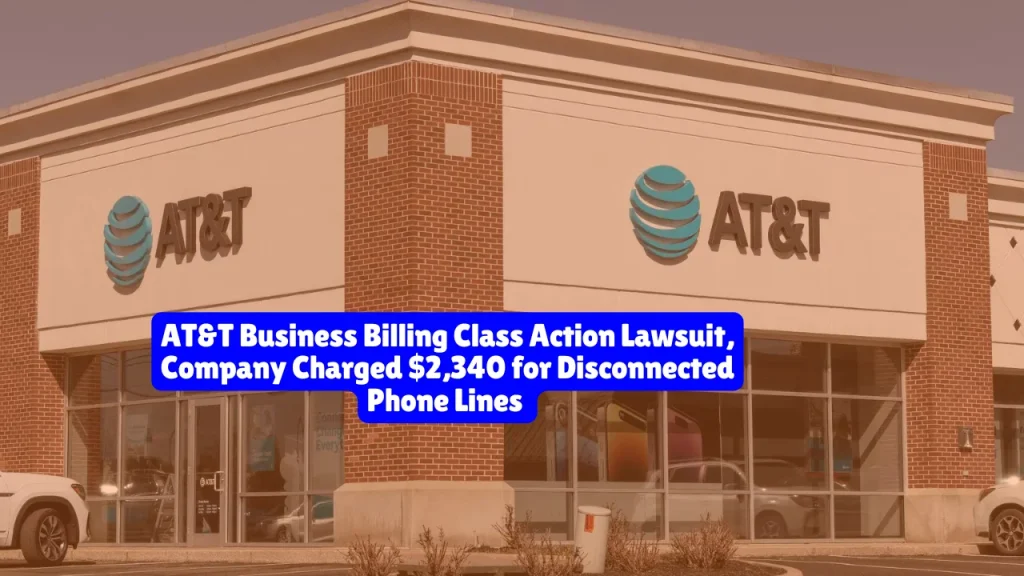
AT&T Business Billing Class Action Lawsuit, Company Charged $2,340 for Disconnected Phone Lines
A new class action lawsuit filed in January 2026 accuses AT&T of billing business customers for months after disconnecting their phone services, then demanding payment to “restore” lines that were already released to other carriers. One business was hit with a $2,340.56 bill for fire-alarm lines AT&T had disconnected. How many businesses got charged for dead phone lines? What can you recover if AT&T billed you after service ended?
The lawsuit alleges AT&T routinely created new billing accounts without telling business customers during its copper-to-digital infrastructure transition, then continued charging monthly fees even after suspending or terminating service. When businesses tried to fix the problem and restore service, AT&T allegedly kept their money but never turned the phones back on.
This Could Mean Thousands in Refunds for Your Business
You need to check your AT&T bills immediately if your business used analog copper telephone lines that AT&T switched to digital service between late 2023 and now.
The lawsuit claims AT&T’s modernization push to replace old copper phone lines with newer IP-based digital systems created billing chaos. AT&T allegedly set up new accounts for the upgraded services without informing customers, failed to consolidate billing with existing accounts as promised, and then suspended service when businesses didn’t pay bills they never knew existed.
Here’s what makes this worse: businesses that relied on these phone lines for critical safety systems—like fire alarms required by law—got slapped with violations when their service went dead. They had no idea AT&T created separate billing accounts that weren’t being paid.
What the AT&T Business Billing Lawsuit Claims
What Is AT&T Accused of Doing to Business Phone Customers?
The 11-page complaint says AT&T began retiring analog copper telephone lines in a push to modernize its infrastructure and cut costs by moving businesses to digital and IP-based alternatives.
Nothing wrong with that. Except the lawsuit alleges AT&T made a mess of the transition:
Created secret new billing accounts. When AT&T installed new digital phone lines to replace the old copper ones, the company allegedly set up completely new billing accounts without telling customers. Businesses had no idea these new accounts existed.
Never sent new service agreements. According to the lawsuit, AT&T didn’t provide written service agreements for the migrated lines. Customers reasonably assumed their new digital service would be billed on their existing AT&T accounts with autopay already set up.
Suspended service for unpaid bills customers didn’t know about. When the new secret accounts went unpaid for months, AT&T allegedly shut off service—including for fire-alarm systems that businesses are legally required to maintain 24/7.
Related article: How to Adopt Your Stepchild When the Father Won’t Sign? Legal Pathways Without Consent
Demanded payment to restore service. To get phone lines turned back on and stop the mounting charges for non-existent service, AT&T told customers to pay thousands of dollars in back bills.
Kept the money but didn’t restore service. Even after businesses paid, AT&T allegedly failed to reconnect the phone lines and had released the service numbers to other carriers. Customers couldn’t get refunds despite continuing to receive bills showing their payment.
The lawsuit specifically describes one plaintiff business that had fire-alarm monitoring lines with AT&T. In late 2023, AT&T installed new equipment to replace the old analog system. The business kept paying its regular AT&T bills through autopay and had no idea AT&T created a separate new account for the fire-alarm lines.
By May 2025, a local fire inspector discovered the fire-alarm system wasn’t working because AT&T had suspended service for months of unpaid bills on this secret account. The business had to immediately fix this or face fines and potential closure.
AT&T demanded $2,340.56 to restore service and clear the unpaid balance. The business paid. AT&T never reconnected the service and had already released the phone numbers. The plaintiff still receives bills for the terminated account showing the $2,340.56 payment but zero service.
Which Business Customers Are Included in This Class Action?
The lawsuit seeks to represent all consumers nationwide who had AT&T business telephone lines that were suspended, disconnected, or terminated by AT&T but who continued receiving bills for the defunct lines during the statute of limitations period.
This covers businesses of any size—from small shops with one or two phone lines to larger companies with dozens of connections. The key factors are:
You had AT&T business phone service (not residential). Your service was suspended, disconnected, or terminated by AT&T. You kept getting billed after service ended. This happened within the applicable statute of limitations, which varies by state but is typically 3-6 years.
The lawsuit doesn’t specify how many businesses AT&T allegedly overbilled this way. But given AT&T’s massive business customer base and the years-long infrastructure transition from copper to digital systems, the number could be substantial.
What Specific AT&T Billing Practices Are Being Challenged?
Billing after service termination. The core allegation is that AT&T charged businesses monthly service fees for phone lines that were suspended or disconnected. Once service ends, there’s no service being provided—charging for it is fraudulent.
Creating undisclosed billing accounts. When migrating customers from old analog systems to new digital ones, AT&T allegedly created new billing accounts without customer knowledge or consent. Businesses couldn’t pay bills they never received.
Failing to consolidate billing. AT&T allegedly told customers their new digital services would be added to existing autopay accounts. Instead, the company set up separate accounts that went unpaid, leading to service suspensions.
Taking payment for non-existent restoration. AT&T allegedly told customers they could get service reconnected by paying the outstanding balance. After receiving payment, AT&T didn’t restore service and had released the phone numbers to other carriers. This is unjust enrichment—keeping money for services AT&T couldn’t and didn’t provide.
Continuing to bill after accepting payment for restoration that didn’t happen. Even after businesses paid thousands to supposedly restore service, they kept receiving bills showing the payment but no active service.
What Are the Legal Claims Against AT&T?
The lawsuit will likely assert several causes of action (the specific legal claims haven’t been fully disclosed in initial reporting, but class actions like this typically include):
Breach of contract. When you sign up for phone service, AT&T promises to provide that service in exchange for payment. Billing you after terminating service violates the contract. Creating new accounts and billing terms without customer agreement also breaches the original service agreement.
Unjust enrichment. This legal concept means AT&T benefited (by collecting payments) at customers’ expense in a way that’s unfair. When AT&T accepted payment to restore service, then didn’t restore service and kept the money, they were unjustly enriched.
Fraud or fraudulent billing practices. If AT&T knowingly billed customers for services that weren’t being provided, that could constitute fraud under state consumer protection laws.
Violations of state consumer protection statutes. Most states have laws prohibiting unfair and deceptive trade practices. Billing for non-existent services and creating secret accounts without disclosure could violate these laws.
Negligence. AT&T had a duty to properly manage customer accounts during the infrastructure transition. Failing to notify customers about new billing accounts and continuing to bill for terminated services could be considered negligent business practices.
The specific legal claims will depend on which state law applies and how the plaintiff’s attorneys structure the complaint.
Has AT&T Responded to These Allegations?
As of early January 2026, AT&T has not publicly commented on this specific lawsuit. The case was just filed and is in its earliest stages.
Based on AT&T’s responses to other class actions, the company will likely deny wrongdoing and argue that any billing issues were isolated mistakes, not systematic fraud. AT&T may also point to its terms of service, which likely include arbitration clauses that could complicate class certification.
AT&T’s standard consumer terms require individual arbitration for disputes and prohibit class actions. But business customers often operate under different service agreements with different terms. Whether AT&T can force business customers into arbitration instead of court will be a key early fight in this case.
What You Must Know About Telecom Billing Fraud
How Does This Kind of Billing Fraud Happen to Businesses?
Enterprise billing is incredibly complex. Business phone systems aren’t like home phone service. A company might have dozens or hundreds of lines, multiple locations, various types of services (voice, data, fax, alarm monitoring), different billing cycles, and services under multiple account numbers.
Monthly bills can run 50+ pages with hundreds of line items. Finance managers don’t always catch errors buried in pages of technical jargon and account codes.
Automated systems keep charging. When telecom companies set up billing for a new service, their automated systems generate monthly charges unless someone manually stops them. If AT&T created new accounts during service migration but didn’t properly link them to existing customer profiles, those accounts could keep billing indefinitely—even after service ends.
Lack of oversight during transitions. Moving from one phone system to another (like copper to digital) involves complex backend work. If AT&T’s systems didn’t properly flag terminated accounts or failed to notify customers about new billing accounts, charges could continue for months before anyone noticed.
Businesses assume carriers audit properly. Most companies trust that a major telecom provider like AT&T has systems in place to prevent billing for services not being provided. They assume bills are accurate unless they spot an obvious error.
Disconnection happens at the switch, not in billing. When AT&T physically disconnects phone service or terminates an account on its network infrastructure, that doesn’t automatically stop the billing system from generating monthly charges. Those are separate systems that should communicate but don’t always sync properly.
Why Do Business Customers Often Miss These Billing Errors?
Volume of charges. A business with 50 phone lines might have a $3,000+ monthly bill. One extra $45 line item for a disconnected service could easily slip through if the total bill looks roughly correct.
Assumption of accuracy. Finance managers paying hundreds of vendor bills monthly can’t scrutinize every line item. They rely on billing systems to be accurate and only investigate when totals seem way off.
Trust in established providers. AT&T is one of the largest telecom companies in the world. Businesses assume a company this big has quality controls preventing systematic billing fraud.
Different people handle different functions. The IT manager who orders a phone line disconnected might not be the same person in accounting who pays the bill. If disconnection orders aren’t properly communicated internally or to AT&T, nobody catches the error when bills keep coming.
Complex service bundling. Business phone service is often bundled with internet, data services, equipment leases, and other features. When one component changes, it’s not always obvious in the combined billing what should and shouldn’t still be there.
Cancellation confirmations aren’t always clear. When you cancel a business phone line, you might get an email confirmation with a case number. But you may not get explicit documentation showing exactly which services were terminated, which account numbers were closed, and what your final bill should be.
What Are the Red Flags for AT&T Overbilling?
Check your AT&T bills immediately for these warning signs:
Charges continuing after cancellation dates. If you have documentation showing you canceled service on a specific date but bills show charges after that date, you’re being overbilled.
Unexpected bills for account numbers you don’t recognize. If you receive bills for AT&T account numbers you never set up or weren’t informed about, AT&T may have created new accounts during service migrations without telling you.
Service fees for disconnected phone numbers. Compare your current active phone numbers to what’s listed on your bill. If you’re being charged monthly fees for numbers you no longer use, that’s overbilling.
Charges for equipment you returned. If you returned modems, routers, or phone equipment but keep getting equipment lease or rental charges, AT&T should credit those.
Duplicate charges. Sometimes during system migrations, charges appear on both old and new accounts for the same service. Look for identical monthly fees appearing multiple times.
Bills after you switched to another carrier. If you moved all your business phone service to Verizon or T-Mobile but keep getting AT&T bills, AT&T should have closed your accounts.
Fees for fire alarm or security monitoring you know is disconnected. These are often separate line items that can be easily overlooked, but they’re also critical services where disconnections are quickly discovered when alarm companies report the problem.
Recent Developments in the AT&T Business Billing Case
January 2026: Class action lawsuit filed against AT&T alleging systematic billing fraud for disconnected business phone services. The case was filed in federal court and seeks class certification to represent all affected business customers nationwide.
Case details: The lawsuit includes specific allegations about AT&T’s copper-to-digital infrastructure transition creating undisclosed billing accounts, service suspensions, demands for payment to restore service, and retention of payments without actually restoring service.
No settlement yet: This lawsuit is brand new. AT&T has not responded, and no settlement or class certification has occurred. The legal process could take 2-3 years before reaching resolution.
Similar cases possible: If this case gains traction and exposes widespread billing fraud, expect more businesses to come forward with similar claims. Additional lawsuits could be filed in various states or consolidated into multidistrict litigation.
What to Do Next If Your Business Was Affected
How to Audit Your AT&T Business Bills for Overcharges
Pull all AT&T bills for the past 3-6 years. Most states allow you to sue for overbilling within a 3-4 year statute of limitations, and some allow up to 6 years. Get every monthly statement.
Create a spreadsheet of all services. List every phone number, every account number, every type of service (voice lines, fax lines, data lines, alarm monitoring, etc.), and when each service was supposedly active.
Compare bills to service records. Match up your AT&T bills with your internal records showing when you ordered installations, upgrades, or cancellations.
Look for these specific problems:
Charges appearing after cancellation dates you have documented. New account numbers appearing on bills without any notification from AT&T that new accounts were created. Service fees for phone numbers you no longer use or never recognized. Monthly charges continuing after you switched all services to a different carrier. Equipment rental fees for devices you returned. Duplicate charges for the same service appearing on multiple account numbers.
Calculate the total overcharges. Add up every month of improper billing for each disconnected service. If AT&T charged you $75/month for a phone line from January 2024 through December 2025 even though you canceled it in December 2023, that’s $1,800 in overbilling.
Document everything. Make copies of:
Service cancellation requests (emails, confirmation numbers, case numbers). Cancellation confirmations from AT&T. Final bills showing service termination dates. Subsequent bills showing continued charges. Correspondence with AT&T customer service about the billing errors. Notes from phone calls including dates, times, representative names, and what was discussed.
Strong documentation is critical if you join the class action or file a separate lawsuit.
How to Join the AT&T Business Billing Class Action
You don’t have to do anything to join right now. When a class action lawsuit is filed, you’re automatically included in the “class” if you fit the definition (business customer who was billed for disconnected AT&T services).
Here’s what happens next in the typical timeline:
Class certification (6-12 months). The court will decide whether to certify this as a class action. If certified, all affected business customers become part of the class unless they opt out.
Notice sent to class members (after certification). If the class is certified, AT&T will be required to send notice to all potentially affected businesses. This might be by mail, email, or publication in business media.
You decide: stay in, opt out, or do nothing. When you receive notice, you can stay in the class action (do nothing), opt out and sue AT&T separately, or object to the settlement terms if one is proposed.
Settlement or trial (1-3 years). Most class actions settle before trial. If a settlement is reached, you’ll receive notice about how to file a claim for your share.
File a claim (if settlement approved). When settlement terms are finalized, you’ll need to file a claim form documenting your losses—how much AT&T overbilled you and for how long.
Receive payment (3-6 months after settlement approval). If the settlement is approved and you filed a valid claim, you’ll receive a check for your portion of the settlement fund.
To stay informed:
Monitor ClassAction.org and TopClassActions.com for updates on this case. Save all your AT&T billing documentation now. Watch your mail and email for official class action notices (these will come from the court-appointed settlement administrator, not from random law firms). Contact the law firm handling the case if you want to be added to their notification list.
When Should You Talk to a Lawyer About AT&T Billing Fraud?
If your business lost more than $5,000 to AT&T overbilling. Class action settlements are divided among all claimants, so individual payouts can be small. If you have substantial damages, you might recover more by filing a separate lawsuit.
If you have complex multi-location billing issues. Businesses with phone systems across multiple states or locations might have more complicated claims that don’t fit neatly into a class action.
If you want to opt out of the class action. Before opting out, talk to a business litigation attorney to understand the pros and cons. Opting out means you can sue AT&T separately, but you’ll need your own lawyer and it’s more expensive and time-consuming than staying in the class.
If AT&T’s billing fraud caused additional business losses. Beyond just overcharges, did the disconnected service cause problems? For example, if your fire alarm system went offline and you faced fines, or if customers couldn’t reach you because phone lines were dead and you lost sales, you might have additional damages a class action won’t cover.
If you’re considering a separate lawsuit. Business contract attorneys and consumer protection lawyers often offer free consultations. They can review your documentation and advise whether you have a strong individual case.
If AT&T refuses to refund overbilling you’ve discovered. Try resolving billing disputes directly with AT&T first. If the company refuses to credit obvious overcharges, legal action might be necessary.
Consumer protection and business litigation attorneys often work on contingency (they get paid a percentage of what you recover) for cases involving significant damages. For smaller claims, staying in the class action is usually more practical.
Common Questions About the AT&T Business Billing Lawsuit
Do I Need Proof That AT&T Billed Me After Disconnection?
Yes, eventually. When settlement claims are filed, you’ll need documentation showing AT&T charged you for services after they were disconnected.
Critical evidence includes: bills showing charges for specific phone numbers or account numbers, proof of when you canceled service (confirmation emails, case numbers, notes from customer service calls), and comparison showing the same services appearing on bills after cancellation dates.
Start gathering this documentation now. Don’t wait until a settlement is announced.
Can Small Businesses Join This Class Action?
Absolutely. Class actions are specifically designed to help people and businesses with smaller individual claims band together.
If AT&T overbilled your small business $500 over two years, it’s not economical for you to hire a lawyer and sue individually. But when thousands of businesses each lost $500-$5,000, a class action makes sense.
Small businesses with just one or two phone lines are just as eligible as larger companies with dozens of connections.
What If I Already Paid AT&T’s Fraudulent Charges?
You can still join the class action and recover what you overpaid.
The lawsuit seeks refunds for all the money AT&T collected for services they weren’t providing. Whether you paid voluntarily (thinking the bill was correct), paid under duress (AT&T demanded it to restore service), or haven’t paid at all, you have the same claim.
If you paid AT&T thousands of dollars to restore service that was never restored, that’s exactly the type of harm this lawsuit addresses.
How Long Does a Class Action Lawsuit Like This Take?
Expect 2 to 4 years from filing to final resolution.
Here’s a typical timeline: months 0-6 after filing, AT&T files a motion to dismiss and the court decides whether the case can proceed. Months 6-18, discovery phase where both sides exchange documents and evidence about AT&T’s billing practices. Months 12-24, class certification hearing where the court decides whether to certify this as a class action. Months 24-36, settlement negotiations or trial preparation. If the case goes to trial, add another 6-12 months. Months 36-48, settlement approval and claims process. Then 3-6 months after settlement approval, checks go out.
Some class actions settle faster (18-24 months) while others drag on for 5+ years, especially if they go through appeals.
Will AT&T Offer Refunds Outside of the Lawsuit?
Maybe, but don’t count on it.
AT&T might settle billing disputes with individual businesses who complain loudly enough, especially if the overbilling is well-documented and the business threatens legal action. But AT&T has no incentive to proactively reach out to all affected businesses and offer refunds.
If you discover overbilling, contact AT&T’s business customer service immediately and demand a credit. Escalate to a supervisor if the first-level rep doesn’t help. Document everything.
But if AT&T refuses, joining the class action may be your best option for recovery.
Can I Sue AT&T Separately for Billing Fraud?
Yes, if you opt out of the class action. But think carefully before doing this.
Opting out means you’re not bound by the class action settlement. You can file your own lawsuit and potentially recover more money. But you’ll need to hire your own attorney, pay legal fees (or find a lawyer willing to work on contingency), and spend 1-3 years in litigation.
This makes sense if your damages are substantial (tens of thousands of dollars) and you have rock-solid documentation. For smaller claims, staying in the class action is usually smarter.
If you’re considering opting out, consult a business litigation attorney before the opt-out deadline.
What Happens If the Class Action Is Dismissed?
If the court dismisses the case early or refuses to certify the class, the lawsuit ends and class members get nothing through that litigation.
However, you could still: file an individual lawsuit if the statute of limitations hasn’t expired, join a different class action if another law firm files a similar case, report AT&T to state attorneys general and the FCC for billing fraud, or pursue binding arbitration if required by your AT&T service agreement.
Even if this specific lawsuit fails, the publicity might pressure AT&T to review business billing practices and offer voluntary refunds.
Pro Tip: Right now—today—pull your last 12-24 months of AT&T business bills and create a simple spreadsheet listing every phone number you’re being charged for. Then verify each number is actually active and in use. Call each number to make sure it works. If you find numbers that are disconnected or you don’t recognize, you’re likely being overbilled. Document it immediately and demand a credit from AT&T. This 30-minute audit could save you thousands.
Last Updated: January 12, 2026 — We keep this current with the latest legal developments in class action litigation and consumer protection laws.
Important Legal Disclaimer: This article provides general information about the AT&T class action lawsuit alleging fraudulent business billing practices. It is not legal advice. The AT&T business billing lawsuit is in early stages, and outcomes are uncertain. AllAboutLawyer.com does not provide legal services, represent claimants, or process legal claims. For specific questions about whether your business was affected by AT&T overbilling or telecommunications overcharging, review your service agreements and billing statements, or consult a qualified business litigation or consumer protection attorney in your jurisdiction. Class action participation does not guarantee recovery, and individual results vary.
Report telecom billing fraud to regulators: File a complaint with the FCC Consumer Complaint Center or your state attorney general’s consumer protection division.
Stay informed, stay protected. — AllAboutLawyer.com
About the Author

Sarah Klein, JD, is a licensed attorney and legal content strategist with over 12 years of experience across civil, criminal, family, and regulatory law. At All About Lawyer, she covers a wide range of legal topics — from high-profile lawsuits and courtroom stories to state traffic laws and everyday legal questions — all with a focus on accuracy, clarity, and public understanding.
Her writing blends real legal insight with plain-English explanations, helping readers stay informed and legally aware.
Read more about Sarah