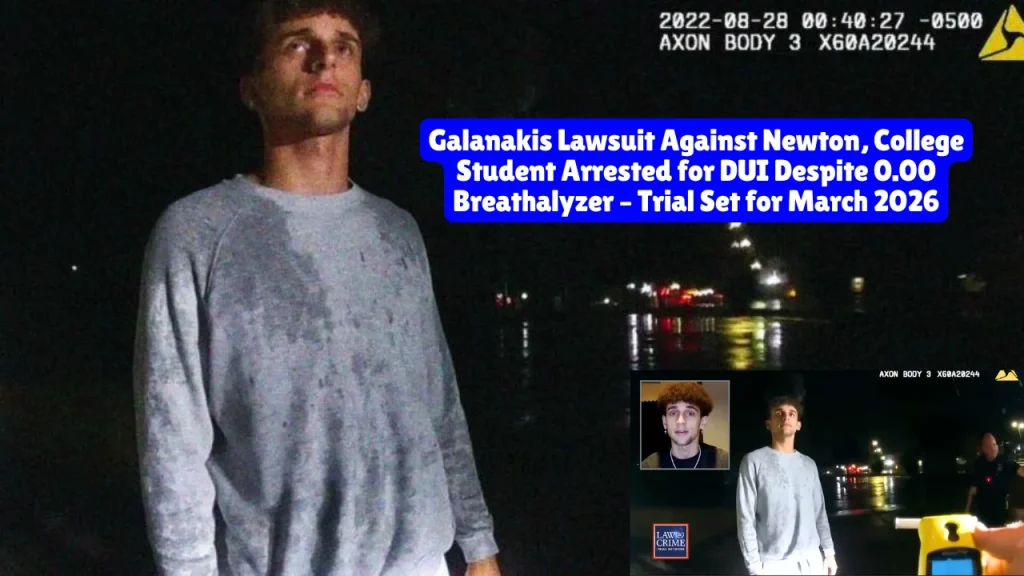
Galanakis Lawsuit Against Newton, College Student Arrested for DUI Despite 0.00 Breathalyzer – Trial Set for March 2026
LATEST UPDATE: Trial Scheduled for March 16, 2026
Breaking: The Galanakis lawsuit against Newton, Iowa police officers is heading to jury trial on March 16, 2026. In April 2025, a federal appeals court denied the officers’ qualified immunity appeal, ruling they had no reasonable basis to arrest a completely sober teenager. The 5-day trial will determine damages for this wrongful arrest that gained national attention.
The Bottom Line: Tayvin Galanakis filed a lawsuit under federal civil rights law (42 U.S.C. § 1983) and Iowa state law against Newton Police Officers Nathan Winters and Christopher Wing, along with the City of Newton, claiming they violated his Fourth Amendment rights by arresting him without probable cause in August 2022. Despite Galanakis blowing 0.00 on a breathalyzer and passing drug tests, officers arrested him for driving while intoxicated. Courts have repeatedly ruled the officers are not entitled to immunity, finding no reasonable officer could have believed the arrest was justified. The case goes to trial March 16, 2026, where Galanakis will seek damages for false arrest and violation of his constitutional rights.
Picture this: it’s just after midnight on August 28, 2022. Tayvin Galanakis, a 19-year-old college football player at William Penn University, is driving home in Newton, Iowa. His high beams are on—that’s it. No swerving, no erratic driving, nothing suspicious.
Within minutes, he’s pulled over. Within an hour, he’s arrested for driving under the influence—despite blowing a perfect 0.00 on a breathalyzer test and insisting from the very first moment that he’s completely sober.
The bodycam footage Galanakis later posted went viral, racking up over 2 million views on YouTube. People were outraged. How could police arrest someone who repeatedly asked for a breathalyzer, passed it, and then got arrested anyway?
Now, nearly four years later, the Galanakis lawsuit is finally heading to trial. And the courts have already made one thing crystal clear: the officers had absolutely no justification for this arrest.
Related Article: WWE Class Action Lawsuit, Fans Slam $29.99 ESPN Fee After Being Told Access Was “Free” – Here’s What You Need to Know
What Happened That Night: The Traffic Stop That Became a Lawsuit
Officer Nathan Winters and Lieutenant Christopher Wing pulled Galanakis over for driving with his high beams on—a minor traffic violation. From the moment Winters approached the window, he started asking about alcohol.
“Have you been drinking?” Winters asked almost immediately.
“None,” Galanakis replied. He was chewing gum. There were air fresheners hanging from his rearview mirror. Winters later claimed he smelled alcohol and saw “watery, bloodshot eyes”—but the bodycam footage doesn’t back this up.
Galanakis asked if he could take a breathalyzer test. Winters ignored him. Instead, he made Galanakis perform a series of complex field sobriety tests for over ten minutes: following his finger, walk-and-turn, one-leg stand, finger-to-nose tests, you name it.
Galanakis performed them well. He made a few minor mistakes—counting out loud wrong, taking too many steps—but nothing suggesting intoxication. The court would later note that Galanakis was “moving confidently and directing subtle and not-so-subtle verbal jabs at Winters in a manner that would have been difficult for an impaired person.”
Finally, Winters gave him the breathalyzer. The result? 0.00. Zero alcohol in his system.
A normal person would assume that’s the end of the story. Not Officer Winters.
“I Blew a Zero, So Now You’re Trying to Think I Smoked Weed?”
The moment the breathalyzer showed 0.00, Winters immediately pivoted. He read Galanakis his Miranda rights and started asking about marijuana.
“When did you last smoke marijuana?” Winters demanded.
Galanakis, clearly frustrated, insisted he hadn’t smoked that night. He explained he was a college athlete who got drug-tested every week. If he smoked, he’d be kicked off the team.
“I’ve had no weed tonight,” Galanakis said on camera. “I blew a zero, so now you’re trying to think I smoked weed? That’s what’s going on. You can’t do that, man.”
Winters asked Galanakis to come to the station for a drug evaluation. Galanakis agreed at first, but then changed his mind and said he wanted to go home.
That’s when Winters arrested him for driving while intoxicated.
At the police station, a drug recognition expert evaluated Galanakis. The result? Not under the influence of any substances. He was completely sober—just like he’d said from the beginning.
Galanakis was released. But the damage was done.
The Lawsuit: Fighting Back Against Wrongful Arrest
In February 2023, Galanakis filed the lawsuit that would become a landmark case about police accountability. He sued Officers Winters and Wing under federal civil rights law and Iowa state law, claiming:
Federal Claims (42 U.S.C. § 1983): Violation of his Fourth Amendment right to be free from arrest without probable cause
State Law Claims: False arrest under Iowa law
Against the City: Vicarious liability for the officers’ actions
The lawsuit alleged the officers’ actions were a “gross disregard” of Galanakis’s constitutional rights. He wasn’t just arrested without evidence—he was arrested despite overwhelming evidence proving his innocence.
The Officers Fought Back—and Lost
Winters and Wing didn’t take the lawsuit lying down. They filed a countersuit against Galanakis, claiming he defamed them in comments posted alongside the viral bodycam footage.
They argued they deserved “qualified immunity”—a legal doctrine that protects police officers from lawsuits unless they violate “clearly established” constitutional rights that any reasonable officer would know about.
In February 2024, Judge Stephen H. Locher dealt the officers a major blow. He ruled the lawsuit could proceed, finding that a reasonable jury could conclude Winters violated Galanakis’s clearly established constitutional rights.
The judge’s reasoning was devastating: “Galanakis’s speech and movements were not even remotely consistent with someone under the influence of a controlled substance. Galanakis insisted almost from the first moment that he wanted to blow into a breathalyzer, which would be a remarkable act of bravado for someone under the influence.”
The officers appealed. They lost again.
April 2025: Federal Appeals Court Crushes Qualified Immunity Defense
On April 17, 2025, the Eighth Circuit Court of Appeals issued a ruling that legal experts say could reshape how courts view police arrests.
Judge Jane L. Kelly wrote the opinion, and it pulled no punches.
“No officer could reasonably conclude that there was a substantial chance that Galanakis was under the influence of marijuana,” Kelly wrote. “Galanakis evinced almost no indicia of intoxication: no erratic driving; no odor of marijuana; no watery or bloodshot eyes; no staggering or physical instability; no refusal to take sobriety tests—rather, he twice asked to take a breathalyzer test.”
The court emphasized that officers can’t just cherry-pick isolated behaviors and ignore the overwhelming evidence of sobriety. They must look at the “entire situation.”
“Galanakis’s movements and behavior captured on Winters’s body camera footage suggest the opposite of intoxication,” the court found.
The appeals court affirmed the denial of qualified immunity. The officers would have to face a jury.
The Countersuit: Police Sue Galanakis for Defamation
Here’s where things get complicated. While Galanakis won on his main claims, the officers’ defamation countersuit wasn’t completely dismissed.
Most of their claims failed. The court found that Galanakis’s comments calling Winters “on the slow side of the spectrum” and “not fit mentally or physically for the job” were protected opinion, not defamation.
But one claim survived: Galanakis had posted online that Winters was “convicted” of domestic abuse.
The truth? Winters’s ex-girlfriend had obtained a domestic abuse restraining order and submitted an affidavit alleging abuse. But Winters was never charged or convicted of any crime.
That one claim—the allegation of a criminal conviction that didn’t exist—could go forward as defamation. It’s a small part of the countersuit, but it means both sides have something at stake when they walk into that courtroom in March.
What’s Going to Trial in March 2026
The trial is set to begin March 16, 2026, in Des Moines, Iowa, before Judge Stephen H. Locher. It’s expected to last 5 days.
What the jury will decide:
✓ Did the officers violate Galanakis’s Fourth Amendment rights? (Federal civil rights claim)
✓ Did the officers falsely arrest Galanakis? (State law claim)
✓ Is the City of Newton liable for the officers’ actions? (Respondeat superior)
✓ Did Galanakis defame Officer Winters? (Counterclaim – limited to the “conviction” statement)
✓ How much should Galanakis be compensated if he wins?
What’s already been decided: The officers violated Galanakis’s rights. That’s essentially established. The trial will determine damages—how much Galanakis should receive for the wrongful arrest, emotional distress, and violation of his constitutional rights.
Why This Case Matters: Qualified Immunity and Police Accountability
The Galanakis lawsuit has become a flashpoint in debates about police accountability and qualified immunity.
Qualified immunity is supposed to protect officers who make reasonable mistakes in the line of duty. But critics argue it’s become a shield for obvious misconduct.
This case is different because the courts found the arrest so unreasonable that qualified immunity doesn’t apply. That’s rare.
Legal experts point to similar cases where people won settlements after wrongful DUI arrests:
- In 2020, a Colorado man won $400,000 after being arrested for DUI despite being completely sober
- Courts have increasingly scrutinized arrests made despite breathalyzer evidence showing sobriety
The Eighth Circuit’s ruling that officers must consider the “entire situation” rather than isolated behaviors could influence future cases across eight states in the circuit.
The Viral Video That Changed Everything
Galanakis didn’t just sue—he posted the bodycam footage on YouTube with light editing. It went massively viral, sparking national outrage.
That video is both his best evidence and part of the reason the officers sued him back. Without it, this might have been his word against theirs. With it, millions of people could see exactly what happened.
The footage shows Galanakis:
- Repeatedly asking for a breathalyzer from the start
- Cooperating fully with all tests
- Speaking clearly and coherently
- Moving confidently and making sarcastic jabs at the officer
- Expressing confusion and frustration when arrested despite passing all tests
It’s powerful evidence. And the courts have repeatedly cited the video in ruling against the officers.
What Happens Next: Trial Timeline and What to Expect
March 4, 2026: Final pretrial conference
March 16, 2026: Jury trial begins (expected to last 5 days)
Likely outcomes:
If Galanakis wins (which seems likely given the courts’ rulings), he could receive:
- Compensatory damages for the wrongful arrest and emotional distress
- Punitive damages if the jury finds the officers’ conduct particularly egregious
- Attorney’s fees and costs
The City of Newton could be held liable for the officers’ actions, meaning taxpayers would ultimately pay any judgment.
If Winters wins his defamation counterclaim about the “conviction” statement, Galanakis could owe damages for that specific false statement—though likely much less than what he stands to win on his main claims.
Settlements are still possible before trial. But given how far this case has come and how much both sides have invested, it’s looking like it will actually go to a jury.
Frequently Asked Questions About the Galanakis Lawsuit
What is the Galanakis lawsuit about?
The Galanakis lawsuit is a federal civil rights case where Tayvin Galanakis sued Newton, Iowa police officers for arresting him for DUI despite him passing a breathalyzer test (0.00 BAC) and all drug tests. He claims they violated his Fourth Amendment rights by arresting him without probable cause.
Did Galanakis win the lawsuit?
The case hasn’t gone to trial yet—that’s scheduled for March 16, 2026. However, Galanakis has won every major pre-trial ruling. Courts have denied the officers’ qualified immunity twice, finding their arrest had no reasonable basis. The trial will determine damages.
How much money could Galanakis get?
That depends on what a jury awards. Similar wrongful DUI arrest cases have resulted in settlements ranging from $400,000 to over $1 million, depending on damages for emotional distress, violation of constitutional rights, and whether punitive damages are awarded.
Why were the officers denied qualified immunity?
The courts found that no reasonable officer could have believed the arrest was justified. Galanakis showed “almost no indicia of intoxication,” passed a breathalyzer showing 0.00 BAC, passed drug tests, and repeatedly asked to be tested. The evidence of sobriety was overwhelming.
What is the current status of the case?
As of January 2026, the case is scheduled for a 5-day jury trial beginning March 16, 2026, in Des Moines, Iowa. A final pretrial conference is set for March 4, 2026. Both sides are preparing for trial, though settlement is still possible.
Can the officers still get qualified immunity?
No. The Eighth Circuit Court of Appeals affirmed the denial of qualified immunity in April 2025. That issue is settled—the officers will face trial without immunity protection.
What happened with the officers’ defamation lawsuit against Galanakis?
Most of the officers’ defamation claims were dismissed. However, one claim survived: Galanakis’s statement that Officer Winters was “convicted” of domestic abuse. While Winters’s ex obtained a restraining order, he was never criminally charged or convicted. That false statement could be defamatory.
Why did Galanakis post the bodycam video?
Galanakis posted the lightly edited bodycam footage on YouTube to show what happened. The video went viral with over 2 million views, sparking national attention and debate about police accountability. While it became powerful evidence for his case, it also led to the officers’ defamation countersuit.
Will taxpayers pay if Galanakis wins?
Yes. The City of Newton is named in the lawsuit under respondeat superior liability (employer liability for employee actions). If Galanakis wins, the city—and ultimately taxpayers—would pay any judgment or settlement.
What does this case mean for police accountability?
Legal experts say this case demonstrates that qualified immunity has limits. When police arrest someone despite overwhelming evidence of innocence, they can be held accountable. The Eighth Circuit’s ruling that officers must consider the “entire situation” could influence future cases.
Disclaimer: This article is for informational purposes only and does not constitute legal advice. For specific questions about your situation, consult a qualified attorney.
About the Author

Sarah Klein, JD, is a licensed attorney and legal content strategist with over 12 years of experience across civil, criminal, family, and regulatory law. At All About Lawyer, she covers a wide range of legal topics — from high-profile lawsuits and courtroom stories to state traffic laws and everyday legal questions — all with a focus on accuracy, clarity, and public understanding.
Her writing blends real legal insight with plain-English explanations, helping readers stay informed and legally aware.
Read more about Sarah