
Cotton On Hit With Washington Spam Lawsuit—Fake “Sale Ends Tonight” Emails Could Cost Retailer Millions in $500-Per-Email Penalties
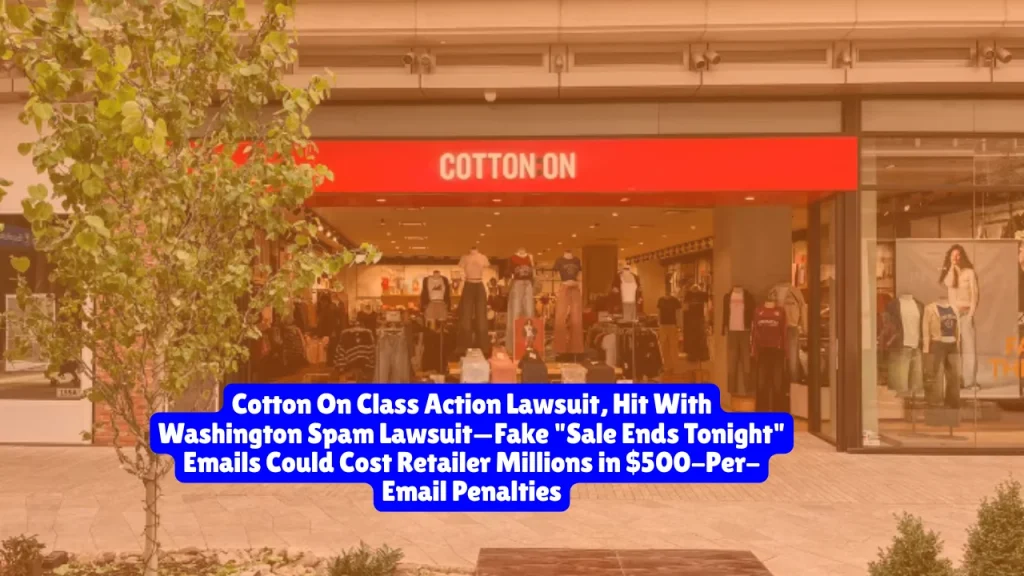
A new class action lawsuit accuses Cotton On of violating Washington’s Commercial Electronic Mail Act by sending marketing emails with misleading subject lines that create false urgency. Plaintiffs Hannah Ryu and Ella Boers filed the lawsuit on November 5, 2025, in King County Superior Court, alleging Cotton On floods consumers’ inboxes with repeated false notifications that sales are ending—when they’re not—to pressure shoppers into buying. Each violation carries up to $500 in statutory damages, potentially exposing the retailer to millions in liability.
You’ve seen these emails before. Your inbox explodes with subject lines screaming “ENDS TONIGHT!” or “FINAL HOURS!” The panic sets in. You drop everything to shop before missing the deal.
Except the sale didn’t end. The next morning, there it is again—same sale, same urgency, different day.
According to a new lawsuit, Cotton On has been playing this game with Washington consumers for years. And now they’re facing legal consequences.
What Cotton On Allegedly Did—The Email Scheme Creating False Panic
The lawsuit alleges Cotton On sends spam emails to Washington consumers with subject lines that create a false sense of urgency, enticing consumers to engage with the retailer’s marketing efforts for fear of missing out.
Picture this: You receive an email Tuesday claiming a sale ends “tonight.” You’re tempted but busy, so you wait. Wednesday morning, another email arrives advertising the exact same promotion you thought had expired.
That’s the pattern the lawsuit describes. Cotton On floods consumers’ inboxes with repeated false notifications that the time to act is short, ultimately steering consumers away from shopping for better deals.
Why does this matter legally? Because Washington has one of the nation’s strictest laws against deceptive email marketing—and the state Supreme Court just made it even more powerful.
The Game-Changing Supreme Court Decision That Changed Everything
This lawsuit comes on the heels of a bombshell ruling that sent shockwaves through the retail industry.
In April 2025, the Washington Supreme Court held that the Commercial Electronic Mail Act (“CEMA”), RCW § 19.190.020(1)(b), imposes a $500 statutory penalty on every commercial email sent to Washington residents that contains any false or misleading information in the email’s subject line.
The Brown v. Old Navy case was a 5-4 decision that rejected Old Navy’s argument that CEMA only prohibits emails that hide their commercial nature. The court broadly interpreted CEMA as prohibiting any false or misleading information in a commercial email subject line.
Here’s why this is devastating for retailers: In the six months since the Washington Supreme Court issued Brown v. Old Navy, more than thirty CEMA class-action lawsuits have been filed in Washington.
Cotton On is now part of this wave.
Related article: FTC Sends $52.5M in December 2025 Refunds—Over 1.3 Million People Getting Paid for CBD Scams, Avast Privacy Violations, and CafePress Data Breach
How Washington’s Spam Law Actually Works—The Legal Weapon Hitting Retailers
Washington’s Commercial Electronic Mail Act is deceptively simple but brutally effective.
The law prohibits sending commercial emails to Washington residents that “[c]ontain false or misleading information in the subject line,” according to RCW 19.190.020(1)(b).
What makes this law so powerful? Three things:
Statutory Damages: CEMA carries statutory penalties of $500 to $1,500 per message. You don’t need to prove actual harm—the violation itself is enough.
No Injury Required: Unlike most lawsuits where you need to prove damages, CEMA violations are per se violations of Washington’s Consumer Protection Act. The deception is the damage.
Per Email Exposure: Each misleading email counts as a separate violation. If Cotton On sent one false urgency email per week to 10,000 Washington consumers for a year, that’s 520,000 emails. At $500 each, we’re talking about $260 million in potential exposure.
The math gets scary fast.
What the Cotton On Lawsuit Specifically Alleges
The complaint filed by Ryu and Boers targets a specific type of deception that the Brown decision made actionable.
According to the lawsuit, Cotton On sends emails with subject lines that create a false sense of urgency through deceptive time-sensitivity, falsely narrowing the field and steering consumers away from shopping for better deals to its own products.
Here’s the legal theory: When Cotton On sends an email saying a sale “ends tonight,” consumers believe they must act immediately or lose the opportunity. This manufactured urgency prevents consumers from comparison shopping or waiting for better deals.
But if the sale continues the next day, or if Cotton On regularly “extends” these supposedly ending sales, the subject line was false when sent.
The Washington Supreme Court clarified that puffery like “Best Deals Ever!” remains legal, but specific claims about timing, duration, and availability can violate CEMA if false.
Cotton On’s alleged “ends tonight” claims are facts that can be verified—not puffery.
The Flood of Similar Lawsuits Targeting Retail Email Marketing
Cotton On isn’t alone. The retail industry is under siege.
Since Brown, plaintiffs have filed at least twenty new putative class actions in Washington State trial court alleging violations of CEMA, which several defendant retailers have subsequently removed to Washington federal district court.
The lawsuits target common email marketing practices:
Time-Limited Sales: Emails that falsely advertise time-limited sales where the sale was not actually limited for the time stated in the subject line because retailers consistently “extended” each sale.
Free Gift Claims: Similar to the recent L’Oreal lawsuit, retailers face claims for advertising “free gifts” that require undisclosed purchase minimums.
Percentage-Off Discounts: Some lawsuits allege product discounts at a specified percentage off where those discounts are calculated from inflated list prices.
Last month, plaintiffs filed separate class action lawsuits against Macy’s and Discount Tire, alleging that defendants sent marketing emails containing misleading subject lines regarding the duration or urgency of promotional offers.
For more on similar deceptive marketing claims, see our coverage of the L’Oreal free gift email lawsuit.
Why This Matters More Than Just Cotton On—The Industry Crisis
CEMA’s combination of broad liability, statutory damages, and lack of an injury requirement transforms every marketing email into a potential lawsuit.
Think about what this means: Every retailer that sends promotional emails to Washington residents—regardless of where the company is located—now faces this exposure.
Retailers should immediately review their email marketing practices, with a specific eye toward time-sensitive language. Phrases implying urgency, such as “today only,” “last chance,” and “ends soon,” are exceptionally high risk.
The Washington Retail Association warns that most of these suits are driven by a growing list of out-of-state lawyers, some of whom are even seeking admission to the State Bar to invest further in these cases.
This is becoming an industry.
What Cotton On Could Be Facing—The Staggering Numbers
Let’s do the math on Cotton On’s potential exposure.
If Ryu and Boers can certify a class representing all Washington consumers who received these allegedly deceptive emails, and if Cotton On sent just one false urgency email per week to, say, 50,000 Washington consumers over two years, that’s approximately 5.2 million emails.
At $500 per email, that’s $2.6 billion in maximum statutory exposure.
Will Cotton On actually pay billions? Almost certainly not—these cases typically settle for far less, and courts may reduce damages in extreme cases. But the exposure is real enough to force settlement discussions.
The lawsuit seeks:
- Statutory damages of up to $500 per email violation
- Treble damages under Washington’s Consumer Protection Act
- Injunctive relief forcing Cotton On to stop false urgency tactics
- Attorneys’ fees and costs
- Class certification for all affected Washington consumers
Similar to other consumer protection cases like the Talbots fake sale lawsuit, these claims put significant pressure on retailers to change practices.
The Constitutional Defense—Will Retailers Win on Preemption?
Retailers aren’t taking this lying down. They’re raising two powerful defenses that could reshape the entire legal landscape.
Federal Preemption: Defendants have argued the federal CAN-SPAM Act, which similarly regulates commercial email subject lines, expressly preempts CEMA as interpreted.
The federal CAN-SPAM Act was supposed to create a uniform national standard for email marketing. Retailers argue Washington can’t impose stricter requirements that contradict federal law.
Commerce Clause Violations: Defendants can also argue that CEMA violates the U.S. Constitution’s dormant Commerce Clause because CEMA directly controls commerce occurring entirely outside the boundaries of Washington and/or imposes an excessive burden on interstate commerce.
This argument is compelling: A retailer in California sends an email from a server in Texas to consumers nationwide, including Washington. Should Washington’s law govern that entire transaction?
These constitutional questions will likely take years to resolve through appeals. These are issues that will surely need to be resolved by the appellate courts eventually.
What Washington Consumers Can Do Right Now
If you’re a Washington resident who received Cotton On emails with allegedly false urgency claims, you may be part of this class action.
Save those emails. They’re evidence. Look for subject lines claiming sales are ending when they continued, or repeated urgency claims for the same promotions.
Watch for class certification news. If the court certifies the class, you’ll receive notice about your rights and how to participate or opt out.
Know your rights under CEMA. You’re entitled to truthful subject lines. “Ends tonight” should mean it actually ends that night.
For information on other active consumer protection settlements, see our guide to 2026 class action settlements.
Key Takeaways for Consumers and Retailers
For Consumers:
- Washington’s spam law is one of the nation’s strongest consumer protections
- You don’t need to prove harm to join CEMA class actions
- Each deceptive email is a separate violation worth up to $500
- Urgency claims like “ends tonight” must be truthful, not marketing tactics
For Retailers:
- Review every email subject line for factual accuracy before sending
- Avoid time-limited language unless absolutely true
- “Puffery” like “Best Sale Ever!” is still legal
- Washington law applies to anyone emailing Washington residents, regardless of company location
Frequently Asked Questions
Q: What is the Cotton On class action lawsuit about?
A: The lawsuit alleges Cotton On violated Washington’s Commercial Electronic Mail Act by sending marketing emails with false urgency in subject lines, claiming sales were ending when they weren’t, to pressure consumers into purchasing.
Q: Who can join the Cotton On spam lawsuit?
A: The lawsuit seeks to represent all Washington state residents who received Cotton On marketing emails with allegedly misleading subject lines. If the court certifies the class, eligible consumers will receive notification.
Q: How much could Cotton On pay in damages?
A: Washington law allows up to $500 in statutory damages per email violation, plus potential treble damages under the Consumer Protection Act. With potentially thousands of class members receiving multiple emails, exposure could reach millions of dollars.
Q: What is Washington’s Commercial Electronic Mail Act (CEMA)?
A: CEMA prohibits sending commercial emails to Washington residents with false or misleading information in subject lines. Violations carry $500-$1,500 in statutory damages per email without requiring proof of actual harm.
Q: How is the Cotton On lawsuit different from regular spam complaints?
A: This isn’t about unwanted emails—it’s about misleading subject lines. Cotton On allegedly sent emails falsely claiming urgency to manipulate purchasing decisions, which violates Washington consumer protection law.
Q: What did the Brown v. Old Navy decision change?
A: In April 2025, the Washington Supreme Court ruled that CEMA prohibits any false or misleading information in email subject lines—not just information hiding the email’s commercial nature. This dramatically expanded retailer liability.
Q: Can Cotton On defend by claiming the information was in the email body?
A: No. The Washington Supreme Court made clear that only the subject line matters. Even if the email body contains disclaimers or clarifications, a false subject line violates CEMA.
Q: What is “false urgency” in email marketing?
A: False urgency occurs when retailers claim sales are ending or time-limited when they’re not, creating artificial pressure to purchase immediately rather than comparison shopping or waiting for better deals.
Q: How many similar lawsuits have been filed since the Brown decision?
A: More than thirty CEMA class action lawsuits have been filed in Washington since April 2025, targeting major retailers for allegedly misleading email subject lines.
Q: What should Washington consumers do if they received these emails?
A: Save the emails as evidence, watch for class certification news, and consider consulting a consumer protection attorney if you believe you were misled by false urgency claims.
The Bigger Picture—A Reckoning for Email Marketing
This lawsuit represents something bigger than Cotton On or even Washington state. It’s about whether retailers can use psychological manipulation disguised as marketing to pressure consumers into purchasing.
The plaintiffs argue Cotton On’s deceptive time-sensitivity falsely narrows the field, steering consumers away from shopping for better deals to its own products.
That’s the harm CEMA was designed to prevent. When every email screams urgency, consumers can’t make informed decisions. They’re pushed to act on fear rather than preference.
The outcome of this case—and the dozens like it flooding Washington courts—could fundamentally reshape how retailers communicate with consumers.
For Cotton On, the message is clear: “Ends Tonight” should mean it actually ends tonight. Anything else isn’t just bad marketing—in Washington, it’s illegal.
Case Information: Ryu, et al. v. Cotton On USA Inc., Case No. 2:25-cv-02459, Superior Court of the State of Washington, County of King (filed November 5, 2025)
Legal Representation:
- Plaintiffs: Information pending from court documents
This article is for informational purposes only and does not constitute legal advice. If you believe you have been affected by deceptive email marketing practices, consult with a qualified consumer protection attorney. Information based on court filings, Washington Supreme Court decisions, legal expert analysis, and news reports from consumer privacy outlets as of January 2026.
About the Author

Sarah Klein, JD, is a licensed attorney and legal content strategist with over 12 years of experience across civil, criminal, family, and regulatory law. At All About Lawyer, she covers a wide range of legal topics — from high-profile lawsuits and courtroom stories to state traffic laws and everyday legal questions — all with a focus on accuracy, clarity, and public understanding.
Her writing blends real legal insight with plain-English explanations, helping readers stay informed and legally aware.
Read more about Sarah