
What is the Supreme Law of the Land? That Overrules Everything—Why the Constitution Beats State Laws, Federal Statutes, and Even Presidential Orders
The US Constitution is the supreme law of the land, as established by Article VI, Clause 2 (the Supremacy Clause). This means when state laws or even federal statutes conflict with the Constitution, the Constitution wins. Every law, treaty, court ruling, and government action must comply with constitutional requirements—or it can be struck down as unconstitutional.
In June 2025, the Supreme Court unanimously ruled in Martin v. United States that even federal law enforcement officers acting in pursuit of federal policy must respect constitutional limits. The Court rejected arguments that the Supremacy Clause shields government agents from accountability when they violate individual rights. This landmark case demonstrates a principle older than America itself: no law—federal or state—can override the Constitution.
The Supremacy Clause: What It Actually Says
Article VI, Clause 2 of the US Constitution states:
“This Constitution, and the Laws of the United States which shall be made in Pursuance thereof; and all Treaties made, or which shall be made, under the Authority of the United States, shall be the supreme Law of the Land; and the Judges in every State shall be bound thereby, any Thing in the Constitution or Laws of any State to the Contrary notwithstanding.”
Translation: The Constitution is America’s highest law. Federal laws made under constitutional authority come next. State laws can’t contradict either. State judges must follow federal constitutional law even when it conflicts with state constitutions.
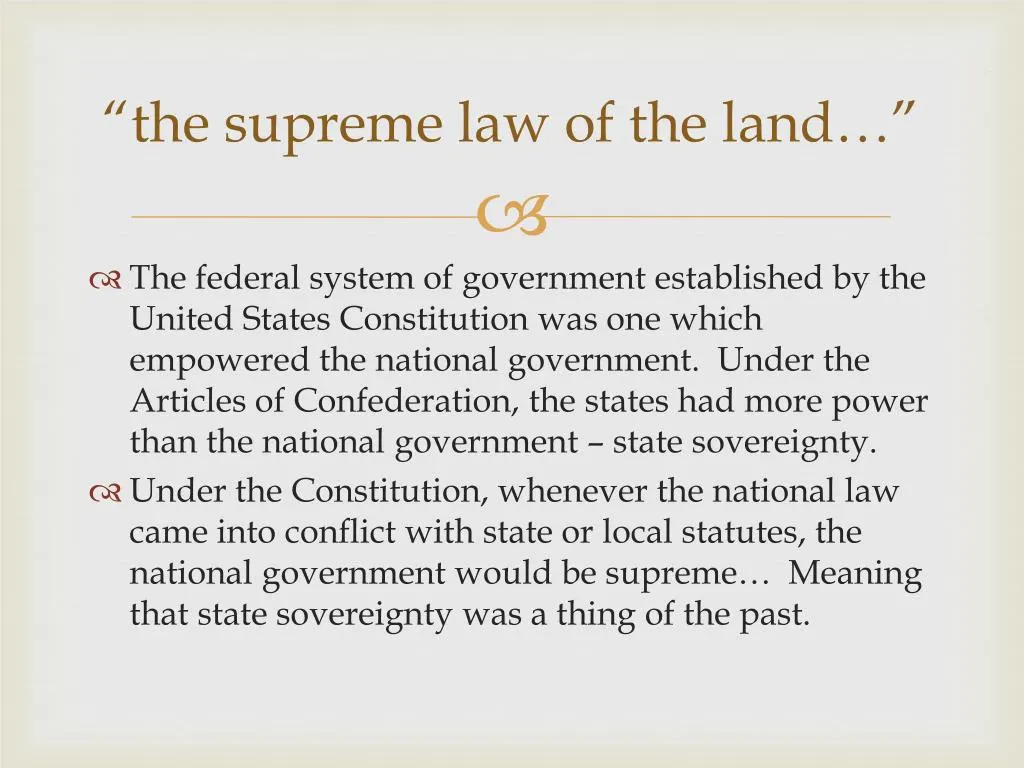
This clause solved a critical problem. Under the Articles of Confederation (1777-1789), states ignored federal laws whenever convenient. The new Constitution needed teeth—a clear hierarchy establishing federal supremacy.
James Madison argued in the Federalist Papers that without this clause, America would descend into “constant political chaos” with states and federal government endlessly battling for power.
The Law Hierarchy: What Beats What
1. US Constitution (Supreme Law)
Everything else must comply with constitutional requirements. If it doesn’t, courts can strike it down.
2. Federal Laws and Treaties
Acts of Congress and ratified treaties rank below the Constitution but above state law—if they comply with constitutional limits.
3. Federal Regulations
Rules issued by federal agencies (FDA, EPA, etc.) have force of law when authorized by Congress and constitutional.
4. State Constitutions
Each state has its own constitution, but it cannot contradict the US Constitution or valid federal law.
5. State Laws and Local Ordinances
State statutes and city/county laws sit at the bottom of the hierarchy. They’re valid unless they conflict with higher law.
The Rule: Higher law always wins. If your city bans something the Constitution protects, the ban is unconstitutional. If your state requires something federal law prohibits, federal law prevails.
When Laws Conflict: Federal Preemption
Federal preemption means federal law overrides conflicting state law in areas where Congress has constitutional authority.
Example from 2024: The Eighth Circuit struck down Missouri’s Second Amendment Preservation Act (SAPA), which attempted to declare federal gun laws “invalid” in Missouri and prohibited state cooperation with federal firearms enforcement.
The court ruled Missouri cannot nullify federal law. While states can refuse to help enforce federal law (the “anti-commandeering doctrine”), they cannot declare federal laws void or punish citizens for complying with them.
The Constitution allows this because: Article I gives Congress specific powers (regulating interstate commerce, collecting taxes, national defense). When Congress acts within those powers, states must comply.
The Landmark Cases That Established Constitutional Supremacy
Marbury v. Madison (1803): The Birth of Judicial Review
Chief Justice John Marshall established that courts have the power to declare laws unconstitutional—a concept called “judicial review.”
The case: Congress passed a law expanding the Supreme Court’s jurisdiction. Marshall ruled the law violated Article III of the Constitution, making it void.
Why it matters: This case established that courts—not Congress or the President—get the final say on what the Constitution means. If a law contradicts the Constitution, courts can strike it down.
Marshall wrote: “It is emphatically the province and duty of the judicial department to say what the law is.”
McCulloch v. Maryland (1819): Federal Law Beats State Law
Maryland tried to tax the Second Bank of the United States. Chief Justice Marshall ruled states cannot tax federal institutions.
Key principle: “The power to tax involves the power to destroy.” Allowing states to tax federal entities would let them undermine federal authority.
The ruling: When valid federal law conflicts with state law, federal law wins. States cannot interfere with legitimate federal operations.
Cooper v. Aaron (1958): States Must Obey Federal Court Orders
After Brown v. Board of Education declared school segregation unconstitutional, Arkansas officials refused to comply, claiming states could interpret the Constitution differently.
The Supreme Court unanimously rejected this argument. All nine justices signed the opinion stating that federal constitutional interpretations by the Supreme Court are binding on states.
The principle: State officials cannot defy Supreme Court rulings on constitutional questions. The Court’s interpretation of the Constitution is “the supreme Law of the Land.”
Recent Supreme Court Cases on Constitutional Supremacy (2024-2025)
Martin v. United States (June 2025)
FBI agents raided the wrong house during a no-knock warrant, deploying flashbangs and SWAT teams on an innocent family. The government claimed the Supremacy Clause shielded agents from liability under the Federal Tort Claims Act.
Ruling: Justice Gorsuch, writing for a unanimous Court, rejected this defense. The Supremacy Clause doesn’t give federal agents immunity from accountability when they harm citizens. The FTCA itself is federal law, so applying it doesn’t violate federal supremacy.
TikTok Inc. v. Garland (January 2025)
TikTok challenged the federal ban requiring ByteDance to sell the platform or cease US operations, arguing it violated First Amendment free speech rights.
Ruling: The Supreme Court upheld the ban. While the First Amendment protects speech, Congress has constitutional authority to regulate foreign adversary-controlled applications for national security. The law survived “strict scrutiny” because it serves a compelling government interest and is narrowly tailored.
Similar to other constitutional cases covered in our analysis of DUI checkpoint constitutionality, courts balance individual rights against government interests when reviewing laws.
What This Means for Your Rights
The Constitution protects specific rights that government cannot infringe—even if elected officials pass laws trying to do so.
Bill of Rights protections include:
- First Amendment: Freedom of speech, religion, press, assembly, and petition
- Fourth Amendment: Protection against unreasonable searches and seizures
- Fifth Amendment: Due process, protection against self-incrimination, double jeopardy
- Sixth Amendment: Right to speedy trial, impartial jury, legal counsel
- Eighth Amendment: Protection against cruel and unusual punishment
Recent example: When Montgomery County, Maryland schools required elementary students to read books on gender and sexuality without parental notice or opt-out options, parents sued claiming it violated their First Amendment right to direct their children’s religious upbringing.
In Mahmoud v. Taylor (2025), the Supreme Court ruled the policy likely violated the Free Exercise Clause and remanded for a preliminary injunction.
How Constitutional Amendments Work
The Constitution isn’t set in stone—it can be changed through the amendment process outlined in Article V.
Two ways to propose amendments:
- Two-thirds vote in both House and Senate (used for all 27 amendments)
- Constitutional convention called by two-thirds of state legislatures (never used)
Ratification requires:
Three-fourths of state legislatures (38 states) must approve the amendment.
Why it’s difficult: The high thresholds ensure only amendments with overwhelming support become law, protecting the Constitution from temporary political majorities.
Recent amendments:
- 26th Amendment (1971): Lowered voting age to 18
- 27th Amendment (1992): Restricts congressional pay raises
Can Federal Laws Be Unconstitutional?
Yes. Federal statutes must comply with the Constitution. If Congress exceeds its enumerated powers or violates individual rights, courts can strike down federal laws.
Examples of federal laws struck down:
Line Item Veto Act (1996): Supreme Court ruled it violated separation of powers by giving the President legislative authority.
Portions of Affordable Care Act: Several provisions were challenged; some upheld, others modified based on constitutional limits.
Federal marijuana prohibition in state-legalized contexts: Lower courts continue grappling with conflicts between federal Controlled Substances Act and state legalization laws.
Citizenship Test Question
“What is the supreme law of the land?” is a common US citizenship test question.
Correct answer: The Constitution
This question tests whether applicants understand America’s foundational legal principle: constitutional supremacy ensures stability, protects rights, and prevents government overreach.
Why This Matters for Everyday Americans
Understanding constitutional supremacy helps you:
Know your rights. When someone claims “there’s a law,” ask whether it violates constitutional protections.
Challenge unconstitutional actions. Government officials who violate constitutional rights can face lawsuits, even when claiming they followed agency policy.
Understand court rulings. When courts strike down laws, they’re often enforcing constitutional limits—not “making law.”
Participate in democracy. Informed citizens can advocate for constitutional compliance and hold officials accountable.
As we explored in our coverage of the Jacob Chansley constitutional lawsuit, even controversial figures can raise legitimate constitutional questions about due process and government accountability.
FAQs
Can states ignore federal law?
Not when federal law is constitutional and within Congress’s enumerated powers. However, states can refuse to enforce federal law with their own resources (anti-commandeering doctrine).
What happens if the President issues an executive order that violates the Constitution?
Courts can block or strike it down. Executive orders must comply with constitutional limits and existing statutes.
Do treaties override the Constitution?
No. Treaties are “supreme law of the land” alongside federal statutes, but both must comply with the Constitution. An unconstitutional treaty provision would be invalid.
Can state constitutions provide more rights than the US Constitution?
Yes. States can grant additional protections, but cannot reduce federal constitutional rights. For example, some states ban DUI checkpoints even though federal courts permit them.
Who decides what the Constitution means?
Ultimately, the Supreme Court. While lower courts interpret the Constitution daily, Supreme Court rulings are binding on all courts and government officials.
What if I think a law is unconstitutional?
You can challenge it in court. Bring a case raising the constitutional issue, or join an existing lawsuit. You’ll need legal representation and must show the law harms you (legal “standing”).
The Bottom Line
The Constitution is America’s supreme law—the foundation upon which all other laws rest. When conflicts arise, the Constitution wins.
This principle protects individual rights, prevents government overreach, and maintains the federal-state balance that defines American government.
From the FBI agents who raided the wrong house to state laws attempting to nullify federal authority, the 2024-2025 Supreme Court term reinforced this bedrock principle: constitutional supremacy isn’t just theory—it’s enforceable in court, binding on all government officials, and essential to American liberty.
Every law, regulation, treaty, and government action must pass constitutional muster. If it doesn’t, courts can—and will—strike it down.
That’s what makes the Constitution the supreme law of the land.
Disclaimer: This article provides general information about constitutional law and the Supremacy Clause. It does not constitute legal advice. For questions about your specific situation, consult with a constitutional law attorney.
About the Author

Sarah Klein, JD, is a licensed attorney and legal content strategist with over 12 years of experience across civil, criminal, family, and regulatory law. At All About Lawyer, she covers a wide range of legal topics — from high-profile lawsuits and courtroom stories to state traffic laws and everyday legal questions — all with a focus on accuracy, clarity, and public understanding.
Her writing blends real legal insight with plain-English explanations, helping readers stay informed and legally aware.
Read more about Sarah