
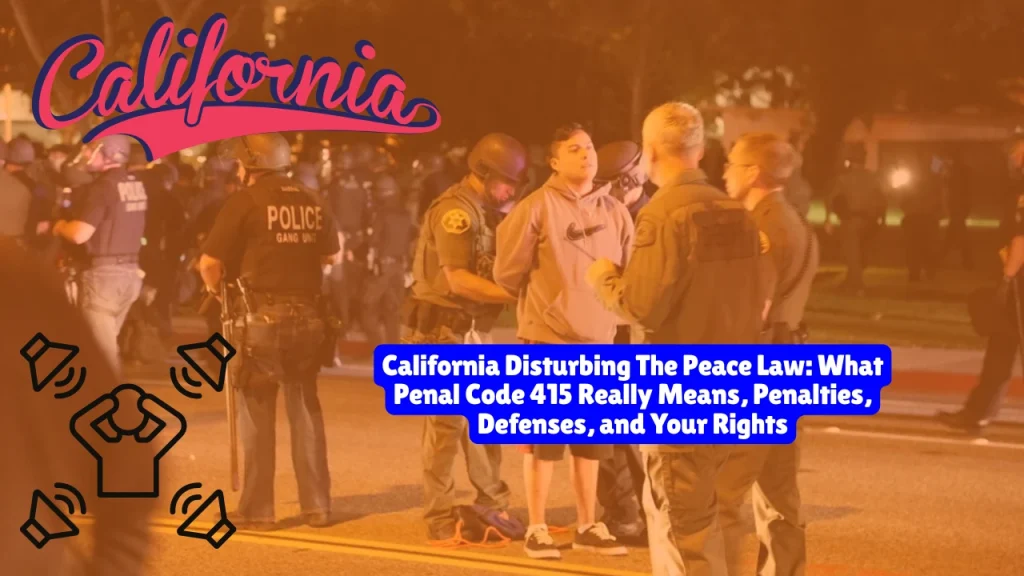
California Disturbing The Peace Law, What Penal Code 415 Really Means, Penalties, Defenses, and Your Rights
California Penal Code Section 415 makes it illegal to disturb the peace through three specific acts: fighting or challenging someone to fight in public, making unreasonable noise that disturbs others, or using offensive words likely to provoke immediate violence. Penalties include up to 90 days in jail and $400 in fines for misdemeanor charges, or up to $250 for infractions. First Amendment protections, self-defense, and lack of intent are common defenses.
What Is California Penal Code 415?
California Penal Code Section 415 is the state’s disturbing the peace law. It prohibits specific disruptive behavior in public places and can be charged as either a misdemeanor or an infraction depending on the circumstances.
The law breaks down into three distinct violations:
PC 415(1): Fighting in Public – Unlawfully fighting or challenging someone to a fight in a public place
PC 415(2): Unreasonable Noise – Maliciously and willfully disturbing someone with loud and unreasonable noise
PC 415(3): Offensive Words – Using offensive words in public that are inherently likely to provoke an immediate violent reaction
Each type requires prosecutors to prove different elements beyond a reasonable doubt.
How PC 415(1) Works: Fighting or Challenging Someone to Fight
To convict you of disturbing the peace by fighting under PC 415(1), prosecutors must prove:
- You willfully and unlawfully fought someone or challenged someone to a fight
- The fight occurred (or the challenge was made) in a public place
- You did not act in self-defense or defense of others
“Public place” means any location open to the general public—sidewalks, parking lots, shopping malls, parks, outside bars, or even department stores.
The unlawful fighting provision covers actual physical altercations and verbal challenges to fight. If you’re standing outside a bar at 2 AM and tell someone “Let’s take this outside and settle it,” that’s technically a PC 415(1) violation even if no punches are thrown.
Here’s a common scenario: Two drunk guys arguing in a parking lot outside a nightclub. One shoves the other. Both start swinging fists. Police arrive and arrest both for disturbing the peace. Even though they were just fighting each other—not threatening bystanders—California law considers public fighting itself a disturbance.
The self-defense exception matters. If someone attacks you and you fight back to protect yourself using reasonable force, you have a legitimate defense to PC 415(1) charges.
How PC 415(2) Works: Loud and Unreasonable Noise
To convict you of disturbing the peace with noise under PC 415(2), prosecutors must prove:
- You maliciously and willfully disturbed another person by making loud and unreasonable noise
- AND either: there was a clear and present danger of immediate violence, OR the noise was used to disrupt lawful activities rather than to communicate
This section targets intentional noise that genuinely disturbs others. The key word is “maliciously”—you have to act with the intent to annoy or disturb someone.
Accidental noise doesn’t count. If you have a naturally loud voice and don’t realize someone nearby is disturbed, you haven’t violated PC 415(2). The prosecution must prove you acted willfully and maliciously.
Common examples include:
- Blasting music at 3 AM after neighbors ask you to turn it down multiple times
- Revving your car engine repeatedly in a residential neighborhood late at night to annoy neighbors
- Shouting or screaming outside someone’s home after being told to leave
- Using loudspeakers or amplified sound to disrupt a lawful meeting or event
What’s NOT typically disturbing the peace: Construction noise during business hours, crying babies, barking dogs (unless you’re deliberately causing the dog to bark to harass someone), normal conversation even if loud, or traffic noise.
The “clear and present danger of immediate violence” requirement means the noise must create a realistic threat that violence will erupt. Loud music alone usually doesn’t meet this standard unless it’s combined with other threatening behavior.
How PC 415(3) Works: Offensive Words
To convict you of disturbing the peace with offensive words under PC 415(3), prosecutors must prove:
- You used offensive words in a public place
- The words were inherently likely to provoke an immediate violent response
- When you spoke, there was a clear and present danger the other person would erupt into violence
This is the most complex PC 415 violation because it bumps up against First Amendment free speech protections.
California courts have made clear that simply being rude, profane, or disrespectful isn’t enough for a PC 415(3) conviction. The words must be what courts call “fighting words”—language directed at someone that’s so inflammatory it would cause an average person to immediately retaliate with violence.
The Supreme Court addressed this in Chaplinsky v. New Hampshire, defining fighting words as those “which by their very utterance inflict injury or tend to incite an immediate breach of the peace.”
Examples that might qualify as PC 415(3):
- Approaching someone and using a racial slur while standing close in an aggressive manner
- Threatening someone’s family members while blocking their path
- Using sexually explicit language directed at someone in a way that creates a physical confrontation
What doesn’t typically qualify:
- General profanity not directed at anyone specific
- Political speech, even if offensive
- Criticism of police or government officials
- Insults shouted from a distance where no immediate confrontation is likely
The “inherently likely to provoke immediate violence” requirement is crucial. If you call someone names on social media or leave an angry voicemail, that’s not PC 415(3) because there’s no immediate danger of face-to-face violence. For more on when words cross the line into criminal territory, see our guide on whether verbal assault is actually a crime.
Penalties for Disturbing the Peace in California
Disturbing the peace is what California calls a “wobbler” or “wobblette”—meaning prosecutors can charge it as either a misdemeanor or an infraction.
Misdemeanor PC 415:
- Up to 90 days in county jail
- Fine of up to $400
- Informal (summary) probation
- Both jail and fine
Infraction PC 415:
- Fine of up to $250
- No jail time
- No criminal record
Here’s the catch: A $400 fine doesn’t mean you pay $400. California adds penalty assessments that can multiply the base fine by 4-5 times. A $400 fine can become approximately $1,700 after assessments. An infraction $250 fine becomes roughly $1,160 total.
Probation is common for misdemeanor disturbing the peace. Judges often order:
- Community service
- Anger management classes
- Stay-away orders from certain locations or people
- Regular check-ins with a probation officer
Violating probation terms can result in jail time even if you didn’t originally go to jail.
For comparison with other California misdemeanor penalties, check out our article on California fireworks laws, which carry similar misdemeanor consequences.
PC 415.5: Disturbing the Peace on School Grounds
California has a separate, stricter law for disturbing the peace at schools.
Penal Code Section 415.5 applies when someone disturbs the peace on the grounds of any school, community college, university, or state university. The law doesn’t apply to registered students or employees engaged in lawful activities.
Penalties are harsher:
First offense: Same as regular PC 415 (up to 90 days and/or $400)
Second offense: 10 days to 6 months in jail and/or up to $1,000 fine
Third or subsequent offense: 90 days to 6 months in jail and/or up to $1,000 fine
The mandatory minimum jail sentences for repeat offenses make PC 415.5 more serious than standard disturbing the peace.
Common Defenses to Penal Code 415 Charges
Several defenses can beat disturbing the peace charges:
1. Self-Defense
If you fought someone because they attacked you first and you used reasonable force to protect yourself, you have a self-defense claim. This defense only applies to PC 415(1) fighting charges.
Example: Someone sucker-punches you outside a bar. You fight back using similar force to defend yourself. Police arrive and arrest both of you. You have a valid self-defense argument even though you were fighting in public.
2. First Amendment Protection
Speech charges under PC 415(3) often violate the First Amendment. Courts have ruled that offensive, rude, or even vulgar speech is protected unless it meets the narrow “fighting words” exception.
If your words didn’t create an immediate danger of violence, or if they were political speech or general complaints rather than personal attacks, you have a strong First Amendment defense.
3. Lack of Intent
PC 415(2) noise violations require malicious and willful conduct. If you didn’t intend to disturb anyone—maybe you were unaware someone could hear you, or you were having a loud conversation without realizing it bothered anyone—you lack the required intent.
Similarly, PC 415(1) requires that fighting be “unlawful.” Self-defense makes the fighting lawful.
4. No Actual Disturbance
If your alleged noise or words didn’t actually disturb anyone, or if no reasonable person would have been disturbed under the circumstances, prosecutors can’t prove all required elements.
Example: You’re playing music in your apartment at 7 PM on a Saturday at a reasonable volume. A neighbor with unusual sensitivity calls police and claims you’re disturbing the peace. The noise wasn’t objectively unreasonable, so there’s no violation.
5. False Accusation
Disturbing the peace charges sometimes stem from disputes where one person falsely accuses another to get them in trouble. If you have witnesses or evidence showing you weren’t where the alleged disturbance occurred, or that the accuser has a motive to lie, you can challenge the charges.
6. No Public Place
PC 415(1) and 415(3) require violations to occur in public. If the alleged fighting or offensive words happened in a private residence with no public access, there’s no violation. (Note: PC 415(2) noise violations can occur even if you’re on private property, as long as the noise disturbs someone else.)
What “Public Place” Means Under California Law
California courts define “public place” broadly for PC 415 purposes.
A public place includes:
- Streets and sidewalks
- Parks and beaches
- Parking lots (even private business parking lots open to the public)
- Shopping malls and stores
- Restaurants and bars
- Apartment building common areas (hallways, lobbies)
- Hotels
- Airports and bus stations
- Any location accessible to the general public
Private property can be a “public place” if the public has access. The parking lot outside a nightclub is a public place even though the nightclub owns it, because anyone can access it.
Your own home generally isn’t a public place. But if you’re fighting or shouting on your front lawn or driveway in view of neighbors and passersby, courts may find the location public enough for PC 415.
How Prosecutors Prove Disturbing the Peace
Prosecutors rely on several types of evidence:
Witness Testimony: Police officers or civilians who observed the disturbance typically testify about what they saw and heard.
Body Camera or Surveillance Video: Police body cams, security cameras, or cell phone videos can capture the alleged disturbance.
911 Calls: Recordings of noise complaints or reports of fighting help establish that someone was actually disturbed.
Expert Testimony: In noise cases, prosecutors might present evidence about decibel levels or expert testimony about what constitutes unreasonable noise.
Defendant’s Statements: Anything you say to police—even if you’re just trying to explain your side—can be used as evidence. The classic example: “Yeah, I was yelling, but that guy deserved it” is an admission you were yelling.
The burden of proof is “beyond a reasonable doubt”—the highest standard in criminal law. If prosecutors can’t prove every required element to that standard, you should be acquitted.
Disturbing the Peace as a Plea Bargain
Here’s something most people don’t know: Disturbing the peace is one of the most common plea bargain charges in California’s criminal justice system.
Defense attorneys routinely negotiate to reduce more serious charges down to PC 415. Why? Because disturbing the peace has relatively minor penalties and doesn’t carry some of the collateral consequences of other crimes.
Charges commonly reduced to disturbing the peace include:
Assault (PC 240) – Threatening to harm someone
Battery (PC 242) – Unlawfully touching someone in a harmful or offensive way
Domestic violence – Various forms of abuse against intimate partners
Trespassing (PC 602) – Entering property without permission
Public intoxication (PC 647(f)) – Being drunk in public
Resisting arrest (PC 148) – Obstructing police officers
The benefit: PC 415 convictions don’t affect gun rights, immigration status (it’s not a crime of moral turpitude), or professional licenses the way other charges might. It’s considered a relatively minor offense that can spare defendants from serious long-term consequences.
How PC 415 Affects Your Record
A misdemeanor disturbing the peace conviction creates a criminal record that shows up on background checks.
This can affect:
- Employment applications (though many employers focus on more serious crimes)
- Housing applications
- Professional licensing
- College applications
An infraction PC 415 doesn’t create a criminal record—it’s treated like a traffic ticket.
California allows expungement of PC 415 misdemeanor convictions under Penal Code Section 1203.4. If you successfully complete probation (or, if no probation was ordered, after one year), you can petition to have the conviction dismissed from your record.
Expungement doesn’t erase the conviction entirely, but it allows you to legally state that you haven’t been convicted for most purposes (except when applying for certain government jobs or professional licenses).
Recent California Case Law on PC 415
California courts continue to refine how PC 415 applies:
First Amendment Protections Remain Strong: Courts consistently dismiss PC 415(3) charges when speech doesn’t meet the narrow “fighting words” standard. Political protests, criticism of police, and even profanity-laced tirades don’t qualify unless they create immediate danger of violence.
“Unreasonable” Noise Is Objective: California courts have held that whether noise is “unreasonable” under PC 415(2) depends on objective factors like time of day, location, duration, and volume—not just on whether a particularly sensitive person was disturbed.
Self-Defense Includes Defense of Others: You can use the self-defense exception to PC 415(1) charges even if you weren’t defending yourself—defending a stranger who’s being attacked also qualifies.
Related California Offenses
Several other California laws address similar conduct:
Battery (PC 242): Unlawfully touching someone in a harmful or offensive way. More serious than disturbing the peace. Carries up to 6 months in jail and $2,000 in fines.
Assault (PC 240): Attempting to commit a violent injury on someone. Also more serious than PC 415.
Public Intoxication (PC 647(f)): Being so drunk or high in public that you can’t care for yourself or pose a danger. Often charged alongside PC 415.
Trespassing (PC 602): Entering or remaining on property without permission. May accompany PC 415 if a disturbance occurs on private property.
Resisting Arrest (PC 148): Obstructing or delaying police officers. Often charged when someone refuses to comply during a PC 415 incident.
Disturbing a Public Meeting (PC 403): Disrupting official meetings or assemblies. More specific than general PC 415.
Creating a Public Nuisance (PC 372, 373a): Maintaining a condition that interferes with community life or property rights. Can overlap with PC 415(2) noise violations.
What to Do If You’re Charged
If police charge you with disturbing the peace:
Don’t Talk to Police Without a Lawyer: Everything you say can be used against you. Politely decline to answer questions and ask for an attorney.
Document Everything: Write down what happened while it’s fresh. Note names of witnesses, take photos of the location, save any text messages or recordings related to the incident.
Preserve Evidence: If you have video, audio recordings, or other evidence supporting your side, save it immediately.
Get Witness Information: If anyone saw what happened and can support your version of events, get their contact information.
Don’t Post on Social Media: Don’t discuss your case online. Prosecutors check social media for incriminating statements.
Contact a Criminal Defense Attorney: Disturbing the peace might seem minor, but a conviction creates a criminal record. An experienced attorney can often get charges reduced or dismissed.
Consider Judicial Diversion: California allows judicial diversion for some first-time offenders. If you complete assigned tasks (community service, classes, etc.), the case gets dismissed entirely.
When You Need a Lawyer
You should contact a criminal defense attorney if:
- You’re charged with misdemeanor PC 415 (not just an infraction)
- You have prior convictions
- The incident involved violence or injuries
- There’s video evidence that might incriminate you
- Police violated your rights during the arrest
- The charges stem from a domestic violence situation
- You have a professional license that could be affected
- Immigration status could be impacted
- You’re considering a plea bargain involving other charges
Many criminal defense attorneys offer free consultations. Most work on flat fees for misdemeanor cases, meaning you know upfront what the representation will cost.
Frequently Asked Questions
Q: Can I be charged with disturbing the peace for arguing with someone?
A: Generally no. Verbal arguments alone don’t violate PC 415 unless you challenge the person to fight (PC 415(1)) or use fighting words likely to provoke immediate violence (PC 415(3)). Disagreements and heated discussions are protected speech.
Q: What if my neighbor keeps calling police on me for noise, but I’m not being unreasonable?
A: If your noise is objectively reasonable (normal conversation, TV at reasonable volume during daytime), repeated complaints don’t create a violation. However, you may want to document the noise levels and gather evidence showing your conduct is reasonable to defend against potential charges.
Q: Does disturbing the peace affect gun rights?
A: No. PC 415 is not among the offenses that prohibit firearm possession under California law. It’s not a felony, not related to drugs, and not a domestic violence offense.
Q: Can I be convicted of disturbing the peace if no one complained?
A: Technically yes. If police observe you fighting, making unreasonable noise, or using fighting words, they can arrest you even without a citizen complaint. However, lack of an actual victim may make prosecution more difficult.
Q: Is yelling at police officers disturbing the peace?
A: Not usually. California courts have held that criticizing police—even loudly and with profanity—is protected First Amendment speech. However, if you interfere with police duties, you could face other charges like resisting arrest (PC 148).
Q: Can playing loud music during the day be disturbing the peace?
A: It depends. Time of day matters when determining if noise is “unreasonable.” Daytime noise has more leeway than late-night noise, but extremely loud music that prevents neighbors from enjoying their property could still violate PC 415(2).
Q: What’s the difference between disturbing the peace and disorderly conduct?
A: These terms are often used interchangeably. California doesn’t have a separate “disorderly conduct” statute—PC 415 is our disturbing the peace law. Other states may use different terminology for similar offenses.
Q: Can I get disturbing the peace charges expunged?
A: Yes. After successfully completing probation (or one year if no probation was ordered), you can petition for expungement under PC 1203.4. This allows you to withdraw your plea and have the case dismissed.
Q: Does a PC 415 conviction count as a crime of moral turpitude?
A: No. Disturbing the peace is not considered a crime involving moral turpitude, which is important for immigration purposes and professional licensing.
Q: Can I be charged with PC 415 for a private argument in my own home?
A: PC 415(1) fighting and PC 415(3) offensive words require a public place, so a private argument in your home wouldn’t qualify. However, PC 415(2) noise violations can apply if your noise disturbs neighbors even though you’re on private property.
The Bottom Line
California’s disturbing the peace law under Penal Code Section 415 criminalizes three specific behaviors: fighting in public, making unreasonable noise that disturbs others, and using fighting words likely to provoke immediate violence.
While it’s considered a relatively minor offense, a PC 415 conviction still creates a criminal record that can affect employment and housing. The good news: strong defenses exist, including self-defense, First Amendment protections, lack of intent, and false accusations.
If you’re facing disturbing the peace charges, don’t assume it’s too minor to fight. With the right defense strategy, many PC 415 cases get dismissed or reduced to infractions. An experienced California criminal defense attorney can evaluate your specific situation and identify the best path forward.
This article provides general information about California disturbing the peace law but does not constitute legal advice. Laws and court interpretations can change. For guidance about your specific situation, consult with a licensed California criminal defense attorney.
About the Author

Sarah Klein, JD, is a licensed attorney and legal content strategist with over 12 years of experience across civil, criminal, family, and regulatory law. At All About Lawyer, she covers a wide range of legal topics — from high-profile lawsuits and courtroom stories to state traffic laws and everyday legal questions — all with a focus on accuracy, clarity, and public understanding.
Her writing blends real legal insight with plain-English explanations, helping readers stay informed and legally aware.
Read more about Sarah