
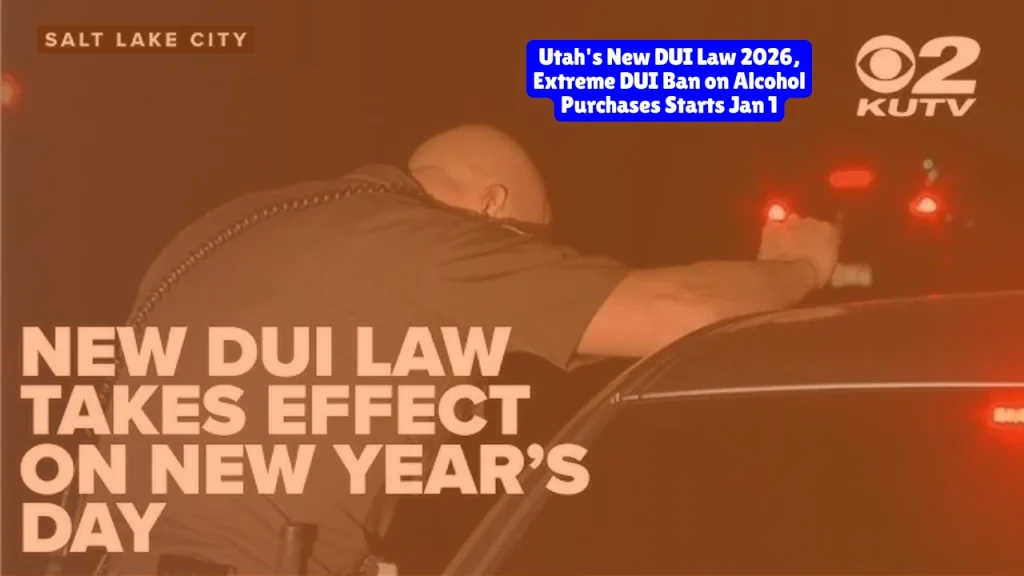
Utah’s New DUI Law 2026, Extreme DUI Ban on Alcohol Purchases Starts Jan 1
Utah’s new DUI law takes effect January 1, 2026, requiring anyone convicted of “extreme DUI” (BAC of 0.16% or higher) to be banned from purchasing alcohol. Under H.B. 437, these offenders must get a new state ID marked “NO ALCOHOL SALE” and retailers must check every customer’s ID for this restriction. Utah maintains the nation’s strictest 0.05% BAC limit for standard DUI charges.
Here’s what Utah drivers need to know about the new law, penalties, and your rights.
What Changed in Utah’s New DUI Law?
H.B. 437 creates a new category called “interdicted persons” who are prohibited from buying alcohol. Anyone convicted of extreme DUI automatically falls into this category. Judges can also apply the restriction to standard DUI offenders at their discretion.
What is extreme DUI in Utah? Extreme DUI is defined as either:
- BAC of 0.16% or higher (more than three times the legal limit)
- Alcohol plus other illegal substances in your system
Key changes effective January 1, 2026:
- Extreme DUI convictions automatically trigger alcohol purchase bans
- Offenders must surrender their current ID and get a new one with a red “NO ALCOHOL SALE” banner above the photo
- All alcohol retailers must check every customer’s ID, regardless of age
- The ban period is set by the judge at sentencing
Understanding Utah’s 0.05% BAC Limit
Utah has the lowest legal BAC limit in the United States. Under Utah Code § 41-6a-502, you can be charged with DUI if:
You have a BAC of 0.05% or higher at the time of driving or chemical testing
You’re under the influence of alcohol, drugs, or both to a degree that renders you incapable of safely operating a vehicle (even if BAC is below 0.05%)
This means even one or two drinks can put you over the legal limit depending on your weight, gender, and how quickly you consumed alcohol.
Related article: DUI vs DWI, Real Difference Every US Driver Must Know in 2026
How Utah’s 0.05% Compares to Other States
Every other state in the US has a 0.08% BAC limit for standard DUI charges. Utah lowered its limit from 0.08% to 0.05% in December 2018, making it the strictest in the nation.
Research shows driving performance is impaired at BAC levels as low as 0.01%, which is why Utah lawmakers chose the lower threshold.
Who Gets the “NO ALCOHOL SALE” ID?
Automatic interdiction: Anyone convicted of extreme DUI (0.16% BAC or alcohol plus drugs)
Discretionary interdiction: Judges may apply the alcohol purchase ban to anyone convicted of standard DUI (0.05% BAC)
Voluntary interdiction: The law allows anyone to voluntarily request a “NO ALCOHOL SALE” ID
Once interdicted, you must surrender your current driver’s license or state ID to the court and apply for a new one marked with the red banner. All alcohol sellers—grocery stores, liquor stores, bars, restaurants, gas stations—must check for this marking before selling alcohol.
Penalties for DUI in Utah
First-Time DUI (Class B Misdemeanor)
- Jail: Up to 180 days (minimum 48 hours or 48 hours community service)
- Fines: Up to $1,000
- License suspension: 120 days
- Screening: Mandatory alcohol/drug screening and treatment if needed
- Ignition interlock: May be required for 18 months after reinstatement
- Probation: Typically ordered instead of full jail time
Second DUI Within 10 Years (Class A Misdemeanor)
- Jail: 10 to 364 days (5 days minimum, or 2 days plus 30 days electronic monitoring)
- Fines: Up to $2,500
- License suspension: 2 years
- Treatment: Mandatory substance abuse treatment
- Ignition interlock: Required for 3 years after reinstatement
Third or Subsequent DUI Within 10 Years (Third-Degree Felony)
- Prison: Up to 5 years
- Fines: Up to $5,000
- License suspension: 2 years minimum
- Treatment: Court-ordered substance abuse program
- Ignition interlock: Required for 3 years after reinstatement
Enhanced Penalties for Aggravating Factors
Penalties increase if you:
- Have a BAC of 0.16% or higher (extreme DUI)
- Have a child under 16 in the vehicle (separate offense for each child)
- Cause an accident with injuries
- Are driving the wrong way on a highway
- Have drugs plus alcohol in your system
For BAC of 0.16% or higher, the court must order treatment, ignition interlock, or ankle monitoring devices.
What Happens If You’re Stopped for DUI in Utah
The Stop
Police must have reasonable suspicion you’re violating traffic laws or driving impaired before pulling you over. Common reasons include:
- Swerving or weaving
- Speeding or driving too slowly
- Running red lights or stop signs
- Failure to maintain lane
- Equipment violations
Field Sobriety Tests
Officers may ask you to perform standardized field sobriety tests like:
- Horizontal gaze nystagmus (following a pen with your eyes)
- Walk-and-turn
- One-leg stand
You can refuse field sobriety tests in Utah without automatic penalties, though refusal may be used as evidence against you.
Chemical Testing
Utah has an implied consent law. By driving on Utah roads, you’ve already consented to chemical testing (breath, blood, or urine) if arrested for DUI.
If you refuse a chemical test after arrest:
- Automatic 18-month license suspension (first refusal)
- 36-month suspension (second refusal)
- Refusal can be used against you in court
- Police may get a warrant to force a blood draw
Your Rights When Stopped for DUI in Utah
Right to remain silent: You’re not required to answer questions about where you’ve been, whether you’ve been drinking, or how much you drank.
Right to refuse field sobriety tests: You can decline roadside physical tests without automatic penalties.
Right to an attorney: You can request to speak with a lawyer, but you must still submit to chemical testing under implied consent.
Right to observe testing procedures: You can request information about how tests were administered and calibrated.
Right to independent testing: You can request a blood test at your own expense.
Utah Code § 41-6a-502: The DUI Statute
Utah Code § 41-6a-502 establishes that a person may not operate or be in actual physical control of a vehicle if:
(a) The person has a BAC of 0.05% or greater
(b) The person is under the influence of alcohol, drugs, or both to a degree that renders them incapable of safely operating a vehicle
(c) The person has a BAC of 0.05% or greater at the time of operation
Note that you can be charged even if you’re not actively driving. “Actual physical control” means you’re in the driver’s seat with access to the keys, even if the engine is off.
License Suspension: Administrative vs. Criminal
Utah has two separate processes that can suspend your license after a DUI:
Administrative Suspension (Driver License Division)
This happens automatically after arrest based on test results or refusal. The Driver License Division (DLD) handles this independently from your criminal case.
- BAC 0.05% or higher: 120-day suspension
- Refused chemical test: 18-month suspension
- Second refusal: 36-month suspension
You have 10 days to request a hearing to contest the administrative suspension.
Criminal Suspension (Court Ordered)
If convicted of DUI in criminal court, the judge imposes additional suspension periods as part of your sentence. These run separately from administrative suspensions.
You may be eligible for a restricted license with an ignition interlock device during some suspension periods.
Ignition Interlock Devices in Utah
An ignition interlock device (IID) prevents your vehicle from starting if alcohol is detected on your breath. Utah requires IIDs for:
- First DUI: 18 months after license reinstatement
- Second DUI: 3 years after reinstatement
- Third or subsequent DUI: 3 years after reinstatement
- High BAC (0.16% or higher): As condition of probation
You must pay for installation, monthly monitoring, and maintenance (typically $70-150/month).
Utah’s 24/7 Sobriety Program
Utah offers a 24/7 Sobriety Program as an alternative to jail time. Participants must:
- Wear a SCRAM bracelet that monitors alcohol consumption, OR
- Appear twice daily at a testing center for breath tests
Program length:
- First DUI: 30 days
- Second or subsequent DUI: 1 year
Successfully completing the program can reduce or eliminate mandatory jail time.
Defense Strategies for DUI Charges in Utah
Common defenses include:
Challenging the stop: Police must have reasonable suspicion to pull you over. If the stop was unlawful, evidence may be suppressed.
Questioning test accuracy: Breathalyzers require proper calibration and administration. Blood tests must follow chain of custody procedures.
Actual physical control: If you weren’t driving, your attorney can argue you weren’t in actual physical control of the vehicle.
Rising BAC: Your BAC may have been below 0.05% while driving but rose by the time of testing.
Medical conditions: Certain medical conditions or medications can affect test results.
Improper procedures: Police must follow specific protocols for testing and arrest.
Zero Tolerance for Drivers Under 21
Utah enforces a “not a drop” policy for drivers under 21. Any detectable amount of alcohol in your system is illegal, resulting in:
- License suspension until age 21 (or 1 year for ages 19-20)
- Fines and penalties
- Mandatory alcohol education
Commercial Drivers: 0.04% BAC Limit
If you hold a commercial driver’s license (CDL), you face a stricter 0.04% BAC limit while operating commercial vehicles. A DUI conviction can result in permanent CDL revocation.
The Real-World Impact: Eli Mitchell’s Story
The push for Utah’s new extreme DUI law came after tragedies like the death of Eli Mitchell, a West Jordan boy killed by a driver with multiple prior DUIs. The driver’s BAC was “multiple times” over Utah’s 0.05% legal limit.
Eli’s grandfather, Glendon Mitchell, said at the time of the crash, they learned the driver had five prior DUI convictions. “Can you imagine if our driver, with five prior DUIs, would have had a restriction on his license so he couldn’t be in a bar drinking? Maybe the outcome would have been completely different.”
This case illustrates why Utah lawmakers created the interdiction system—to prevent repeat offenders from easily accessing alcohol.
How the 100% ID Check Law Works
Starting January 1, 2026, every alcohol purchase in Utah requires ID verification, no exceptions.
Previous law: Retailers could use discretion and skip ID checks for customers who appeared over 35.
New law: Everyone must show ID, regardless of age or appearance.
Employees must check for two things:
- Valid, current ID proving legal age (21+)
- No “NO ALCOHOL SALE” marking indicating interdiction status
This applies everywhere alcohol is sold: grocery stores, state liquor stores, bars, restaurants, gas stations, and event venues.
FAQs About Utah’s New DUI Law
Can I refuse a breathalyzer in Utah?
You can refuse, but you’ll face an automatic 18-month license suspension (36 months for second refusal) and the refusal can be used against you in court. Police may also obtain a warrant to force a blood draw.
What if my BAC is between 0.02% and 0.05%?
You can still be charged with DUI if the officer believes you’re impaired to any degree. The 0.05% limit is a “per se” law, but impairment below that level can still result in charges under Utah Code § 41-6a-502(1)(b).
How long does a DUI stay on my record in Utah?
DUI convictions remain on your criminal record permanently in Utah. They cannot be expunged. However, DUI offenses older than 10 years don’t count as prior convictions for sentencing enhancements.
Can I get a restricted license after a DUI?
Yes. After serving part of your suspension, you may qualify for a restricted license that allows you to drive to work, school, or treatment. You’ll need to install an ignition interlock device.
What happens if I get a DUI from another state while living in Utah?
Out-of-state DUI convictions count as prior offenses in Utah. The Driver License Division will suspend your Utah license based on the other state’s conviction.
Do I need a lawyer for a first-time DUI?
While not required, hiring an experienced DUI attorney is strongly recommended. Utah’s DUI laws are complex, and even first-time convictions carry serious penalties including jail time, fines, and license suspension.
How much do DUI fines and costs total in Utah?
Beyond court fines ($1,000-$5,000), expect to pay: license reinstatement fees ($210), alcohol screening ($150-$300), treatment programs ($500-$2,000), ignition interlock device ($1,260-$2,700/year), increased insurance rates (up to 3x higher), and attorney fees ($2,500-$10,000). Total costs often exceed $10,000.
Can I drive to work during my suspension?
You may be eligible for a restricted license after serving part of your suspension. This requires installing an ignition interlock device and paying associated fees.
What if I was prescribed medication that impaired me?
Prescription medications are not a defense to DUI in Utah. You’re responsible for knowing how your medications affect your ability to drive safely. Many prescription drug DUI cases result in convictions.
Will a DUI affect my job?
Yes. DUI convictions appear on background checks and can affect employment, especially jobs requiring driving, security clearances, professional licenses, or working with vulnerable populations.
What to Do If You’re Arrested for DUI in Utah
1. Stay calm and be polite: Arguing or being combative will only make things worse.
2. Exercise your right to remain silent: Don’t answer questions beyond providing your license and registration.
3. Request an attorney: Tell the officer you want to speak with a lawyer before answering questions.
4. Submit to chemical testing: Refusal carries harsh automatic penalties.
5. Request a DLD hearing within 10 days: You must request an administrative hearing within 10 days to contest your license suspension.
6. Hire an experienced DUI attorney immediately: Early legal representation can make a significant difference in your case outcome.
7. Document everything: Write down what happened, what you drank, when, what the officer said, and what tests were performed.
8. Don’t miss court dates: Failure to appear results in additional charges and a bench warrant.
How to Avoid a DUI in Utah
With Utah’s 0.05% BAC limit, even one or two drinks can put you over the limit. The safest approach:
- Don’t drink and drive at all: If you plan to drink, plan not to drive
- Use rideshare services: Uber and Lyft operate throughout Utah
- Designate a sober driver: Take turns being the designated driver in your group
- Use public transportation: UTA operates bus and light rail service in major cities
- Stay where you are: Get a hotel room or sleep it off at a friend’s house
- Call a cab: Traditional taxi services are still available
Remember: The average DUI costs over $10,000 in fines, fees, and increased insurance. A $20 rideshare is always cheaper.
Utah’s Continuing Efforts to Reduce DUI
Utah has taken aggressive steps to reduce impaired driving:
2018: Lowered BAC limit from 0.08% to 0.05%, the first state to do so
2024: Implemented enhanced penalties for high BAC offenses
2026: Added alcohol purchase bans for extreme DUI convictions and mandatory 100% ID checks
Data from 2018-2023 shows these measures have reduced DUI arrests, though wrong-way driving and fatal crashes linked to impairment remain concerns.
The Bottom Line on Utah’s New DUI Law
Starting January 1, 2026, extreme DUI offenders (0.16% BAC or higher) automatically lose the right to purchase alcohol and must carry an ID marked “NO ALCOHOL SALE.” All retailers must check every customer’s ID without exception.
Utah continues to have the nation’s strictest DUI laws with a 0.05% BAC limit, severe penalties even for first offenses, and comprehensive monitoring programs for convicted offenders.
If you drink, don’t drive. If you’re arrested for DUI, contact an experienced Utah DUI attorney immediately to protect your rights and minimize the consequences.
About the Author

Sarah Klein, JD, is a former criminal defense attorney with hands-on experience in cases involving DUIs, petty theft, assault, and false accusations. Through All About Lawyer, she now helps readers understand their legal rights, the criminal justice process, and how to protect themselves when facing charges.
Read more about Sarah