Grubhub Stole Your Restaurant’s Reputation and Owes You Up to $685—File by March 4 or Lose It Grubhub Class Action Lawsuit Settlement
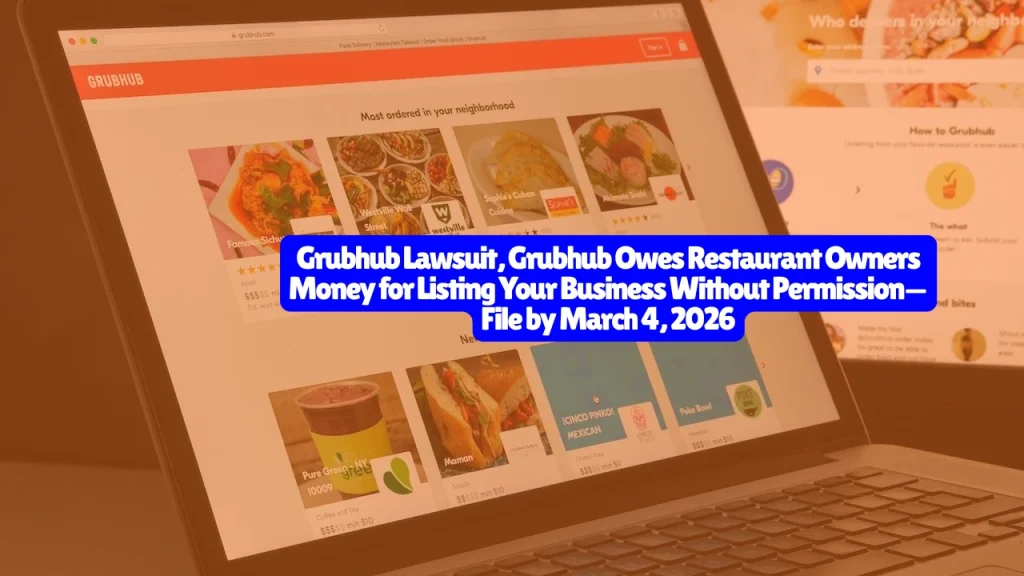
Did Grubhub steal customers meant for you? Grubhub agreed to a $7.15 million class action settlement (Lynn Scott LLC v. Grubhub Inc., U.S. District Court Northern District of Illinois) for adding up to 387,000 restaurants to its platform between January 1, 2019 and April 30, 2024 without contracts or permission. Every unauthorized day they listed you cost you direct orders—and their 30% commission. Now they’re paying back.
What Grubhub Did to Your Restaurant
Grubhub added your restaurant to its platform—and eight other apps including Seamless, Eat24, and Tapingo—without asking. No contract. No permission. No warning.
They used your name, menu, and reputation to make money while you dealt with:
- Wrong orders from your “menu” with items you don’t serve
- Angry customers blaming you for Grubhub’s mistakes
- Lost direct sales when customers used Grubhub instead of calling you
- Bad reviews for delivery problems you had nothing to do with
- Your brand damaged by service you never agreed to provide
One LA restaurant owner discovered the problem when Grubhub drivers kept showing up with orders: “We used to be with them before, with our permission, but early last year we told them to take us off. Then about a month ago, Grubhub drivers started showing up with orders.”
Another owner told the Evansville Courier & Press they only found out after an angry customer ordered something not even on the menu.
This wasn’t an accident. In Q4 2019 alone, Grubhub admitted adding 150,000 non-partner restaurants as a “mechanism to gain national scale” while competing with DoorDash and Uber Eats.
Red Flags You Were Listed Without Permission
You might not even know Grubhub stole your business. Here’s how to tell:
You were listed if:
- Grubhub drivers randomly showed up with orders you never received
- Customers complained about “Grubhub orders” when you had no Grubhub account
- You found your restaurant on Grubhub’s website without signing up
- Your menu appeared online with wrong prices or outdated items
- Negative reviews mentioned delivery issues for orders you never made
- You told Grubhub to remove you but they kept listing you anyway
Even if you never noticed, you still qualify if your restaurant existed between 2019-2024 and you never signed a Grubhub contract.
Do You Qualify for the Grubhub Settlement?
Your restaurant qualifies if it was listed on any of these platforms without a contract between January 1, 2019 and April 30, 2024:
- Grubhub
- Seamless
- Eat24
- Tapingo
- LevelUp
- OrderUp
- AllMenus
- MenuPages
- BiteGrabber
Approximately 387,000 restaurants qualify nationwide. Corporate chains and franchises count too—each location listed without a specific contract qualifies separately.
Still in business? You qualify.
Closed after 2019? You still qualify.
Have a contract with Grubhub now? Doesn’t matter—you still qualify if you were listed without permission during 2019-2024.
Related article: Oregon McDonald’s Workers Lawsuit, You Could Get $872 from This Meal Break Settlement—But Only If You File by March 8, 2026
How Much Money You’ll Actually Get
Everyone gets $50 minimum. Then you get additional payment based on how long Grubhub listed you without permission.
Estimated payouts based on listing duration:
- Listed 6 months = approximately $150-200 total
- Listed 1 year = approximately $250-350 total
- Listed 3 years = approximately $400-600 total
- Listed full 5.5 years = up to $685 total
The catch: Payment amounts depend on how many restaurants file claims. Fewer claims = more money per restaurant. More claims = less money per restaurant.
If only 1% of eligible restaurants file claims, median payout is $685. If 10% file claims, median drops to $80.
Bottom line: File early. Don’t assume others won’t claim. That $685 equals 137 direct orders you could have kept instead of losing to Grubhub’s 30% commission.
What This Really Cost Your Business
Let’s say a customer wanted to order $40 in food from you. They searched Google, found your restaurant on Grubhub (without your knowledge), and ordered through the app.
What you lost:
- Grubhub’s 30% commission = $12 per order
- Customer’s direct phone number and email
- Chance to build repeat business relationship
- Control over delivery experience and timing
Multiply that by dozens or hundreds of orders over months or years. Grubhub didn’t just list you—they intercepted customers who wanted to pay you directly, then charged you 30% for the privilege.
Now they’re paying back a fraction of what they took. Don’t leave money on the table.
Critical Grubhub Settlement Deadlines
- February 4, 2026: Last day to opt out or object to settlement terms
- March 4, 2026: FINAL CLAIM FORM DEADLINE ⚠️
- April 15, 2026: Court holds final approval hearing
- Summer 2026: Payments distributed (if court approves)
Miss March 4 and you get nothing. Even if you received a settlement notice in the mail, you must file a claim to get paid.
How to File Your Grubhub Settlement Claim Right Now
Online (Fastest): Go to RestaurantListingSettlement.com and submit your claim in 5 minutes
By Mail: Lynn Scott v. Grubhub Settlement Administrator P.O. Box 5749 Portland, OR 97228-5749
Questions?
- Phone: 833-662-3703
- Email: [email protected]
What You Need to File:
- Business name and address
- Email and phone number
- Federal tax identification number (EIN) for businesses without current Grubhub contracts
- Unique ID and PIN from settlement notice (if you received one—not required if you didn’t)
Don’t wait. The longer you delay, the closer you get to losing your payment. File today at RestaurantListingSettlement.com.
Why Federal Law Says Grubhub Can’t Do This
Lanham Act (15 U.S.C. § 1125): Federal law that stops companies from lying about business relationships. When Grubhub listed your restaurant, they told customers you partnered with them. That’s illegal misrepresentation.
Illinois Consumer Fraud and Deceptive Business Practices Act: State law protecting businesses from unfair commercial practices like using your brand without permission.
Uniform Deceptive Trade Practices Act: Law adopted by many states that prohibits deceptive trade practices including false representations about business relationships.
Courts ruled that delivery platforms can’t list restaurants without permission and pretend they’re partners. Doing so violates trademark law, unfair competition law, and consumer protection statutes.
Translation: Grubhub broke federal law by using your restaurant’s name and reputation to make money without your consent.
What Grubhub Says About the Settlement
Grubhub spokesperson: “While the practices alleged in this case have not been part of our business model for some time, we’re pleased to settle this case so we can move forward and continue providing excellent value to the over 415,000 merchants who choose to partner with us every day.”
Notice what they didn’t say: “We didn’t do it” or “We were allowed to do it.”
They stopped the practice in 2024 after massive complaints. But between 2019-2024, they listed 387,000 restaurants without permission and built their platform on stolen reputations.
Now they’re paying $7.15 million—a fraction of the commissions they collected from unauthorized listings.
Other Food Delivery Platforms Got Caught Too
Grubhub isn’t the only platform that broke the rules:
DoorDash Settlements:
- $16.5 million in New York (February 2024) for lying about tipping practices
- $11.3 million in Illinois (November 2024) for misleading customers about driver tips
Uber Eats Settlement:
- $15 million in Seattle (August 2025) for misleading delivery drivers over potential earnings
Grubhub FTC Settlement:
- $25 million with Federal Trade Commission and Illinois AG (December 2024) for:
- Hidden “junk fees” that doubled advertised delivery costs
- Lying about driver earnings ($40/hour advertised vs. $11/hour actual median)
- Adding restaurants without permission
- Deceptive Grubhub+ subscription practices
Between this $7.15 million restaurant class action and the $25 million FTC settlement, Grubhub has paid over $32 million for unauthorized listing practices alone.
The message is clear: delivery platforms must get permission before listing restaurants.
Timeline: How Grubhub Got Caught
- 2019: Grubhub starts adding 150,000 non-partner restaurants to compete with DoorDash
- 2019-2020: Restaurant owners discover unauthorized listings, file complaints
- 2020: Lynn Scott LLC and other restaurants file class action lawsuit
- 2021-2024: Discovery reveals Grubhub knew the practice harmed restaurants but continued anyway
- 2024: Grubhub finally discontinues unauthorized listing practice
- August 2025: Preliminary $7.15M settlement filed in federal court
- November 2025: Settlement notices mailed to 387,000 eligible restaurants
- March 4, 2026: Claim deadline—FILE NOW
- April 15, 2026: Final approval hearing
- Summer 2026: Payments distributed if court approves
Evidence That Proved Grubhub Was Wrong
Court filings showed:
- 387,000 businesses had names or logos used without contracts
- 150,000 restaurants added in Q4 2019 alone as deliberate growth strategy
- Restaurant complaints documenting confusion, wrong orders, reputation damage
- Consumer confusion between partnered and non-partnered restaurants
- Sales losses when customers used Grubhub instead of ordering directly
- Internal documents confirming the unauthorized listing strategy was intentional, not accidental
Grubhub knew adding restaurants without permission harmed their businesses. They did it anyway for competitive advantage.
What Legal Experts Say About This Case
Attorney Steven Tindall, representing affected restaurants: “Under the Lanham Act, you’re not allowed to misrepresent to consumers that you have a business relationship with another business when you don’t. There’s a negative experience for the customer and sometimes the restaurant only learns of it when they read a Yelp review.”
Consumer protection attorneys say this settlement establishes important precedent: platform companies can’t use business names, logos, or reputations without permission—even if the information is publicly available online.
The $7.15 million settlement amount for 387,000 potential claimants shows courts view unauthorized platform listings as serious commercial harm requiring real compensation beyond token payments.
Your Rights Under This Settlement
You Can:
- File a claim for payment without hiring a lawyer (it’s free)
- Opt out by February 4, 2026 and sue Grubhub separately
- Object to settlement terms by February 4, 2026 if you think it’s unfair
- Continue running your restaurant with zero Grubhub obligations
You Cannot:
- Sue Grubhub separately for unauthorized listings during 2019-2024 if you accept payment
- Get paid without filing a claim by March 4, 2026
Class counsel (attorneys representing all restaurants) will request up to $2.38 million (one-third of settlement) plus $150,000 in litigation costs. This comes out of the $7.15 million total, not your individual payment.
What This Means for Food Delivery Platforms Going Forward
This settlement sends a message to every delivery platform: list restaurants without permission and face legal consequences.
Other platforms now face increased pressure:
- DoorDash, Uber Eats, and smaller aggregators must obtain explicit contracts before listing restaurants
- Platforms can’t rely on publicly available information (menus, hours, locations) as permission to create commercial listings
- Misrepresenting partnership status violates federal trademark and unfair competition laws
- State consumer protection laws create additional liability for deceptive practices
Restaurant industry groups have pushed for legislation requiring platform consent before listings. Some states now have specific laws addressing unauthorized restaurant listings.
For restaurant owners: This settlement proves you have legal rights. Platforms can’t use your business without permission.
Common Questions Restaurant Owners Ask
Do I need proof I was listed without permission?
No. The settlement administrator has Grubhub’s records showing which restaurants were listed without contracts during 2019-2024.
What if I have a Grubhub contract now?
You still qualify for payment if you were listed without a contract between January 1, 2019 and April 30, 2024. Current contracts don’t disqualify you from past unauthorized listings.
What if I can’t find my unique ID and PIN?
Call 833-662-3703 or email [email protected]. The settlement administrator can look up your restaurant and provide claim information.
Will accepting payment prevent me from suing Grubhub later?
Yes, for claims related to unauthorized listings during January 2019 – April 2024. If you want to sue separately, opt out by February 4, 2026. But most restaurants get more money from the class settlement than individual lawsuits.
Do I pay taxes on settlement money?
Settlement payments for business harm are generally taxable income. Consult your tax advisor about reporting requirements.
How long until I receive payment?
If the court approves the settlement on April 15, 2026, payments process 60-90 days later (approximately June-July 2026).
What if my restaurant closed?
Former restaurant owners still qualify if their business was listed during January 2019 – April 2024.
Can franchise locations claim payment?
Yes. Each franchise location listed without a contract qualifies as a separate claim if that specific location didn’t have a Grubhub agreement.
What if Grubhub removed my listing after I complained?
You still qualify. The settlement covers any time between January 2019 and April 2024 when you were listed without permission—even if Grubhub eventually removed you.
Will Grubhub list restaurants without permission again?
Under both this settlement and the FTC agreement, Grubhub must obtain consent before listing restaurants. Violating these terms could result in additional penalties and contempt findings.
What if I never received a settlement notice?
You can still file a claim. Visit RestaurantListingSettlement.com or call 833-662-3703 to submit your information.
How do I know if I was really listed?
The settlement administrator will verify against Grubhub’s records. If you suspect you were listed, file a claim—they’ll confirm eligibility.
What You Should Do in the Next 10 Minutes
1. Go to RestaurantListingSettlement.com right now
Don’t bookmark it. Don’t save it for later. File your claim today before you forget.
2. Check all your locations
If you own multiple restaurants, each location may qualify separately. File a claim for every eligible location.
3. Gather your EIN
You’ll need your federal tax ID number if you don’t currently have a Grubhub contract.
4. Tell other restaurant owners
Only 387,000 restaurants qualify, but many don’t know about the settlement. Share this information with other owners in your area.
5. Save your confirmation
After filing, save the confirmation email or number in case issues arise with payment processing.
6. Mark your calendar
Set a reminder for March 1, 2026 to verify your claim was received if you haven’t heard anything.
The Bottom Line
Grubhub built its platform on your restaurant’s reputation without asking permission. They intercepted your customers, charged 30% commission, and left you dealing with complaints about orders you never agreed to fulfill.
Now 387,000 restaurants can claim compensation. The payments won’t make you rich—$50 to $685 per restaurant depending on how long you were listed and how many claims get filed.
But it’s your money. And it establishes an important principle: delivery platforms can’t steal your brand.
If Grubhub listed your restaurant without a contract between January 2019 and April 2024, you have until March 4, 2026 to claim what’s yours.
File your claim at RestaurantListingSettlement.com today.
Five minutes now could mean $200, $400, or $685 in your account by summer. Don’t let Grubhub keep money they owe you.
Important Case Details:
- Case Name: Lynn Scott LLC, et al. v. Grubhub Inc.
- Court: U.S. District Court for the Northern District of Illinois
- Settlement Amount: $7.15 million
- Eligible Restaurants: Approximately 387,000
- Claim Deadline: March 4, 2026 ⚠️
- Final Hearing: April 15, 2026
- Settlement Website: RestaurantListingSettlement.com
- Phone: 833-662-3703
- Email: [email protected]
Class Counsel:
- Rosemary M. Rivas, Gibbs Mura LLP
- Elizabeth A. Fegan, Fegan Scott LLC
About the Author

Sarah Klein, JD, is a licensed attorney and legal content strategist with over 12 years of experience across civil, criminal, family, and regulatory law. At All About Lawyer, she covers a wide range of legal topics — from high-profile lawsuits and courtroom stories to state traffic laws and everyday legal questions — all with a focus on accuracy, clarity, and public understanding.
Her writing blends real legal insight with plain-English explanations, helping readers stay informed and legally aware.
Read more about Sarah