
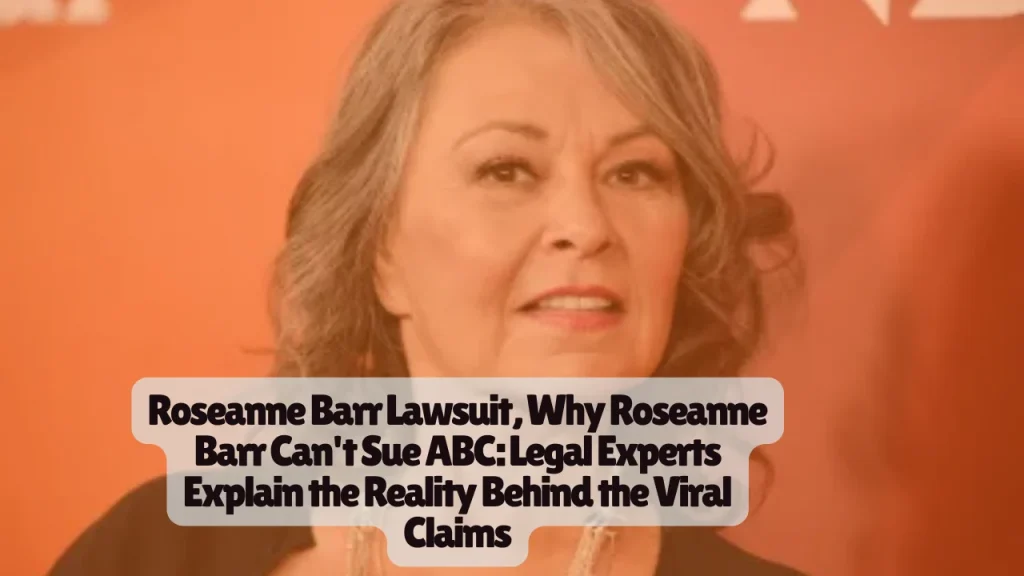
Roseanne Barr Lawsuit, Why Roseanne Barr Can’t Sue ABC: Legal Experts Explain the Reality Behind the Viral Claims
Roseanne Barr has no viable legal claims against ABC despite viral stories claiming she won $208 million—those reports are confirmed satire. Legal experts say ABC’s 2018 cancellation of “Roseanne” was entirely lawful because talent contracts include morals clauses allowing networks to terminate for behavior that damages their reputation, the First Amendment doesn’t protect private employees from job consequences, and Barr herself relinquished her rights to the series before ABC created “The Conners” spinoff.
The Viral Lawsuit That Never Existed
Social media repeatedly circulates claims that Roseanne Barr sued ABC and won hundreds of millions of dollars. These stories are completely false.
Snopes debunked the most popular version—a claim that “ABC was ordered to pay Roseanne Barr $208 million” after stealing “The Conners.” The article originated from Freedom Fictions, a known satire website.
The Reality:
- No lawsuit was ever filed against ABC by Barr
- No jury awarded any money
- No court ordered ABC to pay anything
- Barr relinquished her rights to the series voluntarily
While Barr has threatened to sue multiple times since 2018, she has never followed through. There’s a simple reason: she has no legal case.
What Actually Happened in May 2018
On May 29, 2018, Roseanne Barr tweeted about Valerie Jarrett, a former Obama White House adviser: “muslim brotherhood & planet of the apes had a baby=vj.”
The tweet comparing an African American woman to an ape sparked immediate outrage. Within hours, ABC Entertainment President Channing Dungey announced: “Roseanne’s Twitter statement is abhorrent, repugnant and inconsistent with our values, and we have decided to cancel her show.”
The Cascade of Consequences:
- ABC canceled the “Roseanne” reboot that same day
- ICM Partners dropped Barr as a client
- Viacom pulled reruns from all its channels
- Consulting producer Wanda Sykes quit the show
- Disney CEO Bob Iger publicly supported the cancellation decision
The writing and producing staff arrived for their first day of work on season two only to learn the show no longer existed.
Related article: General Electric Securities Litigation, $362.5M Settlement Closed—Deadline Passed June 20, 2025
Why Barr Can’t Sue: The Legal Realities
1. Morals Clauses Are Standard and Enforceable
Entertainment lawyer Domenic Romano told Law & Crime that Barr’s contract “likely had a thorough morality clause that would cover racially insensitive comments.”
F. Jay Dougherty, professor at Loyola Law School Los Angeles, and Michael LeRoy, University of Illinois labor professor, both confirmed ABC’s contracts almost certainly contained morals clause provisions giving the network termination rights.
How Morals Clauses Work:
A morals clause allows employers to terminate contracts when talent engages in conduct that:
- Shocks, insults, or offends community standards
- Brings public hatred, contempt, scorn, or ridicule
- Prejudices the company or industry
- Damages the employer’s reputation or brand
These clauses date back to 1921 when Universal Studios responded to the Roscoe “Fatty” Arbuckle scandal by inserting protective language into all talent agreements. Courts have consistently upheld morals clauses as legitimate contract provisions for over a century.
Entertainment attorney Andrew Zarriello notes companies favor broad morals clauses “making it easier for the company to split from talent it no longer desires to be associated with.”
ABC had clear contractual authority to cancel the show based on Barr’s tweet violating standard morals clause language.
2. The First Amendment Doesn’t Apply to Private Employers
Many people mistakenly believe the First Amendment protects them from job consequences for their speech. It doesn’t.
“Employees in private workplaces do not have a First Amendment right, even though they often mistakenly think that they do,” LeRoy explained to Illinois News Bureau.
First Amendment Basics:
- The First Amendment begins: “Congress shall make no law…”
- It restricts government interference with speech
- It does not restrict private employers like ABC/Disney
- Companies can fire employees for speech that harms their business
Barr has a constitutional right to tweet whatever she wants. ABC has a contractual right to end their business relationship when her speech damages their brand. Both can be true simultaneously.
3. California’s Political Speech Protection Doesn’t Help
California law protects workers from termination based on political views. However, this protection has fatal limitations for Barr’s potential claims:
Why It Doesn’t Apply:
a) Employment Status: The law only covers employees. Barr was most likely an independent contractor, not an employee.
b) Geographic Jurisdiction: ABC is located in New York, and contracts typically designate the headquarters state for legal disputes. New York lacks California’s broad speech protections.
c) The Tweet Wasn’t Really Political: As the LegalMatch Law Blog noted, Barr’s tweet “was difficult to interpret as anything except racism.” She compared Jarrett—who held no government position at the time—to an ape. The tweet addressed no policy issue or political decision. It was a personal attack based on race, not political commentary.
Even if California law applied, LeRoy explained employees who create conflicts of interest with their employer aren’t protected. Barr’s tweet directly conflicted with ABC’s corporate values and business interests.
4. At-Will Employment and Contract Realities
In the United States, employment is at-will. Either party can terminate the relationship at any time unless a specific contract provision prevents it.
For independent contractors like Barr, everything depends on contract terms. Networks retain broad rights to cancel shows, and talent contracts contain extensive termination provisions.
“Unless there is a specific clause in her contract that forbids the network from canceling the show, Roseanne would have to rely on a state or federal law,” explained the LegalMatch analysis. No such law exists.
Dougherty told the Associated Press that Barr’s deleted tweet could even be considered an “act of God” outside the studio’s control, giving ABC additional rights to cancel contracts.
5. Barr Relinquished Her Rights to the Series
Before ABC created “The Conners” spinoff, Barr voluntarily relinquished her rights to the “Roseanne” intellectual property.
This is why “The Conners” could proceed without her participation or financial stake. She gave up any ownership claims to the characters, storylines, and franchise.
Had Barr maintained her rights, she might have had leverage to negotiate. By relinquishing them, she eliminated any potential claim to the spinoff’s profits.

Why ABC’s Decision Was Legally Bulletproof
ABC executives moved swiftly and decisively, making their termination virtually impossible to challenge:
The Timeline:
- Early morning: ABC executives learned of Barr’s tweets
- 7:00 AM ET: Chelsea Clinton publicly refuted Barr’s conspiracy theory about George Soros
- 7:30 AM PT: Barr tweeted an apology and claimed she was “leaving Twitter”
- 9:00 AM PT: ABC executives concluded “there was no way to come back from this”
- 10:48 AM PT: ABC announced the cancellation
From offensive tweet to show cancellation: approximately 12 hours.
CNN reported ABC arranged a call with Barr, her publicist, and executive producer Tom Werner. Barr was contrite and informed cancellation was possible. But ABC executives determined no apology or sanction would be sufficient.
“There was no way to come back from this,” one source told CNN.
The speed eliminated any argument that ABC acted precipitously or without considering the situation. They consulted with stakeholders, received legal guidance, and made an informed business decision—exactly what morals clauses empower them to do.
What Would a Lawsuit Actually Claim?
Legal experts predict any lawsuit Barr filed would fail on multiple grounds:
Wrongful Termination?
Won’t Work Because:
- She wasn’t wrongfully terminated—her contract allowed termination for the conduct she engaged in
- Morals clauses specifically authorize termination for reputation-damaging behavior
- Courts consistently uphold morals clause terminations
Breach of Contract?
Won’t Work Because:
- ABC didn’t breach the contract—they exercised rights the contract granted them
- Barr violated the contract by engaging in conduct that damaged ABC’s reputation
- Networks have broad contractual authority to cancel shows
Defamation?
Won’t Work Because:
- ABC’s statements were truthful—they called her tweet “abhorrent, repugnant and inconsistent with our values”
- Opinion statements are protected
- Truth is an absolute defense to defamation
First Amendment Violation?
Won’t Work Because:
- The First Amendment doesn’t apply to private employers
- ABC isn’t a government entity
- Constitutional protections don’t prevent job consequences for speech
Romano told Law & Crime: “As for Roseanne herself having a wrongful termination case against ABC? Fat chance.”
Dougherty told the Associated Press: “We can’t predict whether there will be lawsuits or not, but I don’t think there will be successful lawsuits.”
The Cost of Cancellation—to ABC, Not Barr
Ironically, ABC’s decision came with significant financial risk to the network, not to Barr.
Romano noted that on high-profile shows, networks could be “on the hook for any guaranteed payment to well-known cast and crew.” That payment could reach millions of dollars.
ABC’s Costs:
- Severance payments to cast and crew (potentially millions)
- Loss of advertising revenue from a highly-rated show
- Resources spent finding replacement programming
- Over 200 people out of work
An ABC executive expressed regret about the collateral damage but pointedly blamed Barr: “That’s the collateral damage that Roseanne has to live with.”
The network chose to absorb these costs rather than continue associating with Barr. That business decision was entirely within their contractual rights.
Similar Cases: When Morals Clauses Are Invoked
Barr isn’t alone. Networks and studios regularly invoke morals clauses:
CNN’s Chris Cuomo (2021): CNN fired the anchor after investigations revealed deeper involvement in his brother Andrew Cuomo’s defense against sexual harassment accusations. Cuomo threatened to sue for his $18-20 million remaining contract. CNN reportedly told him they had “no intention of paying Cuomo a penny” based on their morals clause.
Kevin Spacey: After sexual misconduct allegations, Netflix cut ties with Spacey and removed him from “House of Cards.” His career effectively ended.
Charlie Sheen: CBS and Warner Bros. fired Sheen from “Two and a Half Men” in 2011 after his public meltdown and attacks on the show’s creator.
Kanye West: Multiple brands including Adidas and Balenciaga terminated lucrative endorsement deals following antisemitic statements in 2022.
In each case, companies exercised morals clause rights. None of the terminated talent successfully sued their way back.
Why Barr Keeps Threatening to Sue
Despite having no viable legal claims, Barr has repeatedly threatened litigation:
May 2020: On Norm MacDonald’s YouTube show, Barr said: “I have the time now to research and come up with the perfect lawsuit. The lawsuit I’m going to wage against Hollywood.”
April 2022: In a Reelz documentary “Roseanne: Kicked Out of Hollywood,” Barr called her firing “witch-burning” and claimed it was “intellectual witch-burning.”
September 2025: Barr weighed in on Jimmy Kimmel’s suspension, tweeting about when ABC “executive cancelled me.”
These statements serve different purposes than actual litigation:
- Maintaining relevance in entertainment news
- Rallying supporters who believe she was wronged
- Creating narrative that she’s a victim of “cancel culture”
- Generating publicity for her comedy tours and projects
Actually filing a lawsuit would require Barr to:
- Pay substantial legal fees
- Subject herself to discovery
- Risk having her claims dismissed quickly
- Create public record of her contractual violations
- Face potential sanctions for filing frivolous claims
Threatening lawsuits costs nothing. Filing lawsuits she can’t win would be expensive and embarrassing.
The Difference Between Public Opinion and Legal Reality
Many of Barr’s supporters believe ABC treated her unfairly. That’s a matter of opinion.
Legal viability is a matter of contract law, employment law, and constitutional law. In that arena, experts across the political spectrum agree: Barr has no case.
“There are not any laws that would forbid a company from canceling her show,” concluded the LegalMatch analysis.
Even if a jury sympathized with Barr personally, they couldn’t award damages when:
- Her contract allowed the termination
- The First Amendment doesn’t apply
- No employment law was violated
- ABC didn’t breach any legal duty owed to her
Frequently Asked Questions
Q: Did ABC violate Roseanne Barr’s free speech rights?
No. The First Amendment restricts government interference with speech, not private employers. ABC is a private company with contractual rights to terminate relationships with talent whose speech damages their brand.
Q: Could Barr sue for wrongful termination?
No. Wrongful termination requires the employer violated a law or breached a contract. ABC followed contract provisions (morals clauses) that specifically authorized termination for reputation-damaging conduct.
Q: What about California’s protections for political speech?
California law protects employees (Barr was likely an independent contractor) from termination for political views, but it doesn’t protect speech that creates employer conflicts. Plus, ABC is in New York where such protections don’t exist, and the tweet wasn’t political speech.
Q: Did Barr actually win $208 million?
No. This claim originated from a satire website and has been debunked by Snopes and other fact-checkers. No lawsuit was filed, no trial occurred, and no money was awarded.
Q: Could Barr sue over “The Conners” using her characters?
No. She voluntarily relinquished her rights to the “Roseanne” intellectual property before ABC created the spinoff. She has no ownership stake in the characters or franchise.
Q: Why hasn’t Barr actually filed a lawsuit?
Because legal experts agree she has no viable claims. Filing a lawsuit she can’t win would cost substantial legal fees and create embarrassing public records of her contractual violations.
Q: Could cast and crew sue ABC for lost income?
Unlikely to succeed. Their contracts likely have force majeure clauses allowing cancellation for circumstances beyond the studio’s control. Courts would likely view Barr’s conduct as such a circumstance. Additionally, suing ABC (rather than Barr, whose actions caused the cancellation) would be difficult.
Q: Are morals clauses legal?
Yes. Courts have consistently upheld morals clauses as legitimate contract provisions since the 1920s. They’re standard in entertainment, sports, and executive contracts.
Q: What if Barr’s tweet was ambiguous?
It wasn’t. The tweet compared an African American woman to an ape—universally recognized as racist. Even Barr apologized, admitting “my joke was in bad taste.”
The Bottom Line
Roseanne Barr can’t successfully sue ABC because:
- Standard morals clauses gave ABC contractual authority to terminate
- The First Amendment doesn’t protect private employees from job consequences
- No employment laws were violated
- Barr violated her contract, not the other way around
- She relinquished her rights to the intellectual property voluntarily
Legal experts universally agree any lawsuit would fail. That’s why, despite years of threats, Barr has never filed one.
The viral stories about her winning millions are satire—not reality. In the actual legal world, ABC’s 2018 cancellation was entirely lawful and contractually sound.
This article provides general information about entertainment law and contracts. For specific legal advice, consult an attorney. Information is current as of December 24, 2025.
Key Legal Principles:
- Morals clauses in talent contracts (enforceable since 1921)
- First Amendment restrictions on government, not private employers
- At-will employment and independent contractor relationships
- California and New York employment law differences
About the Author

Sarah Klein, JD, is a licensed attorney and legal content strategist with over 12 years of experience across civil, criminal, family, and regulatory law. At All About Lawyer, she covers a wide range of legal topics — from high-profile lawsuits and courtroom stories to state traffic laws and everyday legal questions — all with a focus on accuracy, clarity, and public understanding.
Her writing blends real legal insight with plain-English explanations, helping readers stay informed and legally aware.
Read more about Sarah