OxyContin Lawsuit, $7.4 Billion Settlement Approved – Latest 2025 Update
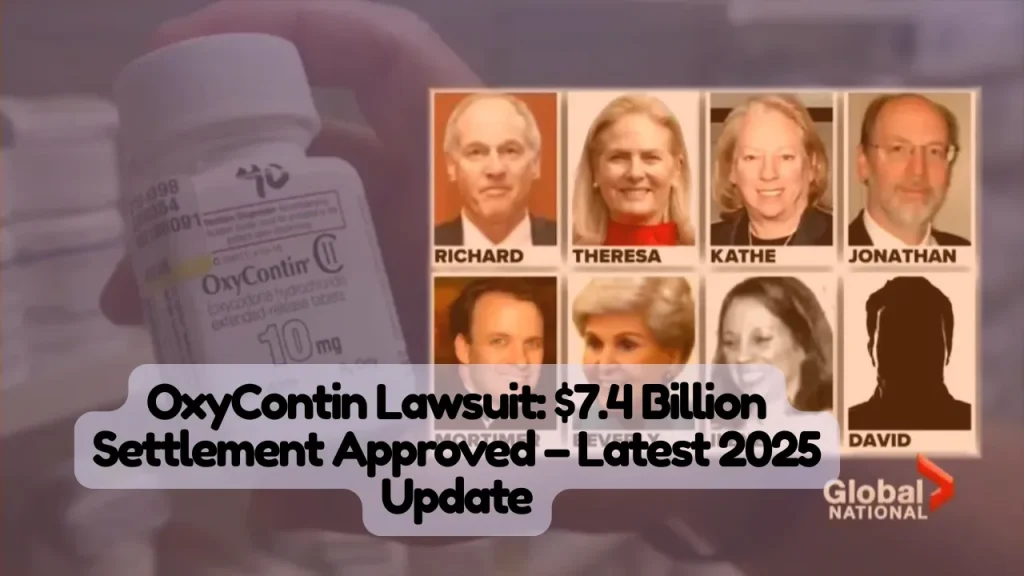
U.S. Bankruptcy Judge Sean Lane formally approved Purdue Pharma’s $7.4 billion settlement on November 18, 2025, ending thousands of lawsuits over OxyContin’s role in the opioid crisis. The Sackler family will pay up to $6.5 billion over 15 years while Purdue contributes $900 million. Individual victims who prove they were prescribed OxyContin will receive payments of $8,000 to $16,000 starting in 2026. The settlement replaces a previous agreement rejected by the U.S. Supreme Court in 2024 for improperly shielding the Sackler family from lawsuits.
What Is the OxyContin Lawsuit About?
The lawsuits allege Purdue Pharma targeted doctors with misleading claims that OxyContin’s addiction risk was low, fueling an opioid crisis linked to 900,000 U.S. deaths since 1999. The aggressive marketing of OxyContin and other prescription pain medications, combined with pain advocacy campaigns encouraging greater pain management, contributed to the initial wave of the opioid crisis between 1999 and 2010.
Purdue filed for bankruptcy protection in 2019 facing thousands of lawsuits from state and local governments, Native American tribes, and individuals. Creditor claims against Purdue exceeded $40 trillion.
Legal Claims Filed
State and local governments filed lawsuits alleging:
- Deceptive marketing practices: Misrepresenting OxyContin’s addiction risks to physicians
- Negligence: Failing to monitor prescription patterns and prevent diversion
- Public nuisance: Creating a healthcare crisis requiring massive public expenditure
- Unjust enrichment: Profiting from practices that devastated communities
- Violations of consumer protection laws: Misleading advertising about opioid safety
New York Attorney General Letitia James filed the nation’s most extensive lawsuit in March 2019, naming Purdue Pharma, its affiliates, and Sackler family members.
Related article: CarShield Lawsuit Settlement Alert, $9.6M Distributed to 168,179 Consumers in FTC Settlement — Did You Miss a Payment?
November 2025 Settlement Approval
Judge Lane gave his formal reasoning on November 18, 2025, after indicating approval on November 14. Lane acknowledged the plan is “not perfect” and wished the court “could do more to ease the suffering,” but determined it was equitable, in parties’ best interests, and overwhelmingly supported by claimants.
Out of more than 54,000 personal injury victims who voted, only 218 voted against the plan. This represented near-unanimous support compared to contested previous settlement attempts.
Key Settlement Terms
Financial Contributions:
- Sacklers pay $1.5 billion plus Purdue pays $900 million in first payment (expected early 2026)
- $500 million after one year, $500 million after two years, $400 million after three years
- $850 million designated for individual victims, including children born with opioid withdrawal
Corporate Restructuring:
- Purdue transforms into Knoa Pharma, controlled by a state-appointed board with a public benefit mission
- Sacklers permanently barred from selling opioids in the United States
- Sacklers agree not to attach their name to institutions in exchange for donations
Transparency Requirements:
- Purdue must release internal documents revealing how it promoted and monitored opioids
- Over 30 million documents related to Purdue’s opioid business will become public
Evidence Presented
The lawsuits documented decades of aggressive marketing tactics:
At OxyContin’s 1996 launch party, a Sackler family member boasted of “a blizzard of prescriptions that will bury the competition.”
Purdue pushed OxyContin sales through large cash bonuses to sales teams and lavish, expense-paid symposia for physicians and pharmacists.
Sackler family members collectively received over $10 billion from Purdue in the decade before stopping involvement in 2018, using about half for taxes.
The company pleaded guilty to criminal activity multiple times while family members denied wrongdoing and claimed ethical leadership.
Supreme Court Rejection and New Settlement
A bankruptcy judge approved a settlement in 2021, but the U.S. Supreme Court rejected it in June 2024 because it granted Sackler family members immunity from lawsuits despite not personally filing for bankruptcy.
The Court’s 5-4 decision forced renegotiation. The revised settlement includes a critical change: entities that don’t opt into the settlement can still sue Sackler family members.
The new deal represents a $1.4 billion increase over the rejected $6 billion settlement.
Payment Distribution to Victims
Individual Victims
People with addiction and survivors of those who died must prove they were prescribed OxyContin through medical records or prescription bottle photos.
Those providing proof receive $8,000 to $16,000 depending on prescription duration and total qualifying claimants. Payments to individuals begin in 2026.
Many of the 137,000 claimants won’t receive anything because they lack documentation—many who died from overdoses were never formally prescribed OxyContin but used pills obtained from friends or street purchases.
Unlike the previous settlement, eligible individuals receive lump-sum payments starting next year rather than payments spread over multiple years.
State Allocations
New York will receive up to $250 million for opioid abatement programs.
Connecticut expects $64 million over eight years.
All 55 attorneys general representing eligible states and U.S. territories agreed to the settlement.
How This Compares to Other Opioid Settlements
The Purdue settlement ranks among the largest in a series totaling approximately $50 billion against drugmakers, wholesalers, and pharmacies.
Major opioid settlements include:
- Purdue Pharma/Sacklers: $7.4 billion over 15 years
- Johnson & Johnson: Approximately $5 billion
- Distributors (McKesson, Cardinal Health, AmerisourceBergen): $21 billion combined
- CVS and Walgreens: Billions in pharmacy chain settlements
- Teva Pharmaceuticals: $4.25 billion
- Allergan: $2.37 billion
The Purdue settlement is the nation’s largest settlement to date with individuals responsible for the opioid crisis.
Unlike other proceedings, there were no protests outside the courthouse during the November 2025 hearings.
Applicable Legal Framework
Bankruptcy Code Limitations
The Supreme Court held that the bankruptcy code does not authorize releases and injunctions that discharge claims against non-debtors without affected claimants’ consent.
This ruling fundamentally altered bankruptcy settlements involving third-party releases. The Purdue settlement complies by making releases consensual—only parties agreeing to the settlement release their claims.
State Consumer Protection Laws
States pursued claims under various statutes:
- False advertising laws
- Consumer fraud acts
- Public nuisance doctrines
- Medicaid fraud statutes
Connecticut first sued Purdue and Sackler family members in December 2018, alleging they peddled falsehoods to push patients toward opioids while reaping massive profits.
Federal Controlled Substances Act
Purdue pleaded guilty multiple times to violations related to OxyContin marketing and distribution, including charges of misbranding and failing to maintain effective controls against diversion.
Defense Arguments
The Sackler family consistently denied wrongdoing throughout proceedings. Family members claim they led the company ethically, despite Purdue pleading guilty repeatedly to criminal activity during their ownership.
Judge Lane noted that alternatives to settlement—such as suing Sackler family members individually—would take years with uncertain success, partly because the family stated they would vigorously fight claims.
Much of the family’s wealth sits in offshore trusts that would be difficult to access through litigation.
Lane calculated that liquidating Purdue would yield only $3.4 billion, with $2 billion going to the federal government, leaving far less for victims and states.
What This Means for Pharmaceutical Accountability
Precedent for Corporate Liability
The settlement demonstrates several principles:
Personal liability for owners: Family members pay billions personally despite not filing bankruptcy, establishing that ownership carries accountability beyond corporate structures.
Permanent industry bans: The Sacklers’ permanent prohibition from selling opioids in the U.S. sets precedent for removing bad actors from regulated industries.
Document disclosure requirements: The 30 million document release creates accountability through transparency, potentially deterring similar misconduct.
Limits on third-party releases: The Supreme Court’s rejection of blanket immunity reshapes how bankruptcy courts can protect non-debtors, strengthening future victims’ rights.
Ongoing Opioid Crisis
Last year, over 50,000 Americans died from opioid overdoses. While deaths have declined from peak years, illicit fentanyl now drives mortality.
The opioid crisis occurred in waves: prescription opioids like OxyContin (1999-2010), heroin (second wave), and illicit fentanyl (third wave beginning around 2013).
Settlement funds primarily support:
- Addiction treatment programs
- Naloxone distribution
- Prevention education
- Recovery support services
- Healthcare infrastructure
No mechanism tracks where settlement money goes or evaluates spending effectiveness.
Victim Perspectives
Kara Trainor, a Michigan woman in recovery for 17 years, became addicted after receiving an OxyContin prescription for a back injury 23 years ago. She praised the deal.
Pamela Bartz Halaschak, whose husband struggled with addiction after receiving OxyContin following an accident, told the court the deal isn’t enough, stating “the natural laws of karma suggest the Sacklers and Purdue Pharma should pay for what they have done.”
Kathleen Scarpone, a member of the 26-member victims committee, noted “there are people who are struggling who needed that money yesterday.”
Many Massachusetts families divided over the plan—some wanted larger individual payouts and expressed concern that paperwork requirements would impede accountability.
Some victims will receive only hundreds or a few thousand dollars when dividing $850 million among all claimants, leading to anger over inadequate compensation.
Current Status and Next Steps
Implementation Timeline
Early 2026: First payment of $2.4 billion ($1.5 billion from Sacklers, $900 million from Purdue)
2027-2028: Annual $500 million payments
2029: $400 million payment
Through 2040: Remaining payments distributed over 15-year term
Corporate Transformation
Purdue becomes Knoa Pharma with a board appointed by participating states, focused on addiction treatment and addressing the opioid epidemic.
Legal Finality
Connecticut Attorney General William Tong stated the confirmation “permanently exiles the Sackler family from the addiction industry and ensures their name be forever synonymous with greed, shame and devastation.”
One feature not repeated from the previous settlement: Sackler family members won’t be forced to hear directly from people harmed by OxyContin.
Judge Lane described this as one of the most complicated bankruptcies in U.S. history.
Remaining Litigation
Parties not opting into the settlement retain the right to sue Sackler family members individually. However, the family retains substantial wealth despite the settlement, with much of their fortune protected in offshore accounts.
Broader Implications for Drug Litigation
Regulatory Oversight
The case exposed failures in pharmaceutical regulation and physician education about addiction risks. Federal and state agencies have since:
- Tightened prescription monitoring programs
- Enhanced training requirements for prescribers
- Implemented prescription drug monitoring databases
- Restricted initial opioid prescription durations
Marketing Accountability
The settlement’s transparency requirements may deter aggressive pharmaceutical marketing by making internal communications subject to disclosure in future litigation.
Bankruptcy Code Reform
The Supreme Court’s rejection of broad third-party releases may prompt Congressional action to clarify when bankruptcy courts can protect non-debtors, balancing victim compensation against litigation efficiency.
Frequently Asked Questions
How much will individual victims receive from the OxyContin settlement?
Victims proving they were prescribed OxyContin receive $8,000 to $16,000 depending on prescription duration and the number of qualifying claimants. Payments begin in 2026. You must provide medical records or prescription bottle photos documenting OxyContin prescriptions.
When will settlement payments start?
The first $2.4 billion payment is expected in early 2026 pending final court approval. Individual victim payments will be distributed next year, while state payments occur over 15 years.
Can I still sue the Sackler family if I don’t agree to the settlement?
Yes. The new settlement allows entities that don’t opt into the payments to still sue Sackler family members. However, much of the family’s wealth is held in offshore trusts that may be difficult to access through litigation.
What happens to Purdue Pharma?
Purdue becomes Knoa Pharma, controlled by a board appointed by participating states with a mission to benefit the public and address the opioid crisis. The Sacklers are permanently barred from selling opioids in the United States.
How does this compare to other opioid settlements?
This is the nation’s largest settlement with individuals responsible for the opioid crisis. Combined opioid settlements total approximately $50 billion against manufacturers, distributors, and pharmacies.
Why was the previous settlement rejected?
The U.S. Supreme Court rejected the 2021 settlement in June 2024 because it improperly protected Sackler family members from lawsuits despite the family not filing for bankruptcy. The Court ruled bankruptcy law doesn’t authorize such broad protections for non-debtors without claimant consent.
How will states use the settlement money?
Funds must support opioid crisis abatement including addiction treatment, naloxone distribution, prevention programs, and recovery services. However, no mechanism tracks spending or evaluates effectiveness.
This article provides general information based on court documents, legal filings, and credible news reporting. It does not constitute legal advice. Individuals with questions about claims should consult legal counsel.
Sources: U.S. Bankruptcy Court Southern District of New York case documents, PBS News, NPR, CNN, Axios, Associated Press, state attorney general announcements, Congressional Research Service, Boston Globe, Connecticut Insider
About the Author

Sarah Klein, JD, is a licensed attorney and legal content strategist with over 12 years of experience across civil, criminal, family, and regulatory law. At All About Lawyer, she covers a wide range of legal topics — from high-profile lawsuits and courtroom stories to state traffic laws and everyday legal questions — all with a focus on accuracy, clarity, and public understanding.
Her writing blends real legal insight with plain-English explanations, helping readers stay informed and legally aware.
Read more about Sarah