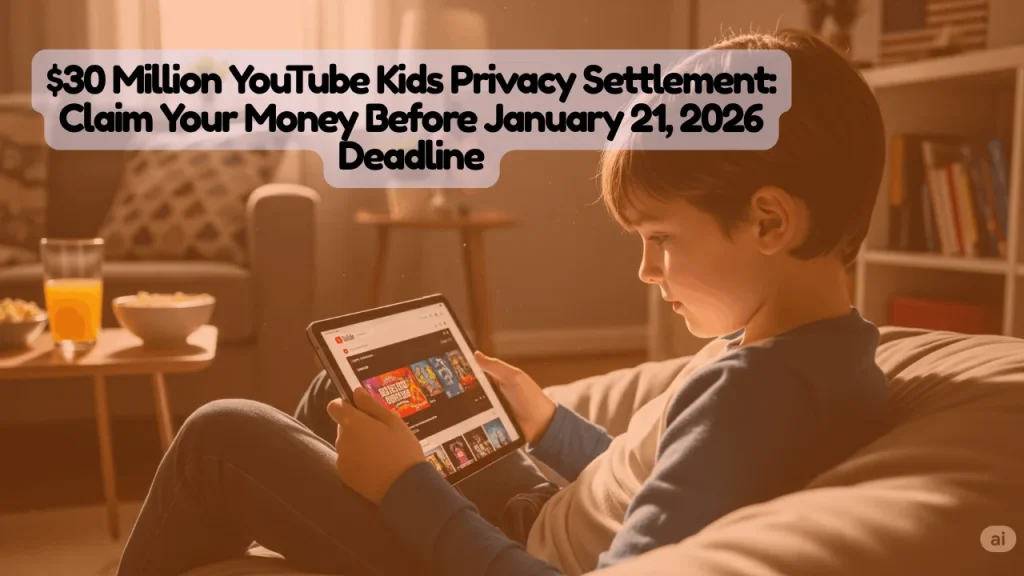
$30 Million YouTube Kids Privacy Settlement, Claim Your Money Before January 21, 2026 Deadline
Google is paying $30 million to settle allegations it illegally collected personal data from children under 13 who watched YouTube without parental consent. If your child watched cartoons, nursery rhymes, or kids’ content on YouTube between July 2013 and April 2020, you can claim money. Deadline: January 21, 2026. File online at YouTubePrivacySettlement.com. No proof required—just attest your child watched kids’ content during this period.
What Is the YouTube Kids Privacy Lawsuit Settlement?
Google and YouTube agreed to pay $30 million to resolve claims they violated the Children’s Online Privacy Protection Act (COPPA) by tracking children under 13 and using their data for targeted advertising without parental consent.
Case Details: Hubbard v. Google LLC, Case No. 5:19-cv-07016-SVK, U.S. District Court for the Northern District of California
Settlement Status: Preliminary approval granted September 23, 2025. Final approval hearing scheduled January 13, 2026.
What YouTube Allegedly Did Wrong:
- Collected persistent identifiers (cookies, device IDs) from children under 13
- Tracked children’s viewing habits across YouTube
- Built detailed profiles of children’s interests and preferences
- Served targeted behavioral advertising to minors
- Failed to obtain verifiable parental consent before collecting data
- Used tracking data for advertising revenue despite knowing children were watching
A federal judge ruled in January 2025 that Google “knowingly engaged in highly offensive conduct” by collecting data from users under 13. YouTube channels showing cartoons, toy reviews, nursery rhymes, and educational kids’ content were specifically identified as targeting children.
Related Article: Gmail Class Action Lawsuit, $425M Verdict Under Appeal in Rodriguez v. Google LLC—Plus Separate Gemini AI Privacy Case
Who Qualifies for the Settlement?
You can claim money if you meet ALL these requirements:
✓ You or your child lived in the United States
✓ You or your child was under 13 years old at any time between July 1, 2013, and April 1, 2020
✓ You or your child watched content directed at children on YouTube during that period
Content directed at children includes:
- Cartoons and animated shows
- Nursery rhymes and children’s songs
- Toy unboxing and review videos
- Educational content for young children
- Videos featuring popular kids’ characters
- Content from channels like ChuChu TV, Ryan’s World, Blippi, and similar
Important Clarifications:
If your child is now over 13: You still qualify if they were under 13 during the claim period (July 2013 – April 2020).
Multiple children: Submit a separate claim for each eligible child.
YouTube Kids app: Both regular YouTube and YouTube Kids app usage qualifies.
Shared family accounts: Eligibility based on viewer’s age, not account holder’s age.
No viewing history needed: You don’t need records—just honest attestation under penalty of perjury.
How Much Money Will You Receive?
Payment structure: Equal share of remaining settlement fund after costs
Estimated payment range: $10 to $60 per eligible child
Exact amount depends on:
- Total number of valid claims filed
- Administrative costs and taxes
- Attorneys’ fees (up to 25% of settlement fund)
- Service awards to lead plaintiffs
Payment amounts remain unknown until claim deadline passes and all claims are processed. Typical class action participation is 4%—lower participation means higher individual payments.
Related article: Hubbard vs Google Lawsuit Settlement, $30M for Kids’ Privacy Violations, Claim by January 21, 2026
How to Claim Your Money: Step-by-Step
Option 1: File Online (Recommended)
- Visit YouTubePrivacySettlement.com
- Click “File a Claim”
- Enter required information:
- Child’s full name
- Child’s date of birth
- Parent/guardian’s full name (for minors)
- Contact information
- Attest that child watched kids’ content on YouTube during claim period
- Submit by 11:59 p.m. PST on January 21, 2026
Option 2: File by Mail
- Download claim form from YouTubePrivacySettlement.com
- Print and complete form
- Mail to: YouTube Privacy Settlement
c/o A.B. Data, Ltd.
P.O. Box 173131
Milwaukee, WI 53217 - Must be postmarked by January 21, 2026
Who Should File the Claim?
If child is still a minor: Parent or legal guardian must file
If former child is now 18+: They can file on their own behalf
Multiple eligible children: File separate claim for each child
What Documentation Is Required?
Answer: NONE.
This settlement requires no proof of YouTube viewing history. You simply attest under penalty of perjury that:
- Your child was under 13 during the claim period
- Your child watched content directed at children on YouTube
- The information provided is truthful
Do NOT provide:
- YouTube viewing history
- Purchase receipts
- Screenshots of account activity
- Email confirmations
Submitting false claims constitutes perjury and fraud, potentially resulting in criminal penalties.
Critical Deadlines You Must Know
| Action | Deadline |
| Submit Claim | January 21, 2026 |
| Opt Out/Exclude Yourself | December 8, 2025 |
| File Objections | December 8, 2025 |
| Final Approval Hearing | January 13, 2026 at 10:00 a.m. PST (via Zoom) |
Missing the January 21, 2026 deadline means:
- You receive NO payment
- You lose your right to sue Google separately
- You remain bound by court’s final decision
No extensions are granted. Courts rarely reopen claim deadlines.
The Legal Battle Behind This Settlement
Original FTC Enforcement (2019)
Before this class action, the Federal Trade Commission and New York Attorney General sued Google in September 2019 for COPPA violations. Google paid a record $170 million ($136 million to FTC, $34 million to New York) in government fines.
However, that FTC settlement provided no money to affected families. It only required Google to:
- Stop collecting data from kids’ channels without consent
- Implement systems for content creators to identify child-directed content
- Delete previously collected children’s data
The Private Class Action (2019-2025)
Parents filed the Hubbard lawsuit in October 2019, seeking compensation for families whose children’s privacy was violated.
Major Legal Obstacles:
- COPPA contains no private right of action (only government can enforce)
- Case dismissed twice by District Judge Beth Labson Freeman who ruled state privacy claims were preempted by federal COPPA
Breakthrough Victory (December 2022): The Ninth Circuit Court of Appeals reversed the dismissals in a landmark unanimous decision, ruling that state privacy laws that “supplement or require the same thing” as COPPA are not preempted. This allowed families to pursue compensation under state law for conduct that violated COPPA.
Judge Van Keulen’s Ruling (January 2025): After the case returned to district court (now assigned to Judge Sunita van Keulen), the court ruled that plaintiffs adequately alleged Google “knowingly engaged in highly offensive conduct” by:
- Collecting children’s data despite COPPA requirements
- Receiving notifications from content creators about COPPA compliance concerns
- Understanding that young children regularly used YouTube
- Responding to concerns by claiming YouTube didn’t need to comply with COPPA
The judge found Google knew it was collecting children’s data in violation of COPPA, distinguishing this case from typical data collection scenarios.
Named Defendants
The lawsuit targets not just Google and YouTube, but also major YouTube channel owners who profited from advertising on kids’ content:
- Cartoon Network, Inc.
- DreamWorks Animation LLC
- Hasbro, Inc. and Hasbro Studios LLC
- Mattel, Inc.
- ChuChu TV Studios
- Pocketwatch, Inc. (Ryan’s World)
- Various other channel operators
Plaintiffs alleged these channel owners knowingly allowed Google to track children while monetizing their content through targeted advertising.
What Google Collected from Children
According to court documents, Google collected the following “Personal Information” from children under 13 without parental consent:
Persistent Identifiers:
- Cookies stored on devices
- Unique device identifiers
- IP addresses
- Mobile advertising IDs
Behavioral Data:
- Videos watched
- Search queries
- Viewing duration
- Click patterns
- Content preferences
Profile Building: Google used this data to create detailed profiles of individual children, tracking their interests and preferences to serve targeted behavioral advertising. This allowed Google to:
- Show ads based on children’s specific interests
- Maximize ad revenue by precisely targeting young viewers
- Track children across the internet beyond YouTube
- Build comprehensive behavioral profiles of minors
The Advertising Business Model: YouTube channel owners could monetize their channels by allowing Google to serve behavioral advertising. Google and channel owners split the advertising revenue. More detailed child profiles meant more effective ad targeting and higher revenue for both Google and content creators.
Recent Legal Developments
September 23, 2025: Court granted preliminary approval to $30 million settlement
January 13, 2026: Final approval hearing scheduled (via Zoom videoconference at 10:00 a.m. PST)
Post-Approval: Payments will be distributed after final approval and resolution of any appeals—typically several months to two years
Common Mistakes to Avoid
Missing the deadline: January 21, 2026 is firm. No extensions.
Not filing for all eligible children: Each child needs a separate claim.
Waiting for YouTube to contact you: YouTube will not notify you—you must file proactively.
Providing false information: Perjury is a crime. Only claim if your child genuinely watched kids’ content.
Opting out unnecessarily: Opting out means you get no payment but can sue separately. Only do this if you have a strong individual case worth more than the settlement payment.
Assuming you’ll be automatically included: Unlike the Google Play Store settlement, this requires active claim submission.
Your Options: What You Can Do
Submit a Claim (Deadline: January 21, 2026)
Get payment from settlement fund. This is the only way to receive money. By claiming, you give up your right to sue Google separately for these claims.
Exclude Yourself/Opt Out (Deadline: December 8, 2025)
Receive no settlement payment but preserve your right to sue Google independently. Only consider this if you have a stronger individual case. Submit exclusion request at YouTubePrivacySettlement.com.
Object to Settlement (Deadline: December 8, 2025)
Tell the court why you don’t like the settlement terms. You can still receive payment if you object. File written objection with court and submit to settlement administrator.
Go to Final Hearing (January 13, 2026)
Attend via Zoom to speak about settlement fairness. You must file written objection first to speak at hearing.
Do Nothing
Receive no payment. Give up rights to sue Google. Remain bound by court’s final decision.
What Happens After You File?
- Confirmation: You’ll receive confirmation that claim was received
- Review period: Settlement administrator reviews all claims for validity
- Court approval: Judge holds final approval hearing January 13, 2026
- Appeals: Any appeals must be resolved before payment
- Payment calculation: Administrator determines per-person payment based on valid claims
- Distribution: Checks or electronic payments sent to claimants
Expected timeline: Payments typically distributed 6 months to 2 years after final approval, depending on appeals.
How This Settlement Compares to Other Google Cases
| Settlement | Amount | Payment Type | Your Action |
| YouTube Kids Privacy | $30M | Must file claim | Submit by Jan 21, 2026 |
| Google Play Store | $700M | Automatic | Nothing needed |
| Incognito Mode | $0 class action | No direct payments | Must sue individually |
| FTC YouTube Fine | $170M | No consumer payments | Went to government |
The YouTube Kids settlement is one of the few Google privacy settlements requiring active claim submission to receive payment.
Contact Information
Settlement Administrator:
YouTube Privacy Settlement
c/o A.B. Data, Ltd.
P.O. Box 173131
Milwaukee, WI 53217
Phone: 877-390-3347
Email: [email protected]
Website: YouTubePrivacySettlement.com
Class Counsel:
Silver Golub & Teitell LLP
Steven L. Bloch
Pritzker Levine LLP
Jonathan K. Levine
Frequently Asked Questions
Q: How do I know if my child watched “content directed at children”?
A: Content directed at children includes cartoons, nursery rhymes, toy videos, educational shows for young kids, and videos featuring children’s characters. If your child watched typical kids’ programming like Peppa Pig, Paw Patrol, toy unboxings, or similar content, they likely qualify.
Q: What if I don’t remember if my child used YouTube during 2013-2020?
A: If you’re uncertain, you likely shouldn’t file. Claims require attestation under penalty of perjury. Only file if you genuinely believe your child watched kids’ content on YouTube during the claim period.
Q: Can I claim if my child only used YouTube Kids app, not regular YouTube?
A: Yes. Both YouTube and YouTube Kids app usage qualifies.
Q: My child watched YouTube on my account. Do they still qualify?
A: Yes. Eligibility is based on the viewer’s age (under 13 during 2013-2020), not the account holder’s age.
Q: Will I need to provide proof my child watched YouTube?
A: No. The settlement requires no documentation—only your attestation under penalty of perjury.
Q: How much money will I actually receive?
A: Unknown until all claims are processed. Estimates range from $10-$60 per child based on typical class action participation rates, but actual amounts could be higher or lower.
Q: What if I miss the January 21, 2026 deadline?
A: You receive nothing and cannot sue Google separately for these claims. The deadline is firm—courts do not grant extensions.
Q: Should I opt out and sue Google on my own?
A: Only if you have a particularly strong individual case worth significantly more than the estimated $10-$60 settlement payment. Consult an attorney before opting out. Individual lawsuits are expensive and risky.
Q: Is this settlement legitimate or a scam?
A: Legitimate. The settlement is court-approved and administered by A.B. Data, Ltd., a reputable claims administrator. Only file claims through the official website: YouTubePrivacySettlement.com. Never pay fees to claim settlement money.
Q: What should I do right now?
A: If your child was under 13 and watched kids’ content on YouTube between July 2013 and April 2020, file your claim immediately at YouTubePrivacySettlement.com. Don’t wait until the deadline—file today.
What Parents Should Know About Children’s Online Privacy
This settlement highlights ongoing concerns about how tech companies collect and use children’s data. COPPA, enacted in 1998 and enhanced in 2013, requires websites and online services to:
- Obtain verifiable parental consent before collecting personal information from children under 13
- Provide clear privacy policies about data collection practices
- Maintain reasonable security for collected children’s data
- Delete children’s information when no longer needed
- Not condition participation on providing more information than necessary
The 2013 COPPA Enhancement expanded “personal information” to include persistent identifiers like cookies and device IDs, recognizing how companies track children across the internet for advertising purposes.
Why This Case Mattered: Before the Ninth Circuit’s 2022 ruling, companies violating COPPA faced only government fines—no compensation for affected families. The landmark decision opened the door for victims to seek damages through state privacy laws, making companies more accountable for privacy violations affecting children.
What’s Changed Since: Following the FTC’s $170 million fine and this lawsuit, YouTube now requires content creators to identify child-directed content. Videos marked “made for kids” have:
- Personalized ads disabled
- Comments turned off
- Limited data collection
- Restricted features
However, enforcement remains challenging as many creators resist labeling content as child-directed due to reduced ad revenue.
What Claimants Need to Know Before Filing
Verify settlement legitimacy: Only use YouTubePrivacySettlement.com—the official court-approved website. Scammers create fake settlement sites.
Never pay fees: Legitimate settlements never require upfront payment. Claims are completely free.
Be honest: Perjury carries criminal penalties. Only claim if your child genuinely watched kids’ content during the claim period.
Act quickly: Don’t wait until January 20, 2026. File now to avoid last-minute technical issues.
Keep confirmation: Save your claim confirmation number and any communications from the settlement administrator.
Update contact information: If you move, notify the settlement administrator so they can reach you about payment.
Check for updates: Monitor YouTubePrivacySettlement.com for news about final approval and payment timeline.
Read the full notice: The complete settlement terms and class notice are available on the settlement website.
Consider tax implications: Settlement payments may be taxable income. Consult a tax professional about reporting requirements.
Legal References:
- Hubbard v. Google LLC, Case No. 5:19-cv-07016-SVK (N.D. Cal.)
- Jones v. Google LLC, 73 F.4th 636 (9th Cir. 2023) (landmark preemption ruling)
- Children’s Online Privacy Protection Act, 15 U.S.C. §§ 6501-6506
- FTC v. Google LLC, Case No. 19-cv-02642-BAH (D.D.C. 2019)
Sources: Official settlement website YouTubePrivacySettlement.com; court filings in Hubbard v. Google LLC; Ninth Circuit Court of Appeals opinion in Jones v. Google LLC; FTC press releases and enforcement documents; district court orders dated January 13, 2025 and September 23, 2025.
Last Updated: December 2025. Settlement terms subject to final court approval. Verify current information at YouTubePrivacySettlement.com.
About the Author

Sarah Klein, JD, is a licensed attorney and legal content strategist with over 12 years of experience across civil, criminal, family, and regulatory law. At All About Lawyer, she covers a wide range of legal topics — from high-profile lawsuits and courtroom stories to state traffic laws and everyday legal questions — all with a focus on accuracy, clarity, and public understanding.
Her writing blends real legal insight with plain-English explanations, helping readers stay informed and legally aware.
Read more about Sarah