
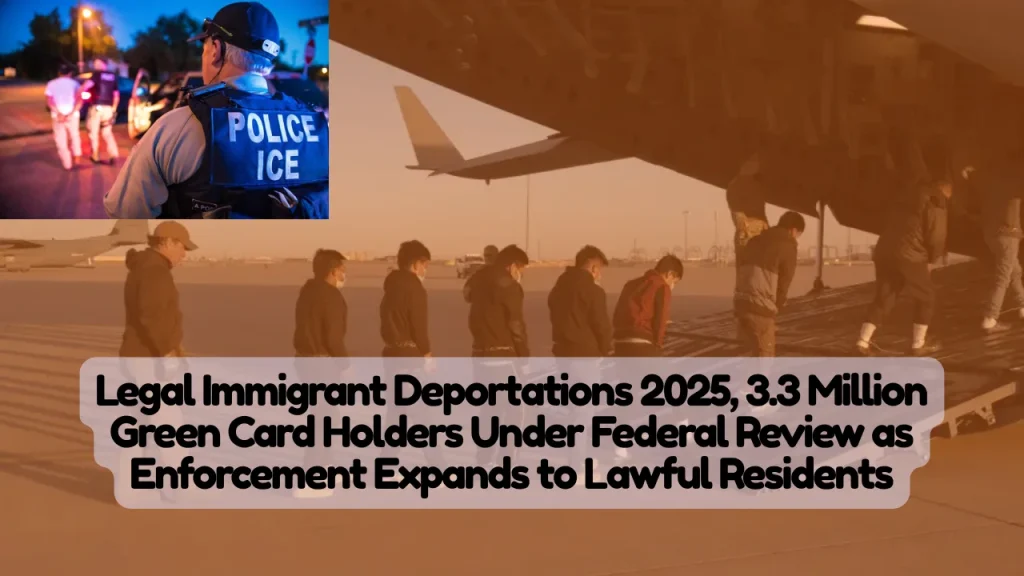
Legal Immigrant Deportations 2025, 3.3 Million Green Card Holders Under Federal Review as Enforcement Expands to Lawful Residents
Critical Alert: USCIS is reviewing 3.3 million green card holders from 19 designated countries, with 180,000 Biden-era refugees facing mandatory review and potential deportation. Nearly 50% of detained individuals in 2025 have no criminal record, marking a dramatic shift in enforcement priorities. Legal permanent residents now face deportation for minor offenses that previously wouldn’t trigger removal proceedings.
The Numbers: DHS announced over 605,000 deportations through December 2025, but these figures primarily track unauthorized immigrants. No comprehensive public data exists specifically tracking legal immigrant deportations, creating uncertainty for millions of lawful permanent residents.
2025 Deportation Statistics: What We Know About Legal Immigrants
DHS reported more than 605,000 deportations and 1.9 million voluntary self-deportations since January 2025. Through August 2025, immigration judges issued 470,213 deportation orders in 54.9% of completed cases.
However, NPR investigations found DHS deportation claims lack transparency, with no detailed breakdown provided. No public data exists on how many lawful permanent residents face deportation proceedings at ports of entry.
Key 2025 Statistics:
- 3.3 million green card holders from 19 countries under mandatory status review
- 180,000 Biden-era refugees facing automatic review with no appeal rights
- Daily ICE arrests jumped to 310 per day—a 67% increase from fiscal year 2023
- 65% of ICE detainees had no criminal convictions; 93% had no violent convictions
- 12.8 million green card holders currently live in the United States
What Are the Legal Grounds for Deporting Legal Immigrants?
INA Section 237 authorizes deportation of lawful permanent residents for specific violations.
Criminal Grounds (INA § 237(a)(2)):
Conviction of crime involving moral turpitude within five years after admission Two or more crimes involving moral turpitude at any time after admission Conviction of aggravated felony at any time after admission Drug-related convictions except single offense involving 30 grams or less of marijuana Domestic violence, child abuse, or stalking offenses Firearm offenses
Immigration Violations (INA § 237(a)(1)):
Inadmissible at time of entry or adjustment of status Marriage fraud involved in obtaining green card Failure to notify immigration authorities of address change within 10 days Visa overstays or status violations
National Security Grounds (INA § 237(a)(4)):
Activities to control or overthrow US Government Terrorist activities or participation in genocide Foreign policy consequences—allows deportation when Secretary of State determines presence would have potentially serious adverse foreign policy consequences
Critical 2025 Expansion: Trump administration targeting green card holders for past crimes or political activity. ICE detained green card holder Mahmoud Khalil for activism supporting Palestinian rights using foreign policy deportation authority.
Related article: DR Horton Class Action Lawsuit, Construction Defects, Mortgage Fraud, Homeowner Lawsuits Across Multiple States
Recent Policy Changes Affecting Legal Immigrants in 2025
Mandatory Reviews:
USCIS memo requires review of all 180,000 refugees admitted January 2021-February 2025 Review targets 3.3 million green card holders from 19 “countries of concern”—including 1 million from Cuba, 700,000 from Venezuela, 500,000 from Haiti If USCIS determines person didn’t qualify for refugee entry, they have no appeal right and face immediate removal proceedings
Expanded Enforcement Authority:
Attorney General Pam Bondi issued directive allowing law enforcement to enter migrants’ homes without warrants on March 14, 2025 Federal immigration court ruled September 5, 2025 that undocumented immigrants ineligible for bond release, subjecting millions including longtime residents to mandatory detention Supreme Court ruled May 2025 permitting revocation of protected status for 350,000 Venezuelan immigrants—”largest single action stripping any group of non-citizens of immigration status in modern U.S. history”
Port of Entry Scrutiny:
CBP detaining green card holders at airports and encouraging them to sign Form I-407 abandoning lawful permanent resident status Reports of lawful immigrants including green card holders, H-1B workers, F-1 students being detained, questioned, or deported have risen sharply under renewed “extreme vetting”
Denaturalization Campaign:
Department of Justice announced June 2025 it would “prioritize and maximally pursue” denaturalization proceedings in ten broad categories Trump administration filed 102 denaturalization cases during first term and five cases in first five months of second term
How 2025 Enforcement Trends Compare to Previous Years
Arrest and Detention Increases:
Daily ICE arrests jumped to 310 per day—67% increase compared to fiscal year 2023 ICE arrests doubled and number of people in detention at all-time high
Shift in Priorities:
Proportion of immigrants convicted of violent crimes dropped from Biden administration’s 10% to 7% during Trump administration Nearly 50% of detained and deported individuals have no criminal record—significant shift from previous enforcement priorities As of May 2025, ICE arrested only 752 non-citizens convicted of murder and 1,693 convicted of sexual assault out of 435,000 identified
Expanded Expedited Removal:
Expedited removal expanded to apply anywhere in United States to anyone who cannot prove continuous presence for at least two years Single immigration officer can order deportation without court review for those unable to prove two years continuous US presence

Targeting Legal Status Holders:
Green card holders with criminal convictions or extended time outside US face heightened scrutiny at ports of entry ICE arresting people at routine check-ins and immigration interviews, even those with pending applications Administration moved to revoke protections for humanitarian parole holders and place them in removal proceedings
Court Rulings Impacting Legal Immigrant Deportations
Constitutional Challenges:
US District Judge James Boasberg ordered planes carrying those covered by his order be turned back, but Trump administration allowed flights to proceed despite order Supreme Court ruled April 8, 2025 that Judge Boasberg was without jurisdiction, thus order was nullity
Torture Convention Protections:
US District Judge Brian Murphy issued temporary restraining order March 28, 2025 prohibiting DHS from deporting immigrants to nation other than covered in proceedings without “meaningful opportunity” to make claim under UN Convention Against Torture Murphy granted preliminary injunction April 18, 2025 requiring government to give written notice before third-country removals and allow torture convention claims Supreme Court granted stay of Murphy’s injunction June 23, 2025, allowing administration to continue third-country deportations
Bond Eligibility:
Federal immigration court ruled September 5, 2025 that undocumented immigrants living in US ineligible for bond release Former immigration judge Dana Leigh Marks called policy change “cynical move to try to force people to litigate their cases while they’re detained”
Procedural Changes:
Board of Immigration Appeals issued Matter of H-A-A-V- decision September 2025 clarifying immigration judges may pretermit applications for asylum, withholding, and CAT protection if undisputed facts fail to establish prima facie eligibility
How Deportation Proceedings Work for Legal Immigrants
Notice to Appear:
US government must first serve green card holder with notice to appear—charging document listing reasons government believes person is deportable Once charging document received, immigration court case is initiated
Government’s Burden:
US government has burden of proof and must show through “clear and convincing evidence”—more likely true than untrue—that person can be deported Evidence depends on case—lawyers can use proof of criminal conviction to show aggravated felony or tax filings to prove abandoned permanent status
Due Process Rights:
In most cases, you have right to defend your case in immigration court unless outstanding removal order exists Government cannot terminate green card status without giving person chance to fight case in immigration court Visa holders afforded same due process as legal permanent residents with government having burden of proof
Expedited Removal Exception:
Single officer can order deportation without court review if determining person entered without proper documents and cannot prove two years continuous presence American Immigration Council notes this process has few checks on authority, raising concerns about mistaken deportations
Reinstatement of Removal:
Reinstatement of removal applies to anyone previously deported who reentered without permission—can happen almost immediately upon arrest with no hearing before immigration judge
Court Backlog:
Immigration courts had 3.8 million pending cases as of June 2025, with 63% being asylum cases There are 3.4 million pending deportation cases in US immigration courts Among pending cases, 2.0 million people (59%) navigating deportation proceedings alone with no lawyer
Legal Protections and Rights for Legal Immigrants
Cancellation of Removal:
Green card holders facing deportation might have legal option called “cancellation of removal” depending on how long they’ve lived in United States and past criminal record
Waivers:
INA Section 237(a)(1)(H) authorizes waiver for aliens inadmissible at admission time due to fraud or misrepresentation Waiver available only to person in removal proceedings, requires being spouse, parent, son, or daughter of US citizen or lawful permanent resident Waiver operates to waive not only exclusion ground but also underlying fraud and renders recipient LPR status from time of initial entry
First Amendment Protections:
INA Section 237(a)(4)(C)(i) bars government from deporting someone “because of alien’s past, current, or expected beliefs, statements, or associations, if such beliefs, statements, or associations would be lawful within United States” To overcome this protection, Secretary of State must personally determine individual’s presence would compromise compelling United States foreign policy interest
Humanitarian Protections:
Some green card holders may be afraid to return to their country and could ask for asylum or other humanitarian protections
Representation Impact:
Among cases that closed within past 12 months, 59% of people facing deportation for entering without inspection who had lawyer were permitted to remain in United States Among people in immigration court who had lawyer, 97% continued to appear for hearings; just 3% received removal orders in absentia
Bond Limitations:
New ICE policy attempts to expand immigration detention by limiting bond eligibility
What Legal Immigrants Need to Know Now
High-Risk Activities:
Green card holders more likely targeted by ICE and CBP when: traveling outside United States or leaving continental US, traveling inside US especially by air or crossing immigration checkpoint near border, arrested or involved with police or criminal legal system
International Travel Risks:
Government has special authority to detain and deport when: green card holder outside US for more than 180 days at one time, government believes engaged in illegal activity after leaving US, had pending immigration court case when left US, committed criminal offense making them inadmissible
Form I-407 Warning:
Reports that CBP detaining green card holders at airport and encouraging them to sign Form I-407 agreeing to abandon lawful permanent resident status

Criminal Record Risks:
Immigration law has very broad definition of “conviction”—many old offenses that don’t count as convictions in criminal court do count as convictions in immigration court Old case where plea got withdrawn after drug treatment program participation could still count as conviction in immigration court
National Security Allegations:
ICE can detain and try to deport green card holders by claiming danger to United States’ national security or involved in terrorist activities, defined very broadly under federal law
Protective Measures:
For green card holders, avoid extended trips outside United States, maintain strong documentation of US residence, be prepared to show evidence of ties to United States when reentering Green card holders should avoid any legal trouble since threshold for deportable offense has been lowered—even minor offenses can result in severe immigration consequences Filing US taxes, maintaining permanent address, and other evidence of connection to US are vital
Legal Consultation:
If ever arrested for crime, simply agreeing to plead guilty to avoid jail time could be worst possible choice if means admitting to crime that makes you deportable You’ll want to consult both criminal lawyer and immigration lawyer for assistance in this situation
Naturalization as Protection:
Only immigrants who have successfully become US citizens are safe from grounds of deportability—US citizens cannot be removed unless they used fraud to gain green card Worth applying to naturalize as soon as eligible, bearing in mind any existing grounds of deportability in your case could scuttle citizenship application and result in loss of green card
Who’s at Greatest Risk in 2025?
Geographic Targeting:
3.3 million green card holders from 19 countries under review—bulk of 2.2 million from Caribbean: 1 million from Cuba, 700,000 from Venezuela, 500,000 from Haiti Majority of Caribbean green card holders live in Florida with large concentrations in New York, New Jersey and other states
Status Categories at Risk:
Individuals with final removal orders regardless of how long ago issued People granted humanitarian parole under CBP One, CHNV programs, or other temporary protections Green card holders with certain criminal convictions or spent extended time outside United States In Pennsylvania, 10 Bhutanese refugees detained in ICE raids—as many as 60 Bhutanese refugees detained nationwide
Community Impact:
41% of immigrants say they worry they or family member could be detained or deported, up from 26% in 2023 75% of likely undocumented immigrants worry about detention or deportation as of 2025 Worries increased most among naturalized citizens (from 12% to 31%) and lawfully present immigrants (from 33% to 50%)
Frequently Asked Questions
Q: Can a green card holder be deported?
Yes. Section 237 of INA outlines actions that can cause non-citizen to lose legal status and be removed from country for conduct occurring after admission. Green card holders face deportation for criminal convictions, immigration fraud, national security concerns, or abandonment of residence.
Q: How many legal immigrants have been deported in 2025?
DHS reported more than 605,000 total deportations through December 2025, but no comprehensive breakdown exists for legal immigrants versus unauthorized immigrants. No public data tracks how many lawful permanent residents face deportation proceedings at ports of entry.
Q: What crimes can get a green card holder deported?
Crime involving moral turpitude within five years after admission, two or more crimes involving moral turpitude any time after admission, aggravated felony any time after admission, drug-related convictions except single offense involving 30 grams or less of marijuana. Domestic violence, child abuse, firearm offenses also trigger deportation.
Q: Can a green card holder be denied entry to the US?
Yes. Visa itself does not grant US entry—Customs and Border Protection officers have authority to admit people or deny entry. They might deny entry if visa holders have past criminal conviction, risk overstaying, or might come to US to work without authorization.
Q: What is expedited removal?
Single officer can order someone deported without court review if determining person entered without proper documents and cannot prove two years continuous presence in United States. This process has few checks on authority and can happen within a single day.
Q: Does having a lawyer help in deportation cases?
Among cases closed within past 12 months, 59% of people facing deportation for entering without inspection who had lawyer were permitted to remain in United States. 97% of immigrants with legal representation attend court hearings compared to far lower rates among unrepresented individuals.
Q: Can naturalized citizens be deported?
Denaturalization strips citizenship from naturalized Americans, turning them back into deportable non-citizens. Department of Justice announced June 2025 it would “prioritize and maximally pursue” denaturalization proceedings in ten broad categories.
Legal Assistance:
- National Immigration Law Center: nilc.org
- American Immigration Lawyers Association: aila.org
- EOIR Pro Bono List: justice.gov/eoir/list-pro-bono-legal-service-providers
Data and Statistics:
- TRAC Immigration: tracreports.org/immigration
- ICE Statistics: ice.gov/statistics
- DHS Immigration Enforcement Tables: ohss.dhs.gov/topics/immigration/immigration-enforcement
Meta Description: 3.3 million green card holders under federal review in 2025 as Trump administration expands deportation grounds for legal immigrants. Learn deportation statistics, legal grounds, recent policy changes, court rulings, and what legal immigrants must do now to protect their status.
Last Updated: December 12, 2025 Jurisdiction: United States Federal Immigration Law Legal Disclaimer: This article provides general information about immigration law and deportation proceedings. It does not constitute legal advice. If you face deportation proceedings or believe you may be at risk, consult with a qualified immigration attorney immediately. Immigration law is complex and changes frequently. Individual cases depend on specific facts and circumstances.
About the Author

Sarah Klein, JD, is a licensed attorney and legal content strategist with over 12 years of experience across civil, criminal, family, and regulatory law. At All About Lawyer, she covers a wide range of legal topics — from high-profile lawsuits and courtroom stories to state traffic laws and everyday legal questions — all with a focus on accuracy, clarity, and public understanding.
Her writing blends real legal insight with plain-English explanations, helping readers stay informed and legally aware.
Read more about Sarah