
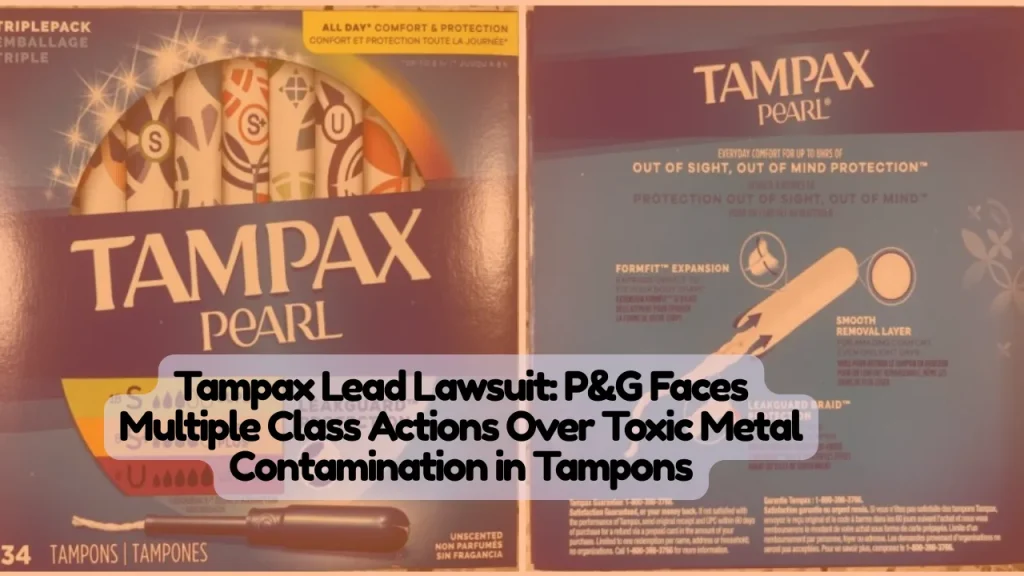
Tampax Lead Lawsuit, P&G Faces Multiple Class Actions Over Toxic Metal Contamination in Tampons
Procter & Gamble faces at least four active class action lawsuits alleging Tampax Pearl tampons contain unsafe lead levels that could enter women’s bloodstreams. Federal courts in California and Ohio have allowed cases to proceed after P&G’s dismissal attempts failed in August 2024, while a magistrate judge ordered October 2024 settlement talks in the first-filed case.
Independent lab testing cited in complaints shows lead concentrations ranging from 0.243 to 0.787 micrograms per tampon—exposing regular users to up to 2.36 micrograms daily, nearly five times California’s safety threshold. The CDC confirms no safe lead exposure level exists.
What the Tampax Lawsuits Allege
Multiple consumers have filed class actions against Procter & Gamble claiming the company concealed dangerous lead contamination in Tampax Pearl and Tampax Radiant tampons.
The Core Allegations:
The first lawsuit, filed July 29, 2024 by Allison Barton in California federal court (Case No. 3:24-cv-01332), contends P&G falsely markets tampons as safe while failing to warn about lead content.
A November 2024 complaint brought by Ciji Sanchez and eight other plaintiffs in Ohio federal court (Case No. 1:25-cv-00852-DRC) alleges P&G knew or should have known about contamination but never disclosed it on packaging.
A separate California case filed by Laura Willis-Albrigo (Case No. 3:24-cv-01416) claims independent testing found 0.206 micrograms of lead per tampon.
Additional lawsuits were filed November 21, 2024 in New York federal courts alleging similar violations of consumer protection laws.
The Independent Lab Testing Evidence
According to independent lab tests cited in Barton’s lawsuit, lead levels in individual Tampax Pearl tampons range from 0.243 micrograms in Pearl Light to 0.787 micrograms in Pearl Ultra.
The critical calculation: Barton points out that Procter & Gamble’s own advertising suggests most consumers use three to six tampons per day. Women would be exposed to a minimum of between 0.729 and 2.36 micrograms of lead daily.
These amounts exceed California Proposition 65’s MADL (Maximum Allowable Dose Level), legally requiring a clear warning label.
Lead concentrations were up to 40 times higher in the affected tampon brands than the EPA’s action level for drinking water.
Some competitors, including P&G’s own Tampax Pure Cotton line, registered no detectable lead in laboratory testing—proving lead-free production is possible.
Why Vaginal Exposure Is More Dangerous
The lawsuit asserts that since tampons are inserted vaginally, any lead they contain could bypass the digestive system and enter the bloodstream directly, posing a greater risk than ingestion through food.
Lead exposure is particularly concerning in tampons, which come into direct contact with vaginal walls and the cervix, allowing lead to enter the bloodstream more easily than through oral exposure.
The vaginal lining is highly permeable. Toxins absorbed there don’t get metabolized by the liver before entering circulation—they go straight into the bloodstream.
Related article: Capital One $425M Settlement REJECTED, Will You Still Get Paid? Latest Dec 2025 Update

The Berkeley Study That Sparked Nationwide Concern
In June 2024, researchers from Columbia University, UC Berkeley, and Michigan State published the first study examining metal presence in tampons. They tested 30 individual tampons from 14 brands and 18 product lines.
The Alarming Findings:
The researchers found measurable concentrations of all 16 metals they tested for – and most concerningly, found lead in every single tampon tested – of which there is no safe exposure level.
The study detected arsenic, barium, calcium, cadmium, cobalt, chromium, copper, iron, manganese, mercury, nickel, lead, selenium, strontium, vanadium, and zinc.
Metal content tended to differ by whether or not a product was labeled as organic. Lead concentrations were higher in non-organic tampons, and organic tampons had higher levels of arsenic.
Current Legal Status: Cases Moving Forward
California Cases Survive Dismissal:
U.S. District Judge Gonzalo Curiel denied P&G’s motion to dismiss the Barton case in August 2024, ruling that the plaintiffs had alleged enough facts to support their claims and that their testing was adequate at this stage of the case.
P&G filed a motion to dismiss the lawsuit, arguing that the plaintiffs’ claims were not plausible and that they had not shown that the tampons posed a health risk. The company also challenged the plaintiffs’ testing of the tampons, saying it was insufficient to prove the presence of lead.
The court disagreed, allowing discovery to proceed.
Settlement Talks Ordered:
A U.S. magistrate judge has ordered both sides in the Barton case to bring representatives with full settlement authority to an October 31, 2025 evaluation and case management conference, to discuss resolving claims.
This signals the court views the claims seriously enough to warrant immediate settlement discussions.
Ohio Lawsuit Recently Filed:
The complaint was brought by Ciji Sanchez and at least eight other plaintiffs in the U.S. District Court for the Southern District of Ohio on November 19.
This nationwide action includes claims under consumer protection statutes in nine states.
Fraud Claims Dismissed (Without Prejudice):
February 13, 2025: A California federal judge dismissed fraud-based claims brought against Kimberly-Clark and Procter & Gamble over their popular Kotex and Tampax tampons, which were alleged to contain toxic levels of lead.
However, the ruling does not end the litigation entirely. Instead, it was made without prejudice, meaning the plaintiff has 25 days to amend and refile the complaint.
What Products Are Affected
The lawsuits specifically name these Tampax products:
- Tampax Pearl (Light, Regular, Super, Super Plus, Ultra)
- Tampax Radiant
- Tampax Cardboard
Notably, P&G’s own Tampax Pure Cotton line registered no detectable lead in laboratory testing, suggesting the contamination is not present across all Tampax products.
The Legal Claims Against P&G
Plaintiffs assert multiple theories of liability:
Consumer Protection Violations:
- California Unfair Competition Law (UCL)
- California Consumers Legal Remedies Act (CLRA)
- New York consumer protection statutes
- Consumer protection laws in nine states
Failure to Warn: P&G knew or should have known about lead contamination but provided no warning labels.
False Advertising: Marketing tampons as safe and “clinically tested” without disclosing toxic metal content.
Breach of Implied Warranty: Products unfit for their intended purpose due to contamination.
Unjust Enrichment: P&G profited from selling contaminated products without disclosure.
Health Risks Associated With Lead Exposure
According to the U.S. Centers for Disease Control and Prevention (CDC), no level of lead in the human body is considered safe.
Lead exposure can cause severe health conditions such as reduced neurological function, anemia, organ damage, seizures and even coma and death.
Lead is a neurotoxin associated with cognitive deficits, mental illness, dementia and hypertension.
Additional documented effects include:
- High blood pressure
- Kidney damage
- Reproductive problems
- Developmental delays
- Learning disabilities
- Cardiovascular system damage
- Endocrine disruption
Women may use more than 7,400 tampons over a lifetime, making cumulative exposure particularly concerning.
P&G’s Defense and Response
Company Position: P&G argues the lawsuits lack merit and that all Tampax products meet FDA safety requirements.
P&G filed a motion to dismiss, arguing that the plaintiffs’ claims were not plausible and that they had not shown that the tampons posed a health risk. The company also challenged the plaintiffs’ testing of the tampons.
Procter & Gamble asserts that the action against it is mooted by the announced FDA review of heavy metals in menstrual products.
Primary Jurisdiction Defense: P&G claims the FDA—not courts—should resolve tampon safety questions first.
Preemption Arguments: The company may argue federal FDA regulation preempts state consumer protection claims.
Testing Challenges: P&G disputes the adequacy and methodology of plaintiffs’ independent lab testing.
Despite these defenses, federal judges have denied motions to dismiss, finding plaintiffs’ allegations sufficient at the pleading stage.
What the FDA Is Doing Now
The FDA has launched an investigation of the potential exposure to heavy metals when using tampons, the agency announced September 10, 2024.
Two FDA Studies Underway:
One of the studies will involve laboratory tests to evaluate metals in tampons and potential exposure people may experience when using them. The other study will be a review of current research regarding the health effects of metals that may be found in tampons.
“The FDA’s laboratory study will measure the amount of metals that come out of tampons under conditions that more closely mimic normal use”.
The Berkeley study tested for metal presence but didn’t test whether metals leach out during actual use or enter the bloodstream.
The FDA announcement did not specify a time frame for the completion of its investigation.
FDA’s Current Regulatory Gap:
The FDA does not require tampon makers to test their products for PFAS or heavy metal contaminants. The FDA only recommends that tampons be free of pesticide and herbicide residues, as well as two specific persistent organic pollutants.
The FDA also does not require tampon makers to disclose the contents of their products.
Tampons are Class II medical devices requiring 510(k) clearance, but manufacturers only must show “substantial equivalence” to already-marketed products—not independent safety testing for contaminants.
Congressional Pressure on FDA
U.S. Senator Patty Murray (D-WA), Chair of the Senate Appropriations Committee, sent a July 2024 letter to FDA requesting the agency examine the findings and evaluate necessary steps to ensure tampon safety.
Murray’s letter posed six specific questions about FDA’s current and planned safety measures.
The Democratic Women’s Caucus also sent letters demanding FDA action.
Senator Murray announced FDA has responded confirming it has commissioned an independent review of the literature, and is conducting a new study on the issue.
State Legislative Responses
Several states have moved ahead of federal regulation:
California: Passed laws prohibiting manufacturers from selling menstrual products containing intentionally added PFAS.
Vermont: Passed a law prohibiting manufacturers from manufacturing, selling, or distributing menstrual products containing intentionally added PFAS. This law will take effect on January 1, 2026.
Colorado: The sale or distribution of menstrual products with intentionally added PFAS will be banned as of January 1, 2026.
Connecticut: Banned the sale of menstrual products containing PFAS unless the manufacturer provides prior written notification to the Connecticut Department of Energy and Environmental Protection. This notification requirement takes effect on July 1, 2026.
These state laws focus on PFAS (forever chemicals), not lead specifically, but reflect growing concern about tampon safety.
Similar Lawsuits Against Other Brands
P&G isn’t alone in facing legal action.
Kimberly-Clark Corp., the maker of U by Kotex tampons, was hit with a proposed class action lawsuit alleging it fails to disclose its products might be contaminated with unsafe levels of lead.
In a similar case, a customer recently sued Kimberly-Clark claiming the company failed to disclose that its U by Kotex Click tampons contain lead.
The pattern suggests systemic contamination issues across the tampon industry, not just one manufacturer.
What This Means for US Consumers
If You Use Tampax Products:
No official recall has been issued. P&G continues selling all Tampax products.
Women concerned about exposure have several options:
- Switch to brands that tested negative for lead (including P&G’s own Tampax Pure Cotton line)
- Use alternative menstrual products (menstrual cups, period underwear, pads)
- Consult a healthcare provider about lead exposure concerns
- Consider lead level testing if experiencing unexplained health symptoms
Who Can Join These Lawsuits:
The Tampax Pearl lawsuit looks to represent anyone in California who, in the past four years, purchased Procter & Gamble’s Tampax Pearl tampons within the state and does not claim any personal injury from using them.
The lawsuit seeks to represent anyone in the United States who purchased Tampax tampons during the relevant statute of limitations.
You typically don’t need to “sign up” for class actions—if you purchased affected products during the relevant timeframe, you’re automatically included unless you opt out.
Personal Injury Claims: Current lawsuits focus on consumer fraud and false advertising, not personal injury. Women who believe they suffered health problems from lead exposure may have separate product liability claims.
What Remedies Plaintiffs Seek
The lawsuits request:
Monetary Damages: Refunds for consumers who purchased contaminated products under false pretenses.
Restitution and Disgorgement: Return of profits P&G earned from misleading marketing.
Injunctive Relief: Court orders requiring P&G to:
- Disclose heavy metal content on labels
- Stop deceptive marketing practices
- Conduct corrective advertising campaigns
Punitive Damages: Additional damages to punish P&G and deter future misconduct.
Attorneys’ Fees and Costs: Payment of legal expenses for bringing the action.
How These Cases Compare to Other Product Liability Lawsuits
The Tampax litigation follows a pattern seen in other toxic exposure cases:
Baby Food Lead Lawsuits: Numerous toxic baby food lawsuits have been filed nationwide against major manufacturers, including Gerber, Beech-Nut Nutrition, Plum, Hain, Campbell, Walmart, Sprout and others for heavy metal contamination.
Thinx PFAS Settlement: In 2023, Thinx settled a lawsuit over whether its period underwear exposed wearers to PFAS.
Past Tampon Litigation: Past class action lawsuits against tampon manufacturers have focused on both false advertising and health risk claims. For instance, a class action against Procter & Gamble alleges that P&G is committing false advertising by claiming some Tampax products are dye-free.
PFAS Lawsuit Dismissed: A proposed Tampax class action lawsuit alleging Pure Cotton tampons contain toxic ‘forever chemicals’ was dismissed by a federal judge on July 7, 2025. The judge found testing methodology flawed.
This dismissal shows P&G will aggressively challenge testing evidence—but lead lawsuits have survived similar challenges.
Key Differences Between Lead and PFAS Cases
The PFAS case was dismissed for inadequate testing. The lead cases have survived dismissal motions.
Why Lead Cases Are Stronger:
- Multiple independent labs confirm lead presence
- Testing methodology follows accepted industry standards
- Lead levels exceed established California safety thresholds
- P&G’s own Pure Cotton line tests negative, proving contamination isn’t inherent to tampon production
Potential Outcomes and Settlement Possibilities
Scenario 1: Settlement: The magistrate judge’s order for settlement talks suggests the court views claims as credible. P&G may settle to avoid discovery revealing internal knowledge of contamination.
Typical class action settlements include:
- Cash payments to class members (often $5-$50 per purchase)
- Changes to product formulations
- Enhanced warning labels
- Independent monitoring of future products
Scenario 2: Trial: If settlement fails, cases proceed to discovery and potentially trial. Plaintiffs would need to prove P&G knew or should have known about contamination and intentionally failed to warn consumers.
Scenario 3: Additional Dismissals: P&G will continue fighting to dismiss claims. Some cases may be dismissed if plaintiffs can’t prove specific elements.
Scenario 4: Consolidation: Multiple federal cases may be consolidated into multidistrict litigation (MDL) for efficiency.
What Experts Say About Tampon Safety
The Testing Is Limited: The small sample size of tampons tested (60 “sub-samples” from 30 different tampons) precluded a formal statistical analysis, which means that the authors could not make any statistically significant conclusions.
The Vaginal Absorption Question: Perhaps the biggest hurdle is whether heavy metals can be absorbed from tampons through vaginal tissue. Currently, expert witnesses cannot comment on existing research. They can only extrapolate from existing evidence of heavy metals present in tampons and knowledge of the absorption properties of the vaginal lining.
As Research Continues: As research continues, these cases will continue to take shape. Broader consumer awareness will also help tampon users identify their own symptoms or have more productive conversations with medical providers.
Critical Questions Remaining Unanswered
Do Metals Leach Out?: The Berkeley study confirmed metals are present but didn’t test whether they release during use. FDA’s ongoing study will address this.
What Are Absorption Rates?: Even if metals leach out, how much enters the bloodstream? Vaginal absorption rates for lead aren’t well-studied.
What Are Cumulative Effects?: With decades of use, do even small amounts create health risks? Long-term studies don’t exist.
Why Does Lead Vary By Product?: If Pure Cotton tests negative but Pearl tests positive, what manufacturing difference causes contamination?
Is This Intentional or Accidental?: Researchers noted that there are many ways that metals can be introduced into tampons, including during production, such as by contaminated water being used in the manufacturing process; metal compounds may also be intentionally added to the products.
What US Readers Need to Know Right Now
The Facts:
- Multiple lawsuits allege Tampax Pearl and Radiant tampons contain lead exceeding California safety limits
- Independent testing found lead in every tampon tested across 14 brands
- Federal courts have allowed lawsuits to proceed despite P&G’s objections
- The CDC confirms no safe lead exposure level exists
- FDA is investigating but has not issued recalls or warnings
The Uncertainties:
- Whether metals leach from tampons during use (FDA studying now)
- Whether vaginal tissue absorbs lead from tampons (research ongoing)
- What health effects, if any, result from current exposure levels
- Whether contamination is intentional or accidental
- When FDA will complete its investigation and issue findings
Consumer Actions:
- No official guidance to stop using Tampax products exists
- Consumers concerned about exposure can switch to brands testing negative for lead or alternative products
- Those experiencing unexplained health issues may want lead level testing
- Class action lawsuits automatically include eligible purchasers—no sign-up required for most cases
Legal Timeline:
- Settlement talks ordered for October 31, 2025 in earliest case
- FDA investigation ongoing with no completion date announced
- Multiple cases in early discovery phase
- Years likely before final resolution
Frequently Asked Questions
Q: Should I stop using Tampax tampons?
No official recall or FDA warning exists. The lawsuits allege contamination, but P&G maintains products are safe. Consumers concerned about exposure can switch to Tampax Pure Cotton (which tested negative for lead) or alternative brands and products. Consult your healthcare provider about your specific situation.
Q: Can I join the Tampax lead lawsuit?
If you purchased Tampax Pearl or Tampax Radiant tampons during the relevant timeframe (typically 4 years), you’re likely automatically included in applicable class actions. You don’t need to “join”—class members are automatically part of settlements unless they opt out. Monitor ClassAction.org for settlement announcements.
Q: What compensation might I receive?
Class action settlements typically provide $5-$50 per product purchase, depending on final settlement terms. No settlement has been reached yet. Personal injury claims (if you experienced health problems) would be separate litigation with potentially higher damages.
Q: Has the FDA recalled Tampax products?
No. The FDA has not issued any recalls, warnings, or guidance to stop using Tampax products. FDA is conducting ongoing studies expected to take months or years.
Q: What tampon brands are safe?
Some competitors, including P&G’s own Tampax Pure Cotton line, registered no detectable lead in laboratory testing. However, the Berkeley study found metals in all 14 brands tested. No comprehensive safety testing of all brands exists. FDA’s ongoing research may provide clearer guidance.
Q: Can lead in tampons cause health problems?
Lead exposure is linked to numerous health problems, but whether tampon use causes harmful exposure is unproven. The Berkeley study confirmed lead presence; FDA’s study will determine if metals leach out and enter bloodstreams. Health impacts depend on absorption rates, which aren’t yet studied.
Q: Why doesn’t the FDA require contaminant testing?
The FDA classifies tampons as Class II medical devices requiring 510(k) clearance but does not require tampon makers to test their products for PFAS or heavy metal contaminants. Manufacturers only must prove “substantial equivalence” to already-marketed products, not independent safety for contaminants.
Q: When will these lawsuits be resolved?
Settlement talks are scheduled for October 31, 2025 in the earliest case. However, class actions typically take 2-5 years to resolve. If no settlement is reached, trials could extend litigation further.
Q: What about other Tampax products like Tampax Radiant or Cardboard?
Lawsuits name Tampax Pearl, Radiant, and Cardboard products. Testing focused primarily on Pearl line. Specific lead levels in Radiant and Cardboard haven’t been publicly disclosed in court filings.
Q: Is this just a California issue due to Prop 65?
Multiple lawsuits have been filed in California, Ohio, and New York federal courts seeking nationwide class certification. California’s Prop 65 establishes specific safety thresholds plaintiffs cite, but lead contamination concerns apply nationally. The CDC confirms no safe lead exposure level exists regardless of state.
Sources: TopClassActions.com, ClassAction.org, Bloomberg Law, Expert Institute, FDA.gov, Senator Patty Murray’s Office, Venable LLP, Mintz Law, NPR, WebMD, Petrie-Flom Center at Harvard Law School, National Law Review, U.S. District Court Southern District of California, U.S. District Court Southern District of Ohio
About the Author

Sarah Klein, JD, is a licensed attorney and legal content strategist with over 12 years of experience across civil, criminal, family, and regulatory law. At All About Lawyer, she covers a wide range of legal topics — from high-profile lawsuits and courtroom stories to state traffic laws and everyday legal questions — all with a focus on accuracy, clarity, and public understanding.
Her writing blends real legal insight with plain-English explanations, helping readers stay informed and legally aware.
Read more about Sarah