
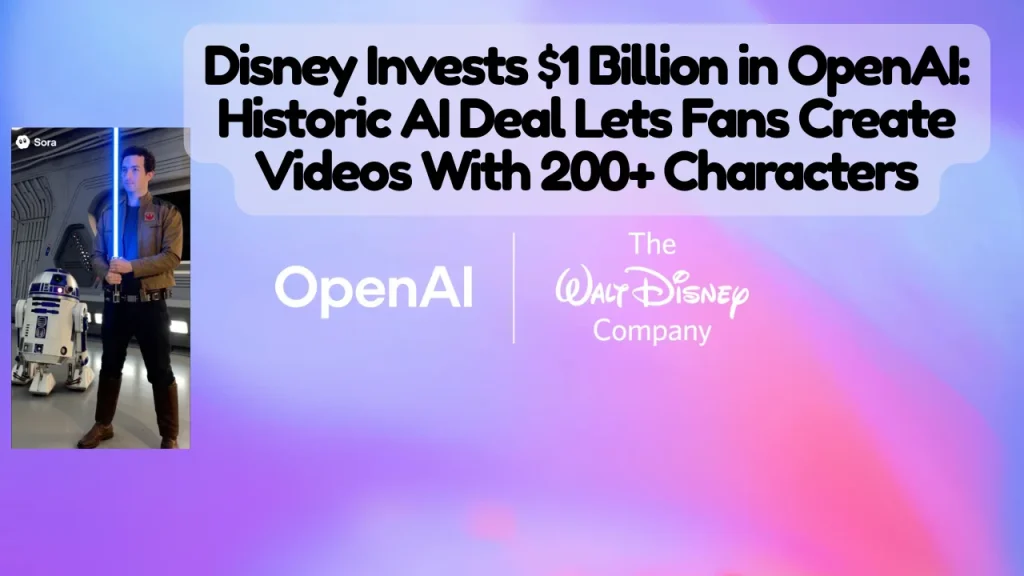
Disney Invests $1 Billion in OpenAI, Historic AI Deal Lets Fans Create Videos With 200+ Characters
BREAKING: December 11, 2025 — Disney announced a $1 billion equity investment in OpenAI today, making it the first major entertainment studio to license its intellectual property to an AI video platform. Starting early 2026, fans can create AI-generated videos featuring 200+ Disney, Marvel, Pixar, and Star Wars characters through OpenAI’s Sora platform. The three-year licensing deal marks a dramatic shift from Disney’s previous lawsuits against AI companies to a groundbreaking partnership that could reshape Hollywood’s relationship with artificial intelligence.
What Just Happened: The Deal Details
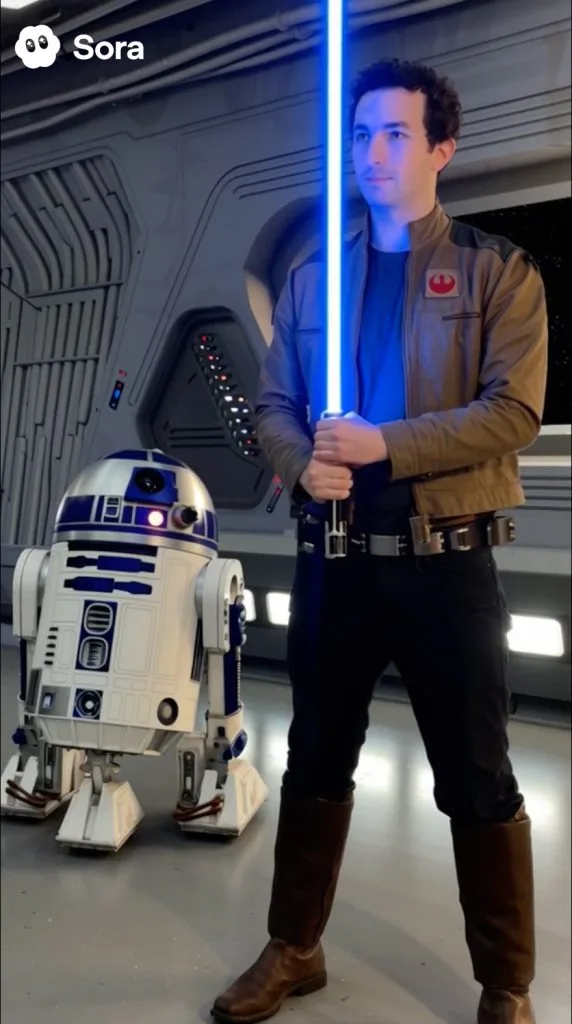
Disney and OpenAI announced this morning that Sora users will be able to generate short videos featuring iconic characters including Mickey Mouse, Darth Vader, Iron Man, Elsa, Buzz Lightyear, and over 200 others.
The agreement includes:
$1 Billion Investment: Disney makes equity investment in OpenAI with warrants to purchase additional equity Three-Year License: OpenAI’s Sora and ChatGPT Images gain access to 200+ animated characters, costumes, props, vehicles, and environments No Talent Likenesses: Agreement excludes actor voices and likenesses—videos can feature Woody without Tom Hanks’ voice Disney+ Integration: Curated Sora-generated videos will stream on Disney+ API Partnership: Disney becomes major OpenAI customer, using APIs to build Disney+ products and deploying ChatGPT for employees
Disney CEO Bob Iger told CNBC this morning: “The rapid advancement of artificial intelligence marks an important moment for our industry, and through this collaboration with OpenAI we will thoughtfully and responsibly extend the reach of our storytelling through generative AI, while respecting and protecting creators and their works.”
Why This Deal Is Unprecedented
This is the first time a major Hollywood studio has licensed IP to an AI video generation platform at this scale.
Six months ago, Disney was suing AI companies. In June 2025, Disney and Universal filed a 110-page lawsuit against Midjourney for copyright infringement, calling the AI company “the quintessential copyright free-rider and a bottomless pit of plagiarism” that threatened to “upend the bedrock incentives of U.S. copyright law.”
Today’s announcement represents a complete strategic reversal. Instead of fighting AI platforms through litigation, Disney has chosen to monetize its IP through licensing while maintaining control over how characters are used.
The timing is critical. OpenAI’s Sora launched in October 2024 with features allowing users to create videos using celebrity likenesses without permission, triggering immediate backlash from Hollywood talent agencies. WME opted out all clients from Sora, CAA called it “misuse” of emerging technology, and UTA termed it “exploitation, not innovation.”
OpenAI walked back those features after the outcry. Now, just weeks later, Disney has signed the industry’s first major licensing deal—validating Sora’s approach while establishing guardrails.
Related Article: Tampax Lead Lawsuit, P&G Faces Multiple Class Actions Over Toxic Metal Contamination in Tampons
What Characters Are Included
The licensed character library includes:
Disney Animation: Mickey Mouse, Minnie Mouse, Lilo, Stitch, Ariel, Belle, Beast, Cinderella, Baymax, Simba, Mufasa, plus characters from Encanto, Frozen, Inside Out, Moana, Monsters Inc., Toy Story, Up, and Zootopia
Marvel: Black Panther, Captain America, Deadpool, Groot, Iron Man, Loki, Thor, Thanos
Star Wars (Lucasfilm): Darth Vader, Han Solo, Luke Skywalker, Leia, The Mandalorian, Stormtroopers, Yoda
Pixar: Full character roster from Toy Story, Finding Nemo, The Incredibles, and other Pixar films
Users will access costumes, props, vehicles, and iconic environments from these franchises. ChatGPT Images will also generate still images using the same IP.
The Business Strategy Behind Disney’s Pivot
Disney’s approach reveals calculated risk management in the AI era.
Monetize Instead of Fight: Rather than watch AI companies potentially profit from unauthorized use of Disney IP, Disney captures licensing revenue while establishing industry standards for AI partnerships.
Control the Narrative: By licensing to OpenAI first, Disney influences how AI-generated content featuring its characters develops. Iger emphasized to CNBC that the deal ensures “OpenAI is putting guardrails essentially around how these are used.”
Exclusive Terms: Iger confirmed “there is exclusivity, basically, at the beginning of the three-year agreement,” giving Disney preferential treatment during Sora’s critical growth phase.
Revenue Diversification: The deal creates a new revenue stream as traditional content production faces disruption from AI tools.
Hollywood Reporter analysis suggests this strategy could transform studios into “IP rights managers” rather than traditional content producers—a shift some see as existential.
What Disney Is Still Fighting: The Google Battle
Even as Disney partners with OpenAI, it’s escalating legal battles elsewhere.
On Wednesday—one day before announcing the OpenAI deal—Disney sent a cease-and-desist letter to Google alleging copyright infringement on a “massive scale.” The letter, viewed by CNBC, accuses Google of using Disney’s copyrighted works to train AI models and distributing protected content without authorization.
Disney stated: “Disney has been raising its concerns with Google for months, but Google has done nothing in response. Google’s mass infringement of Disney’s copyrighted works must stop.”
Disney has also sent similar legal notices to Meta and Character.AI.
The pattern is clear: Disney will partner with AI companies willing to license IP and pay for access, while aggressively pursuing those that use Disney content without permission.
Active Litigation Against AI Companies
Disney’s lawsuits remain ongoing:
Midjourney (June 2025): Disney and Universal sued the AI image generator in Central District of California federal court, alleging Midjourney trained its models on copyrighted Disney and Universal characters. The lawsuit seeks preliminary injunction, damages, and disgorgement of Midjourney’s $300 million 2024 revenue. Case status: Active litigation.
MiniMax/Hailuo AI (September 2025): Disney, Warner Bros. Discovery, and Universal Pictures sued Chinese AI company MiniMax in California federal court for copyright infringement. The complaint alleges MiniMax’s Hailuo AI service markets itself as a “Hollywood studio in your pocket” while generating unauthorized videos of Disney, Warner Bros., and Universal characters. Case status: Active litigation.
Disney’s chief legal officer Horacio Gutierrez (former Microsoft head of IP) stated: “Piracy is piracy, and the fact that it’s done by an AI company does not make it any less infringing.”
How This Affects the Broader AI Copyright Battle
The Disney-OpenAI deal arrives amid escalating legal warfare between content creators and AI companies.
Recent AI Copyright Lawsuits:
- New York Times v. OpenAI and Microsoft (December 2023): Alleges unlawful training on Times journalism. OpenAI called the lawsuit “baseless” and recently appealed court order requiring preservation of ChatGPT output data.
- Reddit v. Anthropic (June 2025): Social media platform sued Claude AI maker for alleged unauthorized scraping
- Thomson Reuters v. Ross Intelligence: Delaware court ruled in February 2025 that copying legal research content to build competing AI platform violated copyright, dealing blow to “fair use” defense
- Getty Images v. Stability AI: Pending in US and UK courts since 2023
- Sony Music Entertainment v. Suno and Udio: Music industry lawsuit against AI song generators
The fundamental question: Can AI companies train models on copyrighted material without permission?
AI companies argue “fair use” doctrine protects training. Content owners argue AI companies are building billion-dollar businesses by stealing copyrighted works.
Disney’s deal with OpenAI suggests a third path: licensing agreements where AI companies pay for access to copyrighted content, and IP owners maintain control over usage.
What the Industry Is Saying
OpenAI’s Position: Sam Altman stated: “This agreement shows how AI companies and creative leaders can work together responsibly to promote innovation that benefits society, respect the importance of creativity, and help works reach vast new audiences.”
Hollywood’s Concerns: Motion Picture Association CEO Charles Rivkin warned: “We remain concerned that copyright infringement, left unchecked, threatens the entire American motion picture industry.”
Impact on Creative Workers: The deal raises concerns for character actors, voice artists, and animators. Euronews notes it signals “a future in which studios can generate whole scenes without the human performers and illustrators who once defined the craft.”
Industry Precedent: Prior to Disney’s move, the largest studio AI partnership was Lionsgate’s September 2024 deal with Runway. Disney’s $1 billion investment dwarfs previous agreements.
Responsible AI Commitments and Guardrails
Disney and OpenAI emphasized safety measures:
Age-Appropriate Policies: OpenAI committed to implementing controls ensuring content is appropriate for all audiences Illegal Content Prevention: Robust controls to prevent generation of illegal or harmful material Creator Rights Protection: Measures to respect content owners’ rights in model outputs Likeness and Voice Controls: Systems to prevent unauthorized use of individuals’ voices and likenesses Evolving Guardrails: Disney can set and modify usage restrictions throughout the three-year agreement
Iger told CNBC: “There’s nothing for us to be concerned about from a consumer perspective” given these protections.
Altman added: “It’s very important that we enable Disney to set and evolve those guardrails over time.”
What This Means for Fans and Creators
For Disney Fans: Starting early 2026, Sora users can create short videos featuring Disney characters in custom scenarios. Imagine prompting Sora to generate: “Darth Vader teaching Elsa how to use the Force” or “Iron Man and Buzz Lightyear racing through space.”
For Content Creators: The deal legitimizes fan-created content using Disney IP within OpenAI’s platforms. Previously, such content risked DMCA takedowns. Now it’s officially licensed.
For Hollywood Workers: The agreement raises existential questions about employment in animation, voice acting, and character performance. If studios can generate content using AI instead of human creators, how does that affect jobs?
For Other Studios: Disney’s deal may pressure competitors to strike similar agreements or risk losing control over how their IP appears in AI-generated content. Altman hinted at pursuing more licensing deals, stating he “won’t rule out anything in the future.”
The Contrarian View: Is Disney Surrendering?
Not everyone sees this as a win for Disney.
Hollywood Reporter’s analysis suggests the deal could represent Disney “turning over the keys to OpenAI and Google” rather than protecting its creative legacy.
If studios become mere IP licensors rather than content producers, “the idea of a studio as we think of it, as it has existed for a century—the idea of a Dream Factory in any meaningful sense of the term—it’s gone.”
The question: Does licensing IP to AI platforms preserve Disney’s business model, or accelerate its obsolescence?
What Happens Next
Early 2026: Sora begins generating Disney-licensed content after final corporate and board approvals Ongoing Litigation: Disney’s lawsuits against Midjourney, MiniMax, and potentially Google continue Industry Response: Other major studios face pressure to announce their AI strategies Regulatory Scrutiny: Congressional and regulatory attention on AI copyright issues likely intensifies Labor Concerns: Creative guilds and unions may respond to implications for human workers
The Disney-OpenAI deal doesn’t resolve the fundamental copyright questions facing AI. It simply chooses one path forward: controlled partnerships over uncontrolled litigation.
Key Legal Questions Still Unanswered
Fair Use Defense: Courts haven’t definitively ruled whether AI training on copyrighted material constitutes fair use. Thomson Reuters v. Ross Intelligence dealt a blow to this defense, but appeals continue.
Scope of Protection: How much control do IP owners have over AI-generated derivative works? Disney’s deal establishes one model, but litigation will test boundaries.
International Jurisdiction: With companies like MiniMax operating from China, enforcement of US copyright law faces practical challenges.
Talent Rights: SAG-AFTRA negotiated a separate deal with OpenAI for Bryan Cranston’s voice and likeness. How do individual talent rights intersect with studio IP licenses?
Bottom Line for US Readers
Disney’s $1 billion OpenAI investment and licensing deal represents the entertainment industry’s first major attempt to monetize AI rather than simply fight it in court.
What’s Certain:
- Disney characters will appear in user-generated AI videos starting 2026
- Disney receives $1 billion equity stake in OpenAI plus licensing revenue
- OpenAI gains legitimacy as Hollywood’s first major AI video licensing partner
- Other AI companies face pressure to license IP rather than scrape it
What’s Uncertain:
- Whether other studios follow Disney’s approach or continue litigation-first strategy
- How this affects employment for animation, voice, and performance workers
- Whether courts ultimately side with fair use defenses or copyright owners
- If AI-generated content will cannibalize demand for traditionally produced entertainment
What to Watch:
- Final corporate approvals and definitive agreements (Q1 2026)
- Disney’s litigation against Google, Midjourney, and MiniMax
- Response from other major studios (Warner Bros., Universal, Paramount, Sony)
- Congressional action on AI copyright legislation
- Creative guild negotiations on AI usage in production
Frequently Asked Questions
Q: When can I create Disney character videos on Sora?
Early 2026, pending final corporate and board approvals. OpenAI and Disney haven’t announced a specific launch date.
Q: How much will it cost to use Disney characters on Sora?
Pricing hasn’t been announced. Sora currently operates on subscription and credit-based models. Disney character access may require premium subscription tiers.
Q: Can I use celebrity voices like Tom Hanks as Woody?
No. The agreement explicitly excludes talent likenesses and voices. Videos can feature characters but not actors’ voices or physical likenesses.
Q: Is Disney dropping its lawsuits against other AI companies?
No. Disney’s active litigation against Midjourney, MiniMax, and cease-and-desist to Google continue. The OpenAI deal doesn’t affect other cases.
Q: Does this mean Disney won’t make original content anymore?
Disney continues producing traditional content. The deal adds AI-generated fan content as a new category, not a replacement for studio productions.
Q: Can I monetize videos I create with Disney characters on Sora?
Usage terms haven’t been fully detailed. Typically, licensed character use restricts commercial monetization. Expect restrictions on selling or licensing Sora-generated Disney content.
Q: Why did Disney partner with OpenAI but sue Midjourney?
OpenAI agreed to license Disney IP and implement guardrails. Midjourney allegedly used Disney characters without permission or compensation. Disney partners with companies that pay for access and fights those that don’t.
Q: What about other Disney properties not mentioned?
The deal covers 200+ characters from Disney Animation, Marvel, Pixar, and Star Wars. Specific character lists will be clarified at launch. Properties like 20th Century Fox and National Geographic weren’t explicitly mentioned.
Q: How does this affect jobs for animators and voice actors?
Long-term impact is unclear. AI-generated content could reduce demand for human creators, or it could expand the market for Disney content overall. Creative guilds will likely negotiate AI usage terms in future contracts.
Q: Is this exclusive to OpenAI or can other platforms license Disney characters?
Iger confirmed initial exclusivity during the three-year agreement, but didn’t specify full terms. Other AI companies may be blocked from similar deals during OpenAI’s exclusivity period.
Sources: OpenAI official announcement, The Walt Disney Company press release, CNBC, CNN Business, TechCrunch, Bloomberg, The Hollywood Reporter, Variety, NBC News, Time, Yahoo Finance, NPR, Euronews, AI and Games, ai fray
About the Author

Sarah Klein, JD, is a licensed attorney and legal content strategist with over 12 years of experience across civil, criminal, family, and regulatory law. At All About Lawyer, she covers a wide range of legal topics — from high-profile lawsuits and courtroom stories to state traffic laws and everyday legal questions — all with a focus on accuracy, clarity, and public understanding.
Her writing blends real legal insight with plain-English explanations, helping readers stay informed and legally aware.
Read more about Sarah