
Admiral Reveals Boat in Double-Tap Strike Was Meeting Vessel Headed to Suriname—What Lawmakers Learned That Changes Everything
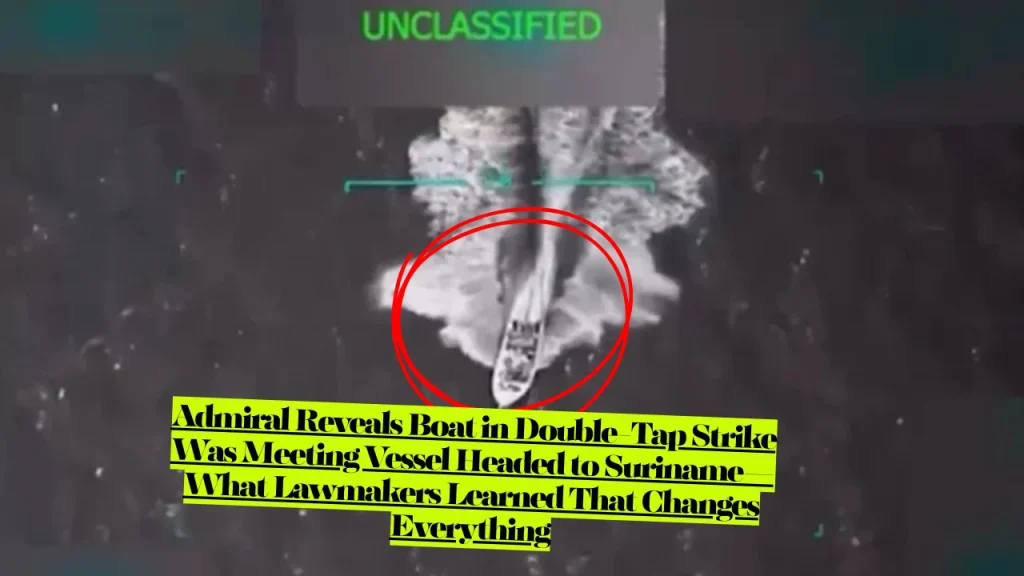
The boat struck by U.S. military forces on September 2, 2025, was planning to rendezvous with a larger vessel bound for Suriname, Admiral Frank Bradley testified to lawmakers on December 5, 2025. The first strike killed nine people and split the boat in half. The military then launched three more strikes—the second killing two survivors clinging to the wreckage, the third and fourth sinking the vessel. This “double-tap” strike has triggered bipartisan congressional investigations into potential war crimes, with the Pentagon’s own Law of War Manual defining killing shipwrecked people as illegal.
What Is the Double-Tap Strike Controversy?
On September 2, 2025, U.S. military forces struck a suspected drug-trafficking boat in international waters near Venezuela. The initial strike killed nine of eleven people aboard and capsized the vessel. Two survivors clung to the wreckage for 41 minutes while military commanders debated what to do. Admiral Frank Bradley, then leading Joint Special Operations Command, ordered a second strike that killed both survivors.
Legal experts argue killing survivors rendered helpless constitutes a war crime under the Pentagon’s Law of War Manual and Geneva Convention. The manual explicitly prohibits killing shipwrecked people “in need of assistance and care” who “must refrain from any hostile act.”
The Boat’s Suriname Connection—Why It Matters
Bradley told lawmakers the struck boat planned to transfer drugs to a second, larger vessel headed to Suriname—a small South American country east of Venezuela. The military was unable to locate this second vessel. Bradley argued drugs could have ultimately reached the U.S. from Suriname, justifying the strike even though the boat wasn’t directly heading to American shores.
This revelation contradicts earlier statements:
- President Trump claimed on September 2 the boat was “heading to the United States.”
- Secretary of State Marco Rubio said the boat was “probably headed to Trinidad or some other country in the Caribbean.”
U.S. drug enforcement officials confirm trafficking routes via Suriname primarily target European markets, not the U.S. U.S.-bound drug routes concentrate on the Pacific Ocean.
Bradley also acknowledged the boat had turned around before being struck because those aboard appeared to see American aircraft.
What Admiral Bradley Told Lawmakers—The Complete Testimony
Admiral Bradley briefed House and Senate Intelligence Committees and Armed Services Committee leadership on December 5, 2025. Here’s what he disclosed:
The Survivors Had No Radio
Bradley acknowledged the two survivors clinging to the capsized boat did not appear to have radio or other communications devices. Defense officials had previously claimed survivors were radioing for backup, justifying them as legitimate targets. Bradley’s testimony contradicts this defense.
The 41-Minute Decision Window
Bradley and the military command center watched the survivors struggle to overturn their boat for 41 minutes before ordering the second strike. Lawmakers viewed zoomed-in, high-definition surveillance video showing both men clinging to the capsized wreckage.
The Strikes—Four Missiles Total
The military used four missiles: two in the initial strike and two in the second strike. The first strike split the boat in half and created a massive smoke plume. The second and third strikes killed the survivors. The fourth sank the vessel.
Were the Survivors Surrendering?
The survivors were waving at something in the air, though it’s unclear whether they were surrendering or asking the aircraft for help. Senator Tom Cotton claimed one survivor removed his T-shirt and appeared to be “sunbathing” and that both were “trying to get the boat back up and to continue their mission.”
Democratic Representative Jim Himes called the video “one of the most troubling things” he’s seen as a lawmaker, stating “Any American who sees the video I saw will see the United States military attacking shipwrecked sailors.”
No “Kill Them All” Order
Bradley told lawmakers Defense Secretary Pete Hegseth did not issue an order to “kill them all” as initially reported. Lawmakers were told Hegseth made clear before the mission the strikes should be lethal but wasn’t aware of survivors until after they were killed.
Bradley understood the mission objective was to kill all eleven individuals and sink the boat, but the order was not specifically to provide “no quarter”—meaning someone who surrenders will be killed, which has “specific implications” and is illegal.
Related Article: Abdimahat Bille Mohamed Convicted Sex Offender Given Probation—Then FBI Charges Him With 8-Year Kidnapping and Rape Spree Involving 15-Year-Old Girl
The Legal Framework—War Crime or Lawful Strike?
Pentagon’s Own Manual Defines This as Illegal
Page 239 of the Department of Defense Law of War Manual states it is “dishonorable and inhumane” to attack people in a “helpless state” due to “wounds, sickness, or shipwreck.” The manual defines “shipwrecked combatants” as no longer valid targets.
The Geneva Convention and Pentagon Law of War Manual include “No quarter” provisions prohibiting “conducting hostilities on the basis that there shall be no survivors.”
What Legal Experts Say
Rachel VanLandingham, former Air Force JAG who advised at U.S. Central Command: “You don’t need a lawyer to know you can’t kill shipwrecked survivors. This is the classic example we use in professional military education of a clearly unlawful order.”
VanLandingham rejected the Pentagon’s backup claim: “The idea that survivors could have called for backup is absolutely irrelevant. Unless they were actively shooting, they remained protected and could not be lawfully targeted.”
Daniel Maurer, retired Army Judge Advocate General: “Killing them while shipwrecked, while they’re hors de combat—while they’re out of the fight—is a war crime.”
Rebecca Ingber, Cardozo Law School professor: “There is no actual armed conflict here, so this is murder.”
The Duty to Disobey Unlawful Orders
The U.S. Manual for Courts-Martial explains the presumption of lawful orders “does not apply to a patently illegal order, such as one that directs the commission of a crime.” Orders to fire upon the shipwrecked would be clearly illegal.
A 1921 case emerging from World War I clearly established killing shipwrecked survivors is a war crime and that superior orders offer no defense, because such orders must be disobeyed.
Who Gave the Orders—Hegseth or Bradley?
Hegseth insisted he learned “a couple of hours later” that Bradley ordered the second strike, adding Bradley “had the complete authority to do.” During a Cabinet meeting, Hegseth said he watched the first strike but left to attend meetings and didn’t learn about the second strike until later, describing it as “fog of war.”
White House Press Secretary Karoline Leavitt confirmed Hegseth authorized Bradley to conduct the second strike: “Admiral Bradley worked well within his authority and the law directing the engagement to ensure the boat was destroyed and the threat to the United States of America was eliminated.”
Critics suggest Hegseth and the White House are “throwing Bradley under the bus.” Democratic Senator remarked: “He is selling out Admiral Bradley and sending chills down the spines of his chain of command, who now know their boss will sell them out if he is taking heat.”
What Happens Next—Congressional Investigations and Timeline
Senate Armed Services Committee Investigation
Senate Armed Services Committee Chairman Roger Wicker (R-Miss.) and ranking member Jack Reed (D-R.I.) announced the committee is conducting “vigorous oversight to determine the facts related to these circumstances.”
The Senate Armed Services Committee has vowed to conduct oversight of what has become the most consequential bipartisan scrutiny of the strikes.
House Armed Services Committee Probe
House Armed Services Committee Chairman Mike Rogers (R-Ala.) and ranking member Adam Smith (D-Wash.) stated the committee is “committed to providing rigorous oversight of the Department of Defense’s military operations in the Caribbean.”
Congressional Demands
Senate Democratic Leader Chuck Schumer demanded immediate release of video tapes from drones and aircraft: “The tapes will show one way or the other what happened and whether Hegseth is telling the truth.”
Democratic Senator Brian Schatz suggested Democrats could use ongoing Defense Authorization Act negotiations as leverage to press for Hegseth’s testimony before the end of December.
Lawmakers Divided on Party Lines
After viewing the video, Republican Representative Rick Crawford said he thought the second strike was justified. Senator Tom Cotton called the strike “entirely lawful and needful,” comparing it to striking terrorist boats off Somalia or Yemen.
Democratic Representatives Jim Himes and Adam Smith stated: “We saw or heard nothing today to convince us that the decision to strike the vessel a second time was justified.”
The Broader Campaign—83 Dead Across 20+ Strikes
The September 2 attack kicked off a broader U.S. operation in which more than 80 people have been killed in strikes on more than 20 boats. Experts have called these attacks illegal under international law.
Survivors of a later strike in October were rescued by the U.S. military and returned to their home countries, in part because it was unclear under what legal authority the military could hold prisoners.
The protocol for future suspected drug boat strikes was altered after the September 2 attack, and the military was instructed to detain any survivors.
Timeline of Events
September 2, 2025
- U.S. military conducts first strike on suspected drug boat in international waters, killing 9 and capsizing vessel
- Two survivors cling to wreckage for 41 minutes while command center debates next steps
- Second, third, and fourth strikes kill survivors and sink boat
September 5, 2025
- Office of Legal Counsel memo issued three days after the attack
November 29-30, 2025
- Washington Post reports Hegseth ordered “kill everybody”
- Senate and House Armed Services Committees announce investigations
December 2, 2025
- White House confirms second strike and says Bradley ordered it
December 4-5, 2025
- Bradley briefs House and Senate Intelligence Committees and Armed Services Committee leadership
- Bradley reveals boat was meeting vessel headed to Suriname
- Bradley confirms survivors had no radio
Implications for Military Accountability
Potential Criminal Liability
International law experts told TIME that if reports are true, Hegseth, Bradley, and others involved may face criminal liability for killing survivors.
Title 18 of the U.S. code covering “war crimes” includes as an example someone who “intentionally kills one or more persons taking no active part in the hostilities, including those placed out of combat by sickness, wounds, detention, or any other cause.”
War crimes are punishable by fine, imprisonment, or death per the U.S. definition, which can apply to U.S. personnel.
Trump’s Legal Shield Attempt
President Trump retroactively announced the U.S. was at war with Designated Terrorist Organizations in the Caribbean, attempting to insulate those responsible from legal consequences. Earlier this year, the Trump administration formally labeled Venezuelan gang Tren de Aragua a terrorist group.
Military Leadership Changes
Admiral Brad Holsey, who commanded U.S. Southern Command overseeing the Caribbean operations, was pushed out after expressing concerns about the legality of the strikes. Holsey is the only commander dismissed during the current military operation in Central America.
Todd Robinson, former assistant secretary for international narcotics and law enforcement: “Having Holsey leave at this particular moment, at the height of what the Pentagon considers to be the central action in our hemisphere, is just shocking.”
What This Means for Similar Cases
The double-tap strike controversy sets critical precedents:
For Military Operations: Future suspected drug boat strikes now require detention of survivors rather than killing them. The September 2 incident forced protocol changes across all subsequent operations.
For Congressional Oversight: The investigations provide a rare moment of Congress asserting authority to conduct oversight of the Trump administration. Both Republican and Democratic committee leadership are demanding accountability.
For International Law: Legal experts warn that disregarding protections for shipwrecked persons would “blow a huge hole” in international humanitarian law. If survivors lose protection by calling for help, the entire framework collapses.
For Chain of Command: The presence of a military attorney during operations doesn’t change underlying legal standards—shipwrecked personnel remain protected unless they take clear steps to rejoin the fight.
Frequently Asked Questions
Q: Is the double-tap strike a war crime?
The Pentagon’s Law of War Manual explicitly states killing shipwrecked people “in need of assistance and care” who “must refrain from any hostile act” is prohibited and considered a war crime. Legal experts call it a “textbook war crime” and “the classic example used in professional military education of a clearly unlawful order.”
Q: Why does the Suriname destination matter?
Drug enforcement officials confirm Suriname routes primarily target European markets, not the U.S. This contradicts the Trump administration’s claim the boat posed an imminent threat to America, undermining the legal justification for the strikes.
Q: Did the survivors have weapons or communications?
Admiral Bradley confirmed the survivors had no radio or other communications devices. Representative Himes stated they were “without any weaponry, without any tools of any kind, clinging to a wrecked boat.”
Q: Who is Admiral Frank Bradley?
Bradley is a 1991 Naval Academy graduate who commanded Joint Special Operations Command, Special Operations Command Central, and SEAL Team Six. He now leads U.S. Special Operations Command and has spent most of his 30-year career in special operations, including counternarcotics missions across South and Central America.
Q: What is the investigation timeline?
Congressional committees have launched inquiries but haven’t announced specific hearing dates. Democrats are pushing for Hegseth’s testimony before the end of December, potentially using Defense Authorization Act negotiations as leverage. Senate Democratic Leader Schumer is demanding immediate release of strike videos.
Q: Could Hegseth or Bradley face prosecution?
Legal experts told TIME both may face criminal liability if reports are accurate. However, long-standing law establishes that carrying out manifestly unlawful orders to kill shipwrecked survivors cannot rely on a superior orders defense if prosecuted. Trump’s retroactive declaration of armed conflict with terrorist organizations attempts to provide legal cover, but experts question its validity.
Q: How many people have been killed in these operations?
More than 80 people have been killed in strikes on more than 20 boats since September 2. At least 87 people have been killed as of December 2025.
Need Legal Guidance on Military Accountability or International Law? The double-tap strike controversy reveals critical gaps in how military operations are conducted and overseen. Understanding protections under the Law of War Manual, Geneva Conventions, and domestic criminal statutes is essential for military personnel, defense contractors, and anyone involved in international operations. Consult qualified legal counsel specializing in military justice and international humanitarian law.
This article is for informational purposes only and does not constitute legal advice. All information is based on verified news reports and official congressional testimony as of December 6, 2025.
About the Author

Sarah Klein, JD, is a licensed attorney and legal content strategist with over 12 years of experience across civil, criminal, family, and regulatory law. At All About Lawyer, she covers a wide range of legal topics — from high-profile lawsuits and courtroom stories to state traffic laws and everyday legal questions — all with a focus on accuracy, clarity, and public understanding.
Her writing blends real legal insight with plain-English explanations, helping readers stay informed and legally aware.
Read more about Sarah