
DoorDash Driver Lawsuit Update 2025, Olivia Henderson Charged After Posting Naked Customer Video on TikTok
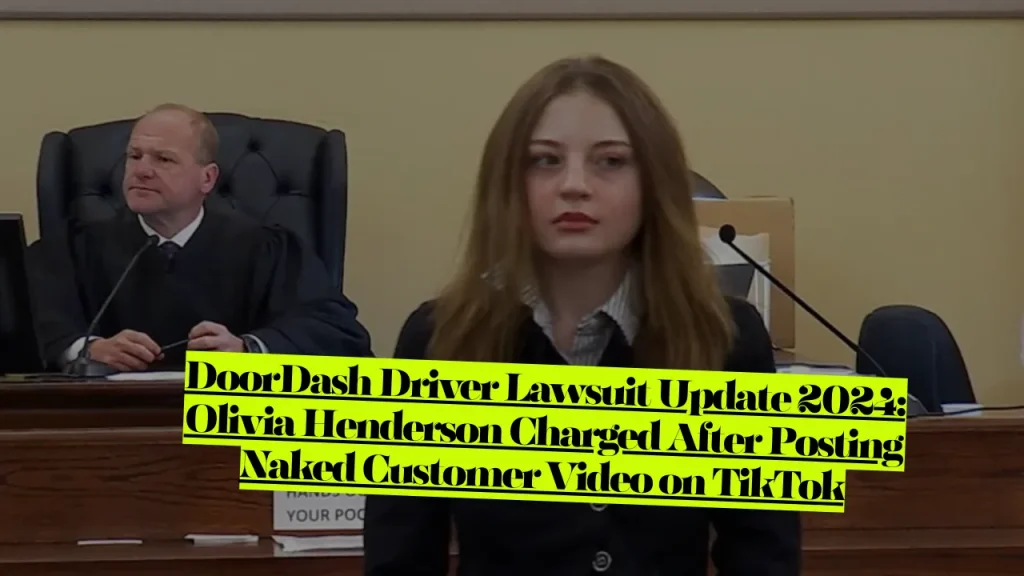
DoorDash driver Olivia Henderson appeared in Oswego City Court on December 4, 2025, facing two felony charges after allegedly recording and posting a video of a naked customer on TikTok. The 23-year-old from Oswego, New York, is charged with second-degree unlawful surveillance and first-degree dissemination of an unlawful surveillance image—both Class E felonies carrying up to 4 years in prison.
Henderson initially claimed sexual assault on TikTok and filed a police report, but a month-long investigation found no evidence supporting her allegations. Instead, police determined she violated New York’s privacy laws by recording and distributing footage of an unconscious customer in his home.
Latest Update: What Happened in Court on December 4, 2025?
Henderson appeared for formal charging at Oswego City Court on Thursday morning, December 4, 2025. She had no comment outside the courthouse when asked about the charges.
Her attorney, Senior Assistant Public Defender David Smallwood, issued a statement acknowledging the viral nature of the case has generated harassment against Henderson. He asked for calm and emphasized their office takes defending accused individuals seriously.
Henderson was previously arrested on November 14, 2025, processed, and released with an appearance ticket. She is represented by the Oswego County Public Defender’s Office.
What Is the DoorDash Driver Lawsuit About?
This is a criminal prosecution, not a civil lawsuit. The incident occurred on October 12, 2025, when Henderson delivered food to a customer’s residence in Oswego, New York. Police say the male customer was incapacitated and unconscious on his couch due to alcohol consumption.
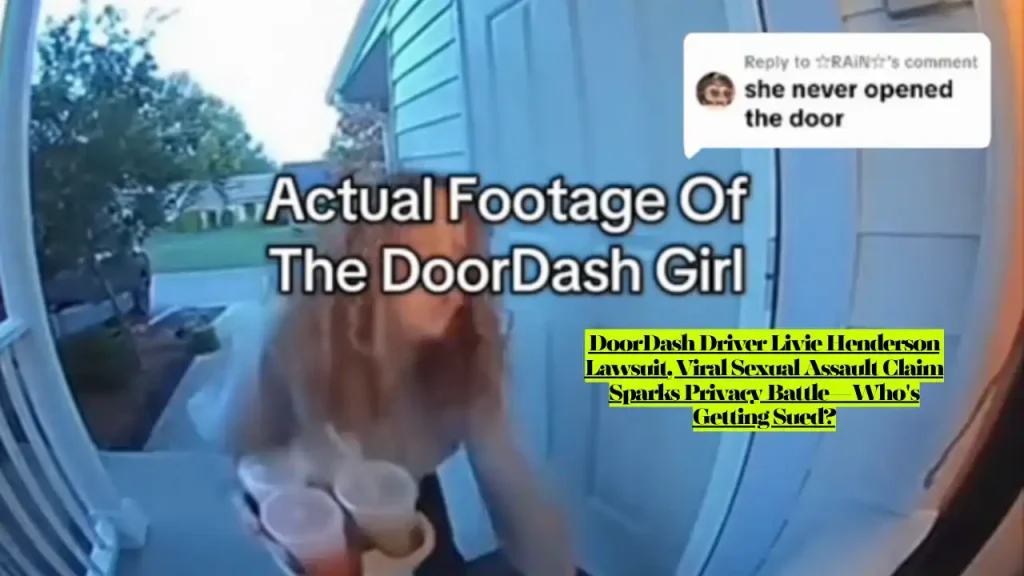
Henderson recorded video showing the man lying naked on his couch, apparently captured from outside the home’s glass door. She then posted the footage to TikTok, where it quickly gained widespread attention and was viewed by thousands.
The next day, on October 12, Henderson reported sexual assault allegations to the Oswego Police Department. However, investigators conducted a month-long investigation and found no evidence to support her claims.
Ring Camera Footage Contradicts Sexual Assault Claims
Ring camera footage from the residence reportedly showed Henderson letting herself into the home, contradicting her claim that she was lured inside. Police stated the man gave no indication for her to enter the residence.
The victim has been cooperating with police throughout the investigation.
Related Article: Boka Toothpaste Lawsuit Reality, Advertising Challenge, NARB Upholds Ruling Against Remineralization and Whitening Claims
Who Are the Parties Involved?
Defendant:
- Olivia Henderson (also known as “Liv” or “Livvie”), 23 years old, Oswego, New York
- Former DoorDash driver (account deactivated)
- TikTok content creator with username “irlmonsterhighdoll”
- Represented by Oswego County Public Defender’s Office (Senior Assistant Public Defender David Smallwood)
Victim:
- Male customer from Oswego (name withheld)
- Cooperating with police investigation
Prosecuting Authority:
- Oswego Police Department (investigating agency)
- Oswego County District Attorney’s Office (prosecution)
- Captain Bryan Thompson (Oswego City Police spokesperson)
Corporate Entity:
- DoorDash (terminated Henderson’s account; deactivated customer’s account during investigation)
What Are the Specific Criminal Charges?
Henderson faces two felony charges under New York Penal Law:
1. Unlawful Surveillance in the Second Degree (NY Penal Law § 250.45)
- Class E felony
- Maximum sentence: 1⅓ to 4 years in prison
- Potential sex offender registration depending on specific subsection
2. Dissemination of an Unlawful Surveillance Image in the First Degree (NY Penal Law § 250.60)
- Class E felony
- Maximum sentence: 1⅓ to 4 years in prison
- Does NOT require sex offender registration
- Applies when someone knowingly publishes or sells images obtained through unlawful surveillance
Court documents accuse Henderson of “degrading” the victim by recording “intimate parts of such person at a place and time when such person has a reasonable expectation of privacy, without such person’s knowledge or consent”.
If convicted on both charges, Henderson could face a combined maximum sentence of 8 years in prison, though sentences could run concurrently.
Legal Framework: New York Unlawful Surveillance Laws
Understanding NY Penal Law § 250.45
New York’s unlawful surveillance statute prohibits intentionally using or installing an imaging device to surreptitiously view, broadcast, or record a person’s sexual or intimate parts when they have a reasonable expectation of privacy, without their knowledge or consent.
The law covers five specific scenarios, but Henderson’s charges appear to fall under subsection 5: recording for purposes of degrading or abusing a person.
Key Elements Prosecutors Must Prove:
- Intentional conduct: Henderson deliberately recorded the video
- Use of imaging device: Recording was made with a camera (smartphone)
- Surreptitious recording: The victim did not know he was being recorded
- Intimate parts visible: The victim was naked from the waist down
- Reasonable expectation of privacy: The victim was inside his own home
- No consent: The victim did not authorize the recording
- Degrading purpose: Henderson posted the video publicly, exposing the victim to ridicule
Reasonable Expectation of Privacy
Under New York law, individuals have a reasonable expectation of privacy in locations such as bedrooms, bathrooms, private residences, and other spaces where intimate activities occur. A person’s home—particularly when they are in a state of undress—represents one of the clearest examples of where privacy expectations exist.
Even though Henderson allegedly recorded from outside through a glass door, the victim was inside his private residence during a vulnerable moment, which satisfies the privacy requirement.
Dissemination Charges: Publishing Unlawful Surveillance Images
NY Penal Law § 250.60 Explained
The dissemination charge is separate from the surveillance charge. A person commits dissemination of an unlawful surveillance image in the first degree when they knowingly sell or publish images of sexual or intimate parts obtained through unlawful conduct.
Henderson faces this additional charge because she allegedly:
- Created the surveillance image herself (satisfying the unlawful surveillance element)
- Intentionally disseminated the image by posting it on TikTok
- Made the image available to thousands of viewers publicly
The dissemination charge recognizes that sharing unlawful surveillance footage causes additional harm beyond the initial privacy violation—it amplifies the victim’s humiliation and makes the invasion permanent and widespread.
Potential Penalties and Sentencing Guidelines
Class E Felony Sentencing in New York
For Class E felonies like unlawful surveillance in the second degree, possible sentences include up to 1⅓ to 4 years in prison for a first-time felony offender.
However, judges have discretion to impose alternatives:
Possible Sentences:
- State prison (1⅓ to 4 years indeterminate sentence)
- Split sentence (up to 6 months jail, remainder on probation)
- Probation (typically 5 years for felonies)
- Conditional discharge (with court-imposed conditions)
- Unconditional discharge (rare for felonies)
Additional Consequences:
- Fines up to $5,000 per charge
- Restitution to the victim
- Permanent felony criminal record
- Loss of voting rights while incarcerated
- Immigration consequences for non-citizens
- Difficulty obtaining employment
- Professional license restrictions
- Potential sex offender registration (depending on specific findings)
Sex Offender Registration Requirements
Some unlawful surveillance charges trigger mandatory Sex Offender Registration Act (SORA) requirements, but dissemination of unlawful surveillance images in the first or second degree does NOT require SORA registration.
For the unlawful surveillance charge, SORA registration depends on which specific subsection Henderson is convicted under. If convicted under subsection 5 (recording for purposes of degradation), registration is typically required.
SORA registration imposes lifelong requirements:
- Registering current address with law enforcement
- Updating registration upon address changes
- Periodic verification of information
- Public listing on sex offender registry (for higher-risk offenders)
- Restrictions on living near schools or parks
- Notification requirements when traveling
Failure to comply with SORA requirements constitutes a separate felony offense.
DoorDash’s Response and Policy Violations
DoorDash issued a statement on TikTok on October 16, 2025, confirming Henderson’s Dasher account was deactivated along with the customer’s account during the investigation.
The company’s statement emphasized: “Posting a video of a customer in their home and disclosing their personal details publicly is a clear violation of our policies”.
DoorDash Independent Contractor Agreement Violations
Henderson’s actions violated multiple DoorDash policies:
- Privacy expectations: Dashers must respect customer privacy
- Professional conduct: Dashers represent the platform and must maintain professionalism
- Customer information protection: Sharing customer details (including location, appearance) is prohibited
- Harassment and discrimination: Creating hostile or degrading content about customers violates community standards
DoorDash’s termination was based on policy violations, not the criminal charges. The platform acted before Henderson was formally charged, demonstrating companies can independently enforce conduct standards for contractors.
Legal Defenses and Strategic Considerations
Potential Defense Arguments
Henderson’s attorney may pursue several defense strategies:
- No Expectation of Privacy: Argue the customer was visible through an open or glass door from a public approach, negating privacy expectations
- Counter: Courts generally find individuals have privacy inside their homes regardless of visibility from outside
- No Sexual/Intimate Content: Claim the video did not clearly show intimate body parts
- Counter: Court documents specify intimate parts were visible
- Legitimate Purpose: Assert Henderson recorded for safety documentation after feeling threatened
- Counter: Posting publicly on TikTok undermines safety justification
- First Amendment Protection: Argue posting was protected speech documenting alleged misconduct
- Counter: New York privacy laws create exceptions to First Amendment for unlawful surveillance
- Self-Defense/Sexual Harassment Documentation: Claim Henderson recorded evidence of sexual harassment
- Counter: Police investigation found no evidence supporting harassment claims; Ring footage contradicts her version
- Consent/Open Door: Argue implied consent because door was allegedly open
- Counter: Unconscious persons cannot consent; no evidence door was fully open
Procedural Challenges
Defense counsel may also challenge:
- Sufficiency of evidence: Demand prosecution prove each element beyond reasonable doubt
- Chain of custody: Ensure TikTok video evidence was properly preserved and authenticated
- Miranda violations: If Henderson made inculpatory statements, challenge admissibility
- Probable cause: Challenge the lawfulness of the arrest and search warrants
Precedent Cases: Similar Unlawful Surveillance Prosecutions
People v. Lema (New York Appellate Court)
Courts have held that unlawful surveillance charges do not require actual successful recording—attempting to record intimate parts is sufficient for prosecution. The statutory language “to surreptitiously view, broadcast or record” includes attempts, not just completed acts.
This precedent means Henderson could have been charged even if the video failed to record or was deleted before posting.
Upskirt Photography Prosecutions
New York courts have consistently upheld unlawful surveillance convictions for individuals who photograph or record under clothing without consent. These cases establish that:
- Recording intimate areas without consent violates privacy rights
- Public posting amplifies the harm and justifies enhanced charges
- Claiming photography “accidents” or artistic purposes are rejected as defenses
Revenge Porn Overlap
While Henderson’s charges are unlawful surveillance, her conduct overlaps with “revenge porn” statutes in other jurisdictions. New York’s dissemination statute functions similarly—criminalizing the sharing of intimate images without consent, regardless of how obtained.
What This Means for Gig Economy Workers
Contractor Status Doesn’t Limit Criminal Liability
Henderson’s status as an independent contractor rather than DoorDash employee is irrelevant to criminal prosecution. Gig workers remain subject to all criminal laws, including privacy statutes.
Platform Policies vs. Criminal Law
Violating platform policies (like DoorDash’s customer privacy rules) can result in termination. But recording customers in private settings crosses into criminal territory that platforms cannot authorize or protect against.
Safety Concerns for Gig Workers
Police offered safety tips for DoorDash drivers, advising them to avoid entering residences whenever possible and to keep personal information private.
Gig workers facing genuine safety concerns should:
- Contact 911 immediately if threatened
- Report safety concerns through platform support
- Document incidents through proper channels (police reports, platform incident reports)
- Avoid taking matters into their own hands through recordings that violate privacy laws
Social Media and Viral Content Risks
Captain Bryan Thompson of Oswego Police emphasized: “When you put something out there, there’s no taking it back typically”.
This case demonstrates that posting “viral content” for attention can result in serious criminal consequences. The temporary social media fame Henderson gained was immediately followed by:
- Termination from DoorDash
- Criminal charges
- Public scrutiny and harassment
- Potential felony convictions and prison time
Privacy Rights in the Digital Age
Balancing Documentation and Privacy
The case highlights tensions between documenting potential misconduct and respecting privacy rights. While smartphone cameras enable people to capture evidence of wrongdoing, recording without consent in private spaces remains illegal.
When Recording Is and Isn’t Legal
Generally permissible:
- Recording in public spaces where no privacy expectation exists
- Recording with all parties’ consent
- Recording police during official duties in public
- Security cameras in one’s own home with notice to visitors
Generally prohibited:
- Recording in bathrooms, bedrooms, changing rooms without consent
- Recording intimate body parts without consent
- Upskirt/downblouse photography
- Recording through windows into private residences
- Posting recordings that violate privacy laws
Impact on the Victim
While much attention focused on Henderson’s criminal charges, the case involves real harm to the victim:
Privacy Invasion: The victim’s most vulnerable moment was captured and shared with thousands
Ongoing Harm: The video may circulate indefinitely despite removal from Henderson’s account
Public Humiliation: The victim’s identity and location were disclosed, exposing him to ridicule
Emotional Distress: Being filmed unconscious and naked represents severe psychological harm
Victims’ Rights Under New York Law
Victims of unlawful surveillance have legal rights including the ability to seek orders of protection, pursue civil damages for emotional distress and invasion of privacy, and receive victim advocate services.
The victim may pursue a separate civil lawsuit against Henderson for:
- Invasion of privacy (intrusion upon seclusion)
- Public disclosure of private facts
- Intentional infliction of emotional distress
- Negligent infliction of emotional distress
Civil damages could include compensatory damages for emotional harm, punitive damages to punish outrageous conduct, and attorney fees.
What Happens Next: Court Process and Timeline
Felony Case Procedures
Henderson’s case will proceed through several stages:
1. Formal Charging (Completed December 4, 2025) Henderson was formally charged at her court appearance.
2. Preliminary Hearing or Grand Jury Prosecutors must establish probable cause through either:
- Preliminary hearing before a judge
- Grand jury indictment (more common for felonies)
3. Arraignment on Indictment If indicted, Henderson will be arraigned on the indictment and enter a plea.
4. Pre-Trial Motions Defense counsel will file motions challenging evidence, seeking dismissal, or requesting discovery.
5. Plea Negotiations Prosecutors and defense counsel will negotiate potential plea agreements.
6. Trial or Plea The case resolves through either guilty plea or trial by jury.
7. Sentencing If convicted, the judge imposes sentence after considering pre-sentence reports and arguments.
Realistic Timeline
Most felony cases in New York resolve within 6-12 months. Given the viral nature and public attention, both sides may push for faster resolution.
Settlement Possibilities
Prosecutors may offer plea deals such as:
- Reducing charges to misdemeanors
- Dismissing one charge in exchange for guilty plea on the other
- Recommending probation instead of prison
- Offering conditional discharge with community service
Henderson must weigh trial risks (potential maximum sentences) against plea certainty (known lesser sentences).
Broader Implications for Social Media and Privacy Law
The Viral Content Trap
Henderson’s case exemplifies how pursuit of social media attention can backfire catastrophically. What began as an attempt to gain TikTok followers and sympathy ended with felony charges.
This case may deter others from posting privacy-violating content, but it also raises questions about how platforms moderate such content and whether they share liability for facilitating privacy violations.
Platform Responsibilities
TikTok removed Henderson’s video after it went viral, but only after thousands viewed it. Should platforms bear responsibility for screening content that violates privacy laws before it spreads?
Current Section 230 protections shield platforms from liability for user-generated content, but lawmakers increasingly question whether platforms should face consequences for hosting and amplifying illegal content.
False Accusations and #MeToo Era
Henderson’s false sexual assault allegations complicate discussions about believing victims. Her case may be weaponized by those seeking to discredit legitimate #MeToo complaints.
However, false allegations remain rare, and this case should not undermine support for genuine victims. Police investigated thoroughly and found evidence (Ring camera footage) contradicting Henderson’s claims before filing charges.
Frequently Asked Questions
What is the latest update in the DoorDash driver case?
Olivia Henderson appeared in Oswego City Court on December 4, 2025, for formal charging on two felony counts: unlawful surveillance in the second degree and dissemination of an unlawful surveillance image in the first degree. She had no comment outside court, and her attorney asked for calm given the harassment she’s received due to the case’s viral nature.
What happened in the DoorDash incident?
On October 12, 2025, Henderson delivered food to a customer’s home in Oswego, New York, and recorded video of the male customer who was unconscious and naked on his couch. She posted the video on TikTok claiming sexual assault, but police found no evidence supporting her allegations after a month-long investigation.
What charges does Olivia Henderson face?
Henderson faces two Class E felonies: unlawful surveillance in the second degree (NY Penal Law § 250.45) and dissemination of an unlawful surveillance image in the first degree (NY Penal Law § 250.60). Each charge carries up to 4 years in prison, for a potential maximum of 8 years combined.
Will Olivia Henderson have to register as a sex offender?
The dissemination charge does NOT require sex offender registration. The unlawful surveillance charge may require registration depending on which specific subsection she’s convicted under. If convicted under subsection 5 (recording for degradation purposes), registration would likely be required.
What did DoorDash do in response?
DoorDash deactivated Henderson’s Dasher account along with the customer’s account while investigating, stating that posting a video of a customer in their home and disclosing personal details publicly is a clear violation of their policies.
Can the victim sue Olivia Henderson?
Yes. The victim can file a separate civil lawsuit against Henderson for invasion of privacy, public disclosure of private facts, and intentional infliction of emotional distress. He could seek compensatory damages for emotional harm and punitive damages.
What evidence contradicts Henderson’s sexual assault claim?
Ring camera footage from the residence reportedly showed Henderson letting herself into the home, contradicting her claim that she was lured inside. Police stated the unconscious man gave no indication for her to enter.
What are Henderson’s potential defenses?
Defense strategies may include arguing no reasonable expectation of privacy (if door was open), challenging whether intimate parts were clearly visible, claiming she recorded for safety documentation, or asserting First Amendment protections. However, police evidence and court documents appear to contradict most of these defenses.
What does this mean for other gig workers?
Gig workers remain subject to all criminal laws including privacy statutes. Violating platform policies results in termination, but recording customers in private settings crosses into criminal territory. Workers facing safety concerns should contact police rather than taking recordings that may violate privacy laws.
When is Henderson’s next court date?
The case is ongoing following her December 4, 2025 formal charging. The next steps will likely include preliminary hearings or grand jury proceedings, followed by arraignment on any indictment. Most felony cases resolve within 6-12 months.
This article is for informational purposes only and does not constitute legal advice. Laws vary by jurisdiction. If you are facing criminal charges or believe your privacy rights have been violated, consult a qualified criminal defense attorney or privacy law specialist. Information is current as of December 5, 2025
About the Author

Sarah Klein, JD, is a licensed attorney and legal content strategist with over 12 years of experience across civil, criminal, family, and regulatory law. At All About Lawyer, she covers a wide range of legal topics — from high-profile lawsuits and courtroom stories to state traffic laws and everyday legal questions — all with a focus on accuracy, clarity, and public understanding.
Her writing blends real legal insight with plain-English explanations, helping readers stay informed and legally aware.
Read more about Sarah
how come that nobody saw this or corrected it??
ALL of the dates in this article are wrong,
they all say 2024 while it supposed to be 2025
every date in this article including the banner on the first picture is inaccurate
Thanks for pointing Out, Fix them ASAP