
Are Drivers License Checkpoints Legal? Your Constitutional Rights and What Courts Say
Are Drivers License Checkpoints Legal?
Yes, drivers license checkpoints are legal under federal law when properly conducted. The Supreme Court ruled in Michigan v. Sitz (1990) that checkpoint stops don’t violate the Fourth Amendment if they serve highway safety purposes and minimize intrusion on drivers. However, 12 states prohibit checkpoints under state law or constitutional protections, while 38 states plus Washington D.C. permit them with strict requirements.
The constitutional validity of checkpoints hinges on Fourth Amendment protections against unreasonable searches and seizures. Courts scrutinize checkpoint location, timing, officer discretion limits, and adherence to standardized procedures to ensure constitutional compliance.
Supreme Court Ruling: Michigan v. Sitz (1990)
The landmark 1990 case established checkpoint legality nationwide. During Michigan’s pilot checkpoint operation, 126 vehicles passed through with an average delay of 25 seconds, resulting in two DUI arrests. The Supreme Court ruled 6-3 that this minimal intrusion balanced against the state’s interest in preventing drunk driving satisfied Fourth Amendment requirements.
Chief Justice Rehnquist’s majority opinion applied a balancing test weighing the state’s interest in preventing accidents, checkpoint effectiveness in achieving that goal, and the level of privacy intrusion. The Court found the brief stops substantially less intrusive than arrests, making warrantless stops permissible under specific conditions.
Notably, Michigan’s Supreme Court later ruled that checkpoints violate the Michigan Constitution, demonstrating how state constitutions can provide greater protections than federal law. Michigan prohibits checkpoints today despite the federal Supreme Court approval.
What Laws Govern Checkpoint Operations?
Federal Constitutional Framework
The Fourth Amendment requires checkpoints to present minimal intrusion, operate according to plans limiting officer discretion, and aim at curbing specific safety problems like impaired driving.
In City of Indianapolis v. Edmond (2000), the Supreme Court ruled 6-3 that checkpoints with primary purposes of general crime control violate the Fourth Amendment. The Court distinguished permissible checkpoints serving border security and highway safety from impermissible “fishing expeditions” for ordinary criminal violations.
The Edmond decision noted that checkpoints verifying drivers’ licenses and vehicle registrations would be permissible because they serve highway safety rather than general crime control.
State-Specific Regulations
States like North Carolina have enacted detailed statutory requirements. North Carolina General Statute 20-16.3A mandates written policies, predetermined vehicle stopping patterns, visible law enforcement presence with blue lights, and prohibits individual officer discretion in selecting vehicles.
State-authorized practices typically include background checks, warrant searches, license inspections, and field sobriety tests. Officers must operate within defined checkpoint scope and authority—requiring vehicle searches without probable cause generally exceeds lawful checkpoint authority.
Related Lawsuit: Progressive Class Action Lawsuits, $159 Million in Settlements, Eligibility, Deadlines and How to File Claims

12 States Where Checkpoints Are Prohibited
These states prohibit DUI and drivers license checkpoints through state law or constitutional interpretations:
- Alaska – Not used
- Idaho – Deemed illegal through case law
- Iowa – Deemed illegal through case law
- Michigan – State constitution prohibition
- Minnesota – State constitution violation
- Montana – Not used (uses saturation patrols instead)
- Oregon – State constitution prohibition
- Rhode Island – State constitution prohibition
- Texas – Prohibited based on U.S. Constitutional interpretation
- Washington – State constitution prohibition
- Wisconsin – State statute prohibition
- Wyoming – State statute prohibition
New Hampshire and South Carolina permit checkpoints only with judicial approval, particularly for high-risk periods like holiday weekends.
Your Constitutional Rights at Checkpoints
Fourth Amendment Protections
At legal checkpoints, officers cannot exercise individual discretion to determine which vehicles to stop. Stops must be brief unless officers develop reasonable suspicion of criminal activity. Officers can ask for license and registration or engage in conversation to observe impairment signs, and may investigate further if they observe contraband in plain view.
Fourth Amendment protections mean police generally need probable cause or a warrant to search your vehicle. Unless exceptions apply—such as illegal items in plain sight—you can politely decline a search request.
Fifth Amendment: Right Against Self-Incrimination
You are not legally required to answer potentially incriminating questions at checkpoints. While you must provide driver’s license, registration, and insurance proof, the Fifth Amendment protects you from self-incrimination, meaning you can decline to answer questions about your activities or sobriety status.
You must provide basic identification information—name, address, license, insurance, and registration. Refusing this information creates separate legal problems. However, you can answer officer questions with short, direct responses without providing more information than requested.
What You Can Legally Refuse
Refusing field sobriety tests isn’t illegal, but if officers have probable cause to arrest you for DUI, refusing chemical tests (blood alcohol or drug testing) triggers penalties under implied consent laws—including automatic license suspension.
Field sobriety tests like walking straight lines are voluntary in many states. While you can refuse, doing so may result in legal consequences including arrest or license suspension.
Types of Legal Checkpoints
DUI/Sobriety Checkpoints
Thirty-eight states utilize sobriety checkpoints—temporary roadblocks where officers screen motorists for drunk driving offenses. States permitting checkpoints ground their legal basis in federal and state constitutions, with some states like Hawaii and North Carolina enacting explicit statutory authorization.
Drivers License and Registration Checkpoints
Several state courts have upheld checkpoints specifically for verifying drivers’ licenses, including State v. Mitchell (North Carolina 2004) and State v. Orr (Ohio 2001). These checkpoints rest on highway safety purposes rather than general crime control.
Border Checkpoints
United States v. Martinez-Fuerte (1976) established that Border Patrol can operate permanent checkpoints on highways near borders without individualized suspicion. The Court ruled 7-2 that these checkpoints don’t violate the Fourth Amendment because the border security interest outweighs minimal intrusion.
What Law Enforcement Can and Cannot Do
Permissible Actions
Officers at valid checkpoints may conduct background checks, warrant searches, and license inspections. They can perform basic field sobriety tests on motorists displaying impairment signs. If officers determine someone is driving under the influence, they can arrest the driver and impound the vehicle.
Officers can question you without providing Miranda warnings at checkpoints, similar to regular traffic stops. If officers see contraband in plain view in your vehicle, they can search without a warrant.
Prohibited Practices
Checkpoints primarily serving general crime control purposes are unconstitutional. The Supreme Court emphasized that allowing dual-purpose justifications would permit authorities to construct roadblocks for virtually any law enforcement purpose, undermining Fourth Amendment protections.
Once you enter a checkpoint perimeter—visible when you observe checkpoint signage—officers can pull you over if you turn around or drive away. North Carolina’s Supreme Court has upheld such stops as constitutional.
Requirements for Legal Checkpoints
Supervisory Planning and Oversight
State authorities must call for checkpoints with logical reasons regarding location necessity. Supervising law enforcement officials must select checkpoint locations and procedures—individual officers cannot simply decide to block public roads for screening.
Kentucky’s Commonwealth v. Cox (2015) demonstrates the importance of proper procedures. The Kentucky Supreme Court ruled a checkpoint illegal when state police failed to provide adequate advance notice, posted no warning signs, provided no media announcement, and operated without emergency lights despite uniformed presence.
Public Notice Requirements
Checkpoints must be advertised before operation so the public has prior notice of timing and location. This advance publicity serves both fairness and deterrence purposes.
Neutral Selection Formula
Drivers must be selected for screening according to neutral formulas. Officers cannot simply stop any driver at checkpoints. Instead, drivers must exhibit specific behaviors from predetermined indicator lists—swerving, speeding, appearing intoxicated, slurred speech, or alcohol odor.
Patterns must be designated in advance for both stopping vehicles and requesting documents. Officers cannot exercise individual discretion over which vehicles to stop or which drivers to question for license and registration.
Safety Measures and Identification
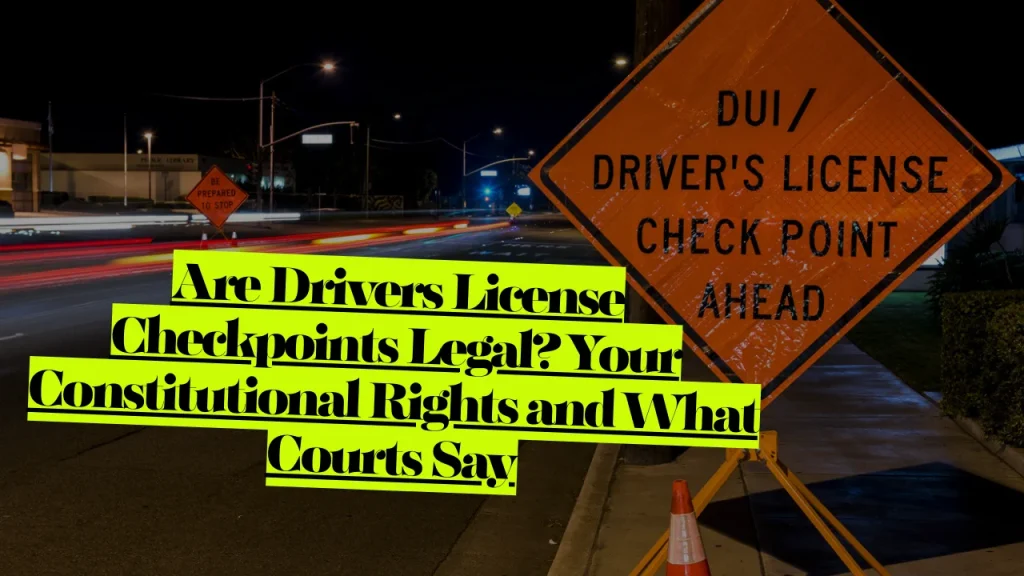
Officers must utilize sufficient safety precautions including adequate lighting, warning signs, and clearly identifiable police vehicles. Checkpoints must be clearly associated with police authority—not speed traps or covert operations. Clear identification ensures motorists recognize legitimate government operations.
Reasonable Duration
Checkpoints face reasonable time limitations. Police cannot conduct never-ending checkpoints. Duration must reflect good law enforcement judgment given the stated checkpoint reasons.
Recent Court Developments and Rulings
2024 Federal Border Checkpoint Litigation
Federal courts continue examining Customs and Border Protection checkpoint practices. A 2021 district court decision allowed an ACLU lawsuit challenging CBP’s New Hampshire checkpoints to proceed, rejecting dismissal arguments. The court noted checkpoints conducted for general crime control and drug interdiction purposes exceed CBP authority and violate Fourth Amendment protections.
State Court Checkpoint Challenges
Minnesota courts have consistently ruled checkpoints unconstitutional. The Minnesota Supreme Court determined that stopping vehicles without reasonable suspicion violates the state constitution’s Fourth Amendment protections by constituting excessive intrusion on individual liberties.
Recent 2024 appellate decisions continue applying the Sitz and Edmond framework. Courts examine whether checkpoints have impermissible primary purposes of advancing general crime control, then assess reasonableness factors including gravity of public concerns, degree of advancement of public interest, and severity of individual liberty interference.
What To Do If Stopped at a Checkpoint
Required Actions
Provide documentation: Present driver’s license, vehicle registration, and insurance proof when requested.
Remain calm and courteous: Polite, respectful behavior prevents unnecessary complications even while exercising rights.
Comply with lawful orders: Follow officer instructions regarding vehicle positioning and basic stop procedures.
Exercising Your Rights
You can exercise your Fifth Amendment right to remain silent during checkpoints. This includes not answering questions about your whereabouts, actions, or alcohol consumption.
Limit responses: Answer required identification questions but decline to answer potentially incriminating questions politely.
Ask if you’re free to leave: If you prefer not to engage in extended questioning, you can ask whether you’re free to go.
Document the encounter: You may document checkpoint interactions as long as documentation doesn’t interfere with lawful police operations.
If You’re Arrested
If arrested at a checkpoint, invoke your right to legal representation immediately. Staying calm and cooperative is essential—resisting arrest or becoming confrontational worsens your situation and potentially leads to additional charges.
Evidence collected at legal checkpoints where police don’t violate constitutional rights can be used against motorists. Conversely, if police stop you unlawfully or conduct searches without probable cause, you can argue collected evidence is inadmissible.
Avoiding Checkpoints: What’s Legal
You can legally turn around and avoid checkpoints. However, you must do so safely without violating traffic laws. You cannot make illegal U-turns, cross solid lines, or commit other violations. Traffic violations committed while avoiding checkpoints give officers reasonable suspicion for stops.
If law enforcement observes you performing illegal U-turns immediately before checkpoints, this can trigger stops based on suspicious behavior.
Police often position spotters watching for checkpoint avoidance strategies. Some jurisdictions deploy saturation patrols on alternate routes where drivers might go to avoid checkpoints. Any evasive action must be completely lawful.
State-by-State Variations in Checkpoint Laws
States Requiring Judicial Approval
New Hampshire, South Carolina, and Utah can only use checkpoints with judicial approval. Judges are more likely to grant approval during high-risk timeframes like Fourth of July weekend or New Year’s Eve.
States Using Alternative Enforcement
Montana doesn’t use traditional checkpoints. Instead, authorities use saturation patrols—dedicated DUI patrols adding additional vehicles to areas for specific periods with the primary purpose of finding and arresting impaired drivers.
Checkpoint Frequency and Notification
Checkpoint locations typically don’t remain static from weekend to weekend. Law enforcement regularly varies checkpoint locations to maintain effectiveness and prevent drivers from habitually avoiding them. While some departments announce checkpoint locations through local media or social media, they often provide general areas rather than exact spots.
Challenging Checkpoint Legality
Grounds for Legal Challenges
Despite checkpoint legality, evidence obtained from them can be suppressed if police didn’t execute checkpoints in compliance with written plans following state statutes. Suppression means courts bar evidence use against defendants during trial.
Common challenge grounds:
- Lack of supervisory approval or planning
- Absence of advance public notice
- Discriminatory or non-neutral vehicle selection
- Excessive stop duration without reasonable suspicion
- Checkpoint primary purpose serving general crime control
- Failure to follow established written procedures
Working with Defense Attorneys
The importance of local departments having clearly established procedures and criteria for operating checkpoints cannot be overstated. Courts closely examine whether police followed their own written policies and state statutory requirements.
If you believe checkpoint procedures violated your rights, experienced DUI defense lawyers can examine checkpoint legality, challenge improperly obtained evidence, and protect your constitutional rights throughout legal proceedings.
Key Takeaways for Drivers
Federal law permits checkpoints: The Supreme Court allows checkpoints if they follow specific safeguards balancing public safety with individual rights.
State laws vary significantly: While 38 states plus D.C. allow checkpoints, 12 states prohibit them under state constitutional protections or statutes.
You have constitutional protections: The Fifth Amendment protects against self-incrimination. You must provide identification but can decline to answer potentially incriminating questions.
Checkpoints must meet strict requirements: Legal checkpoints require supervisory planning, advance public notice, neutral selection formulas, safety measures, and reasonable duration.
Primary purpose matters: Checkpoints primarily serving general crime control violate the Fourth Amendment. Permissible checkpoints serve highway safety, border security, or license verification.
Frequently Asked Questions
Q: Can I refuse to show my driver’s license at a checkpoint?
No. You must show identification when requested by officers at checkpoints. Refusing likely leads to additional interrogation and potentially arrest since law enforcement could reasonably believe you’ve committed a crime.
Q: Do I have to answer questions about where I’ve been or whether I’ve been drinking?
No. While you must provide driver’s license, registration, and insurance, you can decline to answer questions about activities or sobriety. The Fifth Amendment protects you from self-incrimination.
Q: Can police search my vehicle at a checkpoint?
Police generally need probable cause or a warrant to search your vehicle. Unless exceptions exist—such as illegal items in plain sight—you can politely decline a search.
Q: What happens if I refuse field sobriety tests?
Refusing these tests isn’t illegal. However, if officers have probable cause to arrest you for DUI, refusing chemical tests triggers penalties under implied consent laws, including automatic license suspension.
Q: Are checkpoints legal in my state?
Checkpoints are prohibited in Alaska, Idaho, Iowa, Michigan, Minnesota, Montana, Oregon, Rhode Island, Texas, Washington, Wisconsin, and Wyoming. The other 38 states plus Washington D.C. permit them with varying requirements.
Q: Can I turn around to avoid a checkpoint?
Yes, if done legally. You can make legal turns at intersections or legal U-turns before reaching checkpoints. However, illegal turns or suspicious maneuvers give officers probable cause to pursue you.
Q: How do courts determine if a checkpoint is constitutional?
Courts apply a balancing test weighing the state’s interest in preventing accidents or ensuring road safety, the checkpoint’s effectiveness in achieving that goal, and the level of intrusion upon individual privacy.
Legal Disclaimer: This article provides general information about checkpoint laws and should not be construed as legal advice. Checkpoint laws vary by state and specific circumstances. If you face charges from a checkpoint stop, consult an experienced criminal defense or DUI attorney in your jurisdiction for guidance on your specific situation and rights.
Sources:
- Michigan Dept. of State Police v. Sitz, 496 U.S. 444 (1990)
- City of Indianapolis v. Edmond, 531 U.S. 32 (2000)
- United States v. Martinez-Fuerte, 428 U.S. 543 (1976)
- Illinois v. Lidster, 540 U.S. 419 (2004)
- State court rulings and legal publications cited throughout
- Official state statutes and law enforcement guidelines
About the Author

Sarah Klein, JD, is a licensed attorney and legal content strategist with over 12 years of experience across civil, criminal, family, and regulatory law. At All About Lawyer, she covers a wide range of legal topics — from high-profile lawsuits and courtroom stories to state traffic laws and everyday legal questions — all with a focus on accuracy, clarity, and public understanding.
Her writing blends real legal insight with plain-English explanations, helping readers stay informed and legally aware.
Read more about Sarah