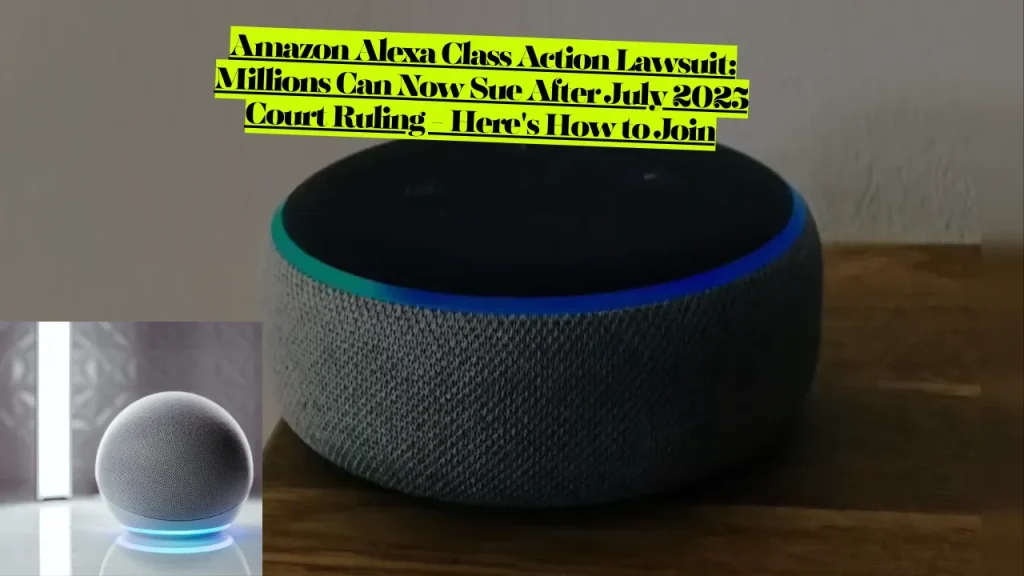
Amazon Alexa Class Action Lawsuit, Millions Can Now Sue After July 2025 Court Ruling – Here’s How to Join
A federal judge certified a nationwide class action against Amazon on July 7, 2025, allowing millions of registered Alexa users to sue for privacy violations. The lawsuit alleges Amazon recorded, stored, and shared billions of private conversations without consent—including those involving children—and used them to train AI systems. The certified class covers U.S. residents who registered one or more Alexa devices. No settlement has been reached yet, but eligible users can expect updates as the case progresses.
What Is the Amazon Alexa Class Action Lawsuit About?
The case, Kaeli Garner v. Amazon.com, was filed in June 2021 in the U.S. District Court for the Western District of Washington. Plaintiffs allege that Amazon recorded, stored, and used Alexa users’ private conversations without providing proper notice or consent, violating Washington’s Consumer Protection Act.
The device often activates mistakenly through “false wakes” and records conversations never intended for Alexa at all. Amazon allegedly used these recordings to improve its machine learning algorithms and provide personalized advertising.
The July 2025 Court Ruling: Class Certification Granted
On July 7, 2025, U.S. District Judge Robert Lasnik granted class certification, one of the biggest steps in a class action lawsuit. This means eligible Alexa users can now sue as a group rather than individually.
Judge Lasnik granted class certification for two groups of Alexa users:
Group 1 – Injunctive Relief Class (Rule 23(b)(2)):
- Alexa registrants seeking to stop Amazon from using and storing voice recordings without consent
- No money damages, only changes to Amazon’s practices
Group 2 – Monetary Damages Class (Rule 23(b)(3)):
- Alexa registrants seeking financial compensation for privacy violations under Washington’s Consumer Protection Act
- Potentially millions of users eligible for damages
Judge Lasnik ruled that non-registered users (people who didn’t set up their own Alexa account but were recorded) cannot join the class because their claims require too much individual analysis.
Related Lawsuit: MyChart Lawsuit Settlement, How to Claim Your Payment – When You’ll Get Paid & Amounts Revealed
Who Can Join the Amazon Alexa Class Action?
You qualify if you:
- Are a U.S. resident
- Registered one or more Alexa-enabled devices (Echo, Echo Dot, Echo Show, etc.)
- Used Alexa between 2014 (when Alexa launched) and present
You do NOT qualify if you:
- Never registered an Alexa device yourself
- Were only recorded by someone else’s Alexa device
- Live outside the United States
What Amazon Allegedly Did Wrong
At the heart of the case is the allegation that Amazon’s design intentionally captures more audio than necessary, including private conversations, to feed its machine learning algorithms.
The key allegations:
“False Wake” Recordings: Alexa activates by mistake, triggered by words that sound like “Alexa” but aren’t. Research discovered more than 1,000 sequences of words that incorrectly trigger smart speakers such as Alexa.
No Clear Consent: Users weren’t properly informed that recordings would be kept indefinitely and used for commercial purposes.
Child Privacy Violations: Amazon recorded children’s conversations without parental consent and kept them even after parents requested deletion.
Third-Party Sharing: Alexa recorded these conversations and shared them with third-party contractors for financial benefits and to provide personalised ads.
Failure to Delete: Even when users requested deletion, Amazon didn’t fully remove recordings from its servers.
How Big Is This Case?
By 2020, Alexa was processing 2.8 billion interactions per week. The class potentially includes tens of millions of Alexa device owners across the United States.
The decision represents one of the most expansive privacy cases to date involving voice-enabled devices.
Amazon’s Defense
Amazon denies wrongdoing and argues:
Users Consented: By agreeing to Alexa’s terms of service, users gave consent to recordings.
Rare Mistakes: The company claims it built Alexa with protections to prevent accidental recordings and that any recordings made by mistake were rare and only used to improve the device.
Controls Available: Users can now delete recordings and opt out of storage, though these features weren’t available when Alexa first launched.
No Harm Proven: Amazon argues users must prove actual harm from the alleged misconduct.
Judge Lasnik rejected Amazon’s arguments for class certification purposes, finding common legal questions across all class members.
The $25 Million Federal Settlement (Separate Case)
In May 2023, Amazon settled a separate case with the Federal Trade Commission and Department of Justice for $25 million over children’s privacy violations related to Alexa.
The order requires Amazon to identify and delete inactive child profiles (profiles that have not been used for 18 months) unless a parent requests that they be retained.
This is NOT the same as the class action lawsuit. The $25 million went to the government, not to individual consumers. The current class action is seeking damages directly for affected users.
What Damages Could You Receive?
No settlement amount has been announced yet. The case is still in litigation. However, Washington’s Consumer Protection Act allows for:
- Actual damages suffered
- Attorney fees and costs
- Injunctive relief (forcing Amazon to change its practices)
Potential payout depends on:
- How many people join the class
- What the final settlement or judgment amount is
- Whether you can prove you were recorded
- How long you owned an Alexa device
Similar privacy class actions have resulted in payouts ranging from $5-$400 per person.
How to Join the Amazon Alexa Class Action
Currently: No action required yet. Since class certification just happened in July 2025, here’s what to expect:
Step 1: Watch for Notice If you’re a class member, you’ll receive notice by mail or email about the lawsuit. This typically happens after a settlement is reached or before trial.
Step 2: Decide to Participate or Opt Out
- Stay in: You’ll automatically be included and eligible for any settlement/judgment
- Opt out: You preserve your right to sue Amazon individually
Step 3: File a Claim Once a settlement is reached, you’ll need to submit a claim form to receive payment.
Where to monitor updates:
- Check TopClassActions.com for lawsuit updates
- Monitor the case docket: Kaeli Garner v. Amazon.com, Case No. 2:21-cv-00915, U.S. District Court for the Western District of Washington
- Sign up for email alerts from class action tracking websites
Timeline of the Amazon Alexa Lawsuit
2014: Amazon launches Alexa
June 2021: Kaeli Garner files class action lawsuit in Seattle federal court
May 2022: Judge Lasnik trimmed wiretapping claims from plaintiffs who had registered their devices while allowing users who had not registered their devices to proceed
May 2023: Amazon settles separate $25 million case with FTC/DOJ over children’s privacy
March 2025: Amazon terminated its “Do Not Send Voice Recordings” privacy feature for users of its Echo product, requiring all voice recordings to be shared with Amazon’s cloud
July 7, 2025: Judge Lasnik certifies nationwide class action for registered Alexa users
Present: Case moving toward settlement negotiations or trial
Similar Voice Assistant Lawsuits
Amazon isn’t alone facing privacy claims:
Apple Siri Lawsuit: Apple’s voice assistant Siri faced similar suit for accidental activation and recording of private conversations, with users viewing its $95 million settlement in the matter as an admission of guilt.
Google Assistant: Faced similar allegations of unauthorized voice recordings.
Meta (Facebook) Portal: Sued over video and voice recording practices.
The Alexa case could set precedent for how courts handle voice assistant privacy claims nationwide.
What the Court Found
The court found that the plaintiffs presented strong common legal questions, including: Whether Amazon disclosed its data collection practices clearly, whether users lost control over their voice data without compensation, and whether these practices constitute unfair or deceptive business conduct under Washington’s CPA.
Judge Lasnik rejected Amazon’s argument that each class member’s case was too different to proceed together.
Key Legal Issues
Express vs. Implied Consent: Lasnik found that determining whether the Alexa device owners gave express or implied consent is intensely fact-based and would require individualized analysis.
Expectation of Privacy: Did users have a reasonable expectation that conversations near Alexa devices wouldn’t be recorded?
Wiretapping Laws: The wiretapping claims were largely dismissed, but privacy claims under Washington’s Consumer Protection Act proceed.
Children’s Privacy: Special protections apply when recordings involve minors.
What This Means for Alexa Users Now
Your data may still be stored. Even if you delete recordings through your Alexa app, Amazon may have already used them for AI training.
You have more control now than before. Amazon now offers:
- Ability to delete recordings manually
- Option to turn off voice storage
- Automatic deletion after 3 or 18 months
- Option to opt out of human review
But transparency remains an issue. The lawsuit revives longstanding concerns about the lack of transparency and meaningful consent in voice assistants’ processing and collection of data.
Canada Is Suing Too
Separate proceedings are underway in Canada, where a proposed class action seeks to represent residents with Alexa accounts registered between 2014 and July 19, 2023.
This highlights international concerns about voice data handling and Amazon’s global privacy practices.
What Happens Next?
Possible outcomes:
Settlement: Amazon and plaintiffs could reach a settlement agreement. Class members would receive notice and a claim form.
Trial: If no settlement, the case goes to trial to determine liability and damages.
Appeal: Either side could appeal Judge Lasnik’s class certification ruling.
More Lawsuits: The class certification could encourage additional state-specific privacy claims.
Based on similar cases, settlement is most likely. Trials are expensive and risky for both sides.
How Much Could This Cost Amazon?
With tens of millions of potential class members, even small per-person damages could total hundreds of millions or billions of dollars.
For comparison:
- Facebook paid $650 million in an Illinois biometric privacy case ($350 per person)
- Apple settled Siri privacy claims for $95 million
- Amazon paid $61.7 million to settle Flex driver tip theft claims
The final amount depends on how many people file claims and what evidence shows about actual harm.
Protecting Your Privacy With Alexa
While the lawsuit proceeds, you can take these steps:
Review your voice recordings:
- Open Alexa app → Settings → Alexa Privacy → Review Voice History
Delete recordings:
- Set auto-delete to 3 months or 18 months
- Or manually delete all recordings
Limit data sharing:
- Turn off “Help Improve Amazon Services and Develop New Features”
- Opt out of human review of recordings
Mute when not in use:
- Press the microphone mute button on your device
Consider unplugging:
- Some users have unplugged devices entirely given privacy concerns
Illinois Biometric Privacy Claim
Amazon has been hit with another class action lawsuit alleging the company violates Illinois’ Biometric Information Privacy Act (BIPA) by capturing and storing biometric data in the form of voice recordings without consent.
This separate Illinois-specific case (Carol Cooper v. Amazon.com) could result in additional damages for Illinois residents under BIPA’s strict privacy law.
Frequently Asked Questions
When will I get paid from the Amazon Alexa lawsuit?
No settlement has been reached yet. Class certification happened in July 2025, but it could take 1-3 years before any settlement is finalized and payments are distributed.
Do I need to do anything now to join the lawsuit?
No. If you’re an eligible class member, you’ll automatically be included unless you opt out. You’ll receive notice by mail or email when settlement negotiations conclude.
How much money could I receive?
Unknown at this time. Settlements in similar cases have ranged from $5 to $400 per person, depending on the total settlement amount and number of claimants.
Does this apply to all Alexa devices?
Yes, if you registered any Alexa-enabled device (Echo, Echo Dot, Echo Show, Fire TV with Alexa, etc.) in the United States.
What if I don’t have my Alexa anymore?
You can still join the class if you owned and registered a device during the relevant time period (2014-present).
Can I still use my Alexa while the lawsuit is pending?
Yes, the lawsuit doesn’t prevent you from using Alexa devices. However, Amazon continues collecting voice data under current practices.
What if Amazon recorded me but I never registered a device?
Unfortunately, Judge Lasnik ruled that non-registered users cannot join the class because their claims require too much individual analysis.
Is there a deadline to file a claim?
Not yet. Claim deadlines will be announced only after a settlement is reached. This typically allows 60-120 days to submit claims.
What happens if I registered my device but didn’t use it much?
You may still qualify as a class member, but your potential damages could be lower than someone who used Alexa extensively.
Can I opt out and sue Amazon myself?
Yes. When you receive class notice, you’ll have an opportunity to exclude yourself and preserve your right to individual legal action. However, this requires hiring your own attorney.
Related Articles:
- Facebook Lawsuit Payout Latest: Active Settlements, Eligibility, Payout Amounts
- MyChart Settlement Lawsuit: How to Claim Your Cash Payment
- Yahoo Tracking Class Action: Claim Your $405 Before December 27
- Temu Settlement Claim Form: Privacy Violation Claims Up to $5000
Disclaimer: This article provides information about the Amazon Alexa class action lawsuit and does not constitute legal advice. Settlement terms have not been finalized. Always verify current case status at official sources. If you have questions about your eligibility or rights, consult with a qualified attorney specializing in class action litigation.
About the Author

Sarah Klein, JD, is a licensed attorney and legal content strategist with over 12 years of experience across civil, criminal, family, and regulatory law. At All About Lawyer, she covers a wide range of legal topics — from high-profile lawsuits and courtroom stories to state traffic laws and everyday legal questions — all with a focus on accuracy, clarity, and public understanding.
Her writing blends real legal insight with plain-English explanations, helping readers stay informed and legally aware.
Read more about Sarah