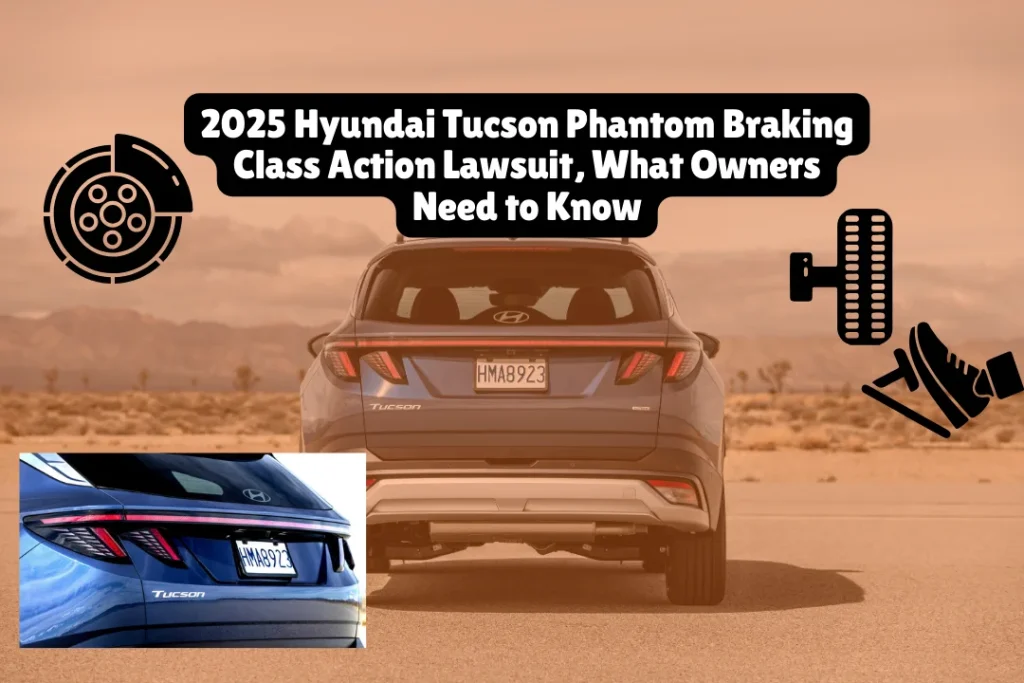
2025 Hyundai Tucson Phantom Braking Class Action Lawsuit, What Owners Need to Know
A class action lawsuit alleges that 2025 Hyundai Tucson SUVs are equipped with defective automatic emergency braking systems. The complaint claims these vehicles experience “phantom braking,” where the system abruptly engages at high speeds without any obstacle present. The case is in early litigation — no settlement exists yet. Owners of 2025 Hyundai Tucson and Tucson Hybrid vehicles may be eligible to join the class.
Quick Facts
| Lawsuit Type | Class Action |
| Defendant | Hyundai Motor America |
| Lead Plaintiff | Dennis Sperling |
| Vehicles Affected | 2025 Hyundai Tucson, 2025 Hyundai Tucson Hybrid |
| Court | U.S. District Court, Central District of California |
| Case Name | Dennis Sperling v. Hyundai Motor America |
| Case Status | Active litigation — no settlement reached |
| Settlement Amount | None — case not resolved |
| Claim Deadline | None — no claim period open |
| NHTSA Complaint Reference | ID 11608921 (among others) |
| Official NHTSA Lookup | nhtsa.gov/vehicle/2025/HYUNDAI/TUCSON |
Current Status & What Happens Next
The lawsuit was filed in the U.S. District Court for the Central District of California on February 28, 2026. The case is at the very beginning of the litigation process. Hyundai has not yet formally responded to the complaint.
Here is what typically follows at this stage:
- Hyundai files a response or motion to dismiss
- Parties enter a discovery phase — exchanging documents and evidence
- Plaintiff attorneys seek class certification from the court
- If certified, the class expands to all similarly affected Tucson owners
- Parties may negotiate a settlement at any point in this process
There is no claim form, no settlement website, and no payment fund at this time. Separate law firms, including Ahdoot & Wolfson, are also conducting active investigations into the same defect, which may result in additional filings or a consolidated case.
What the Lawsuit Alleges
The “Phantom Braking” Defect
The complaint claims the 2025 Tucson’s Forward Collision-Avoidance Assist (FCA) system incorrectly triggers emergency braking at high speeds without obstacles present. The suit argues this unintended deceleration creates significant safety risks for drivers and following traffic.
The lawsuit says the system kicks in when the road ahead is completely clear, causing the Tucson to slow down suddenly and putting drivers at risk of being rear-ended.
The Technical Root Cause Alleged
Technical claims suggest the Electronic Control Unit fails to filter false positives from radar and camera sensors, misinterpreting shadows or road signs as obstacles. The lawsuit argues that the software does not adequately distinguish between actual hazards and non-threats.
The plaintiff complains Hyundai rushed the feature to market and used cheap radar and components for the braking systems.
What Hyundai’s Own Manual Says
The 2025 Tucson owner’s manual includes several pages about limitations of the system. Hyundai states that “Forward Collision-Avoidance Assist may turn off or may not operate properly or may operate unnecessarily depending on the road conditions and surroundings.” The lawsuit argues this language downplays the potential severity of sudden unintended braking at high speed and does not give adequate notice of what a failure to “operate properly” would actually mean for driver safety.
Dealer Response to Complaints
Despite a surge of consumer complaints filed with NHTSA, the suit alleges Hyundai dealerships often inform owners the system is “operating as designed” or blame blocked sensors, leaving drivers without a permanent technical fix.
Which Vehicles Are Affected
The lawsuit names the 2025 Hyundai Tucson and 2025 Tucson Hybrid as the affected vehicles. The class definition has not yet been formally certified by the court. If the court certifies the class, it will define the exact scope — potentially including all U.S. owners and lessees of these model year vehicles.
Owners most often report emergency brakes slamming on during slow-speed city driving or highway conditions, the system reactivating automatically after being manually disabled, and dealers often being unable to replicate or fully resolve the problem.
Related article: Meijer Recalls 211,000+ Lullaby Lane & MCS Children’s Sleepwear Units Due to Burn Hazard
What Owners Should Do Right Now
1. Document every phantom braking event. Note the date, time, location, speed, and road conditions. Take video if possible.
2. Report to NHTSA. File a complaint at safercar.gov or call 1-888-327-4236. One specific NHTSA filing, ID 11608921, describes a vehicle passing under a highway overpass that suddenly decelerated from 70 mph to 20 mph. Your report adds to the official record and may help trigger a formal investigation or recall.
3. Keep all dealership service records. Every visit where you reported this issue creates a paper trail that strengthens any future legal claim.
4. Check your VIN at nhtsa.gov to see if your specific vehicle has open complaints or recalls already on file.
5. Contact a consumer vehicle attorney if your vehicle has experienced repeated incidents. Many offer free consultations and work on contingency — no upfront cost.
6. Do not wait for a settlement. If your state has a lemon law and your vehicle has been in for repairs multiple times for the same unresolved defect, owners who experience repeated or unresolved defects may have rights under state lemon laws, which can include a refund, a replacement vehicle, or other compensation.
NHTSA & Safety Context
The lawsuit points to a surge of consumer complaints filed with NHTSA describing near-miss collisions where trailing vehicles were forced to swerve to avoid rear-ending the Tucson. As of the filing date, NHTSA has not announced a formal investigation or recall specifically for the 2025 Tucson phantom braking issue. Owners can check for any updates at nhtsa.gov.
Prior Related Cases
A separate class action lawsuit filed in May 2025 alleges that 2023–2025 Hyundai Palisade models are equipped with defective anti-lock braking and traction control systems. That case suggests a pattern of braking-related complaints across multiple Hyundai SUV lines. Neither that case nor the Tucson case has reached a settlement.
FAQs
Q: Is this a certified class action?
Not yet. The lawsuit was filed February 28, 2026. The court has not yet certified a class. That determination comes later in the litigation process.
Q: Does my 2025 Tucson qualify?
The complaint names the 2025 Hyundai Tucson and 2025 Tucson Hybrid. If you own or lease either of these vehicles, you are likely in the proposed class — but formal class certification has not been granted yet.
Q: Has a settlement been reached?
No. This case was filed days ago. No settlement, no claim form, and no payment fund exist at this time.
Q: What should I do if I own a 2025 Tucson?
Document all phantom braking events, report them to NHTSA at safercar.gov, keep dealership service records, and consult a vehicle defect attorney if the problem is recurring and unresolved.
Q: Where can I file a claim?
There is no claim to file right now. If the case settles in the future, a court-authorized settlement website will be announced. Bookmark this page for updates.
Q: How do I check NHTSA complaints for my vehicle?
Go to nhtsa.gov, enter your VIN under “Check for Recalls,” and search the complaints database for your specific make, model, and year.
Q: What happens if the class wins?
If the case resolves in plaintiffs’ favor — either through trial or settlement — class members could receive compensation such as cash payments, vehicle repairs, extended warranties, or buyback options depending on the terms negotiated. No amounts can be predicted at this stage.
Q: Can I pursue a lemon law claim separately?
Yes. A class action and a lemon law claim are separate legal paths. Owners who experience repeated or unresolved defects may have rights under state lemon laws, which can include a refund, a replacement vehicle, or other compensation. Consult a lemon law attorney in your state for specific guidance.
This article is for informational purposes only and does not constitute legal advice. Legal claims and outcomes depend on specific facts and applicable law. For advice regarding a particular situation, consult a qualified attorney.
Last Updated: March 4, 2026 | AllAboutLawyer.com
About the Author

Sarah Klein, JD, is a licensed attorney and legal content strategist with over 12 years of experience across civil, criminal, family, and regulatory law. At All About Lawyer, she covers a wide range of legal topics — from high-profile lawsuits and courtroom stories to state traffic laws and everyday legal questions — all with a focus on accuracy, clarity, and public understanding.
Her writing blends real legal insight with plain-English explanations, helping readers stay informed and legally aware.
Read more about Sarah