
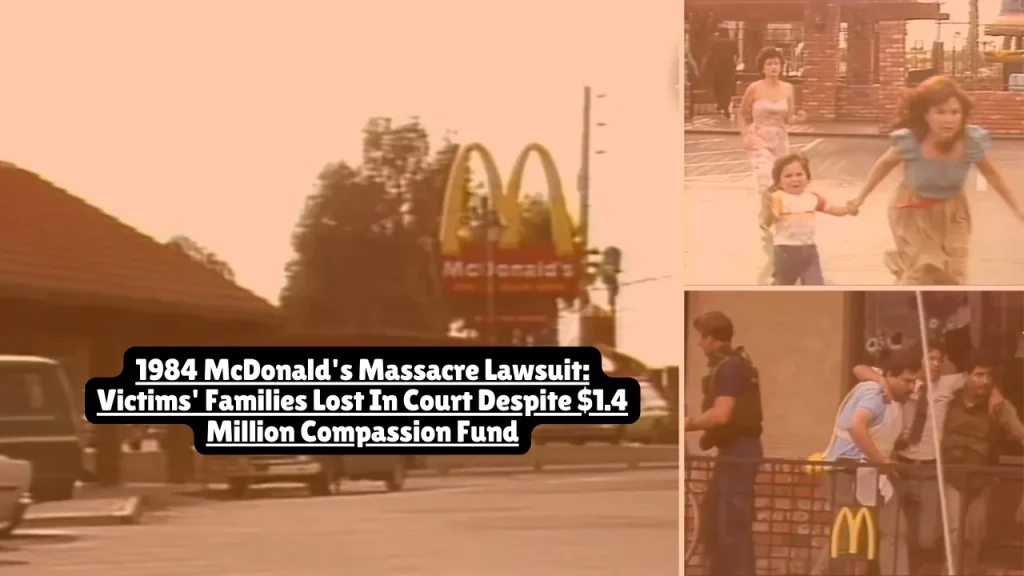
1984 McDonald’s Massacre Lawsuit, Victims’ Families Lost In Court Despite $1.4 Million Compassion Fund
The lawsuits filed by victims and families of the 1984 San Ysidro McDonald’s massacre were all dismissed before trial in 1987 when the California Court of Appeal ruled McDonald’s had no legal duty to protect customers from an unforeseeable mass shooting. Despite the complete legal defeat, McDonald’s Corporation voluntarily created a $1.4 million victims’ fund—demonstrating corporate compassion even without court-ordered liability.
On July 18, 1984, James Oliver Huberty walked into a McDonald’s restaurant in San Ysidro, California, and opened fire with multiple weapons. Over 77 minutes, he killed 21 people and wounded 19 others before a police sniper ended the rampage. It remains California’s deadliest mass shooting.
The Legal Battle That Failed
Survivors and families filed multiple lawsuits against McDonald’s Corporation, its franchisee Bosherro 522 Partnership, franchisee Robert T. Colvin, and the San Diego Police Department. The consolidated case became known as Lopez v. McDonald’s Corporation.
Plaintiffs argued McDonald’s failed to provide adequate security despite operating in a high-crime area. Attorney Federico Sayre claimed there were 348 crimes per 1,000 people in San Ysidro in the 12 months ending June 30, 1984—43 percent higher than any other San Diego area.
Why The Court Dismissed The Case
The trial court granted summary judgment in favor of McDonald’s, meaning the case never reached a jury. On July 25, 1987, the California Court of Appeal upheld this dismissal in a landmark ruling that businesses don’t have a legal duty to protect customers from unforeseeable violent attacks.
The court acknowledged high crime statistics in the area, including five robberies, five batteries, three assaults with a deadly weapon, and 38 felony thefts within two-tenths of a mile of the restaurant during the relevant time period. FBI crime index data showed San Ysidro’s violent crime rate was 228 percent higher than the city-wide average.
However, the court distinguished between ordinary criminal acts like theft—which are foreseeable and require reasonable security measures—and unprecedented mass violence. The judges ruled that even if McDonald’s had employed security guards or installed cameras, such measures wouldn’t have prevented Huberty’s attack since he showed complete disregard for his own survival.
McDonald’s Voluntary Response
Despite owing no legal obligation, McDonald’s took extraordinary steps to support victims and families. The corporation announced a commitment to donate $1 million to a survivors’ fund immediately after the tragedy.
Joan Kroc, widow of McDonald’s founder Ray Kroc, personally added $100,000 to assist with burial costs, financial aid for relatives of the deceased, and counseling for survivors. Total donations to this voluntary fund exceeded $1.4 million.
The Compassion Paradox
In an ironic twist, Etna Huberty—the shooter’s widow—received the first payout from this victims’ fund, sparking protests from some San Ysidro residents and donors. McDonald’s maintained its compassionate approach despite the controversy, focusing on helping all affected families regardless of legal liability concerns.
This response strategy proved remarkably successful for McDonald’s corporate image. A 1995 Public Relations Quarterly article noted that McDonald’s “actions spoke louder than words,” with the compassionate approach leaving the company’s positive reputation intact despite the tragedy occurring at one of its restaurants.
Related Article: What To Do If Martial Law Is Declared? Your Constitutional Rights Still Apply And 6 Critical Steps To Protect Yourself
The Lawsuit Against Police
Families also sued the City of San Diego, former Mayor Roger Hedgecock, and Police Chief William Kolender, claiming negligence in responding to and handling the crisis. This case, Lopez v. City of San Diego, alleged officers failed to exercise reasonable care during the 77-minute rampage.
The court dismissed this lawsuit too, ruling in 1987 that police departments generally have no duty to protect specific individuals from criminal acts. The judges found no evidence that police actions increased the danger or that victims relied on police for protection before being injured.
Etna Huberty’s Failed Lawsuit
In July 1986, exactly two years after the massacre, Etna Huberty and her two daughters filed their own lawsuit seeking $5 million in damages against both McDonald’s and Babcock & Wilcox, her husband’s former employer.
The lawsuit claimed James Huberty’s murderous rampage resulted from monosodium glutamate in McDonald’s food combined with exposure to poisonous metals—specifically lead and cadmium—from 14 years of welding work. She alleged this toxic combination triggered delusions and rage that caused his violent behavior.
This lawsuit was dismissed in 1987. Forensic pathologists suggested Huberty likely suffered from paranoid schizophrenia rather than environmental poisoning. The court found no credible evidence linking McDonald’s food ingredients or his former workplace conditions to the massacre.
Legal Precedent And Impact
The Lopez v. McDonald’s Corporation decision established important precedent in premises liability law. The ruling clarified that property owners and businesses must protect customers from reasonably foreseeable criminal acts—like theft or assault—but not from unprecedented, unpredictable mass violence.
Courts have cited this case in subsequent litigation involving business security obligations. The decision recognized that requiring businesses to prevent all possible violence, no matter how unforeseeable, would impose an impossible standard.
What Businesses Must Protect Against
The court identified a crucial distinction: McDonald’s likely should have provided security cameras, alarms, or uniformed guards to deter theft-related crimes given the area’s high property crime rates. Such measures would help identify and capture ordinary criminals.
However, no reasonable security measure could have prevented Huberty’s attack. He arrived heavily armed with an Uzi semiautomatic rifle, a shotgun, and a pistol, prepared to die in the assault. Standard retail security doesn’t stop determined mass murderers who expect to be killed.
The Aftermath
McDonald’s demolished the San Ysidro restaurant out of respect for community sentiment. The corporation donated the land to the city, which erected a memorial before building Southwestern College on the site.
The permanent memorial, formally unveiled in 1990, consists of 21 hexagonal white marble pillars ranging from 1 to 6 feet tall. Each pillar bears the name of a victim, with varying heights representing the different ages and backgrounds of those killed.
Every anniversary, residents decorate the memorial with flowers. During the three-day Day of the Dead celebration, candles and offerings honor the victims’ memories.
Where To Find Official Records
Court documents from Lopez v. McDonald’s Corporation (1987) are available through California legal databases at 193 Cal. App. 3d 495. The case citation is Lopez v. McDonald’s Corp., 193 Cal. App. 3d 495, 238 Cal. Rptr. 436 (1987).
Lopez v. City of San Diego (1987) is available at 190 Cal. App. 3d 678. Both decisions are accessible through legal research platforms like Justia, Casetext, and California Courts’ official archives.
News coverage from 1984-1987 is preserved in newspaper archives including UPI, Associated Press, and San Diego Union-Tribune records. The San Diego Public Library maintains a special collection on the tragedy.
The 2016 documentary “77 Minutes: The 1984 San Diego McDonald’s Massacre” includes interviews with survivors and the SWAT sniper who ended the shooting. This film provides comprehensive historical documentation of the event.
Frequently Asked Questions
Did Any Victims Receive Compensation From The Lawsuits?
No. All lawsuits against McDonald’s and the San Diego Police Department were dismissed before trial, meaning no court-ordered compensation was awarded. However, victims and families received payments from the voluntary $1.4 million fund McDonald’s created despite having no legal obligation to do so.
Why Did The Court Rule McDonald’s Wasn’t Liable?
California courts determined McDonald’s had no legal duty to protect customers from an unforeseeable mass shooting. While businesses must guard against reasonably predictable crimes like theft, they cannot be held responsible for unprecedented violent attacks that no reasonable security measure could prevent.
What Security Did McDonald’s Have At The Time?
The restaurant had standard 1984 retail security—locks, basic lighting, and employee training. Plaintiffs’ security expert testified McDonald’s should have had cameras, alarms, and possibly a uniformed guard given the area’s high crime rate, but the court ruled such measures wouldn’t have stopped Huberty’s attack.
How Much Money Did Victims’ Families Receive?
Total distributions from the voluntary $1.4 million fund varied by family circumstances. McDonald’s contributed $1 million, Joan Kroc added $100,000, and other donors contributed the remainder. The fund covered burial costs, financial assistance, and counseling services rather than fixed per-victim payments.
Can Similar Lawsuits Succeed Today?
Premises liability law has evolved since 1987, but the core principle remains: businesses must protect against foreseeable risks, not unprecedented violence. The Abigail Zwerner’s $40M lawsuit exposed school ignored 3 warnings before teacher shot by 6-year-old case shows modern courts may find liability when specific warnings are ignored, unlike the McDonald’s case where no advance warning existed.
What Happened To The Huberty Family?
Etna Huberty and her two daughters faced death threats and relocated multiple times after the massacre, eventually settling in Spring Valley, California. All three attended counseling for over nine months. Etna died of breast cancer in 2003. The daughters enrolled in school under assumed names for their safety.
Did This Case Change Police Response Policies?
Yes. The massacre prompted law enforcement agencies nationwide to reconsider policies of waiting outside during active shooter situations. Modern protocols emphasize rapid entry and confrontation of active shooters rather than containment and negotiation. The 77-minute response time is now considered unacceptably long by contemporary standards.
Last Updated: January 20, 2026
Disclaimer: This article provides historical information about the 1984 San Ysidro McDonald’s massacre lawsuits and should not be considered legal advice.
Call to Action: This tragedy reshaped how America understands mass violence and business security obligations. Share your thoughts on how premises liability law should balance business responsibilities with unforeseeable threats.
Stay informed, stay protected. — AllAboutLawyer.com
About the Author

Sarah Klein, JD, is a licensed attorney and legal content strategist with over 12 years of experience across civil, criminal, family, and regulatory law. At All About Lawyer, she covers a wide range of legal topics — from high-profile lawsuits and courtroom stories to state traffic laws and everyday legal questions — all with a focus on accuracy, clarity, and public understanding.
Her writing blends real legal insight with plain-English explanations, helping readers stay informed and legally aware.
Read more about Sarah