
$12.5M Cash App Text Message Settlement, Payments Of $394 Issued February 2026—Washington Residents Who Received Spam Texts
If you received unsolicited Cash App “Invite Friends” referral texts while living in Washington between November 14, 2019 and August 7, 2025, payments of $394.36 were issued on February 2, 2026 to approved claimants—but the claim deadline passed on October 27, 2025.
The $12.5 million settlement in Bottoms v. Block Inc. (Case No. 2:23-cv-01969-MJP) resolved allegations that Cash App’s parent company Block Inc. violated Washington consumer protection laws by assisting users in sending unsolicited commercial text messages through the app’s referral program. The court granted final approval on December 2, 2025, clearing the way for payment distribution that began in early February 2026.
What The Cash App Text Message Lawsuit Alleged
The class action claimed Block violated Washington’s Commercial Electronic Mail Act (CEMA) and the Washington Consumer Protection Act (CPA) by substantially assisting Cash App users to transmit unwanted promotional texts to Washington residents without their consent.
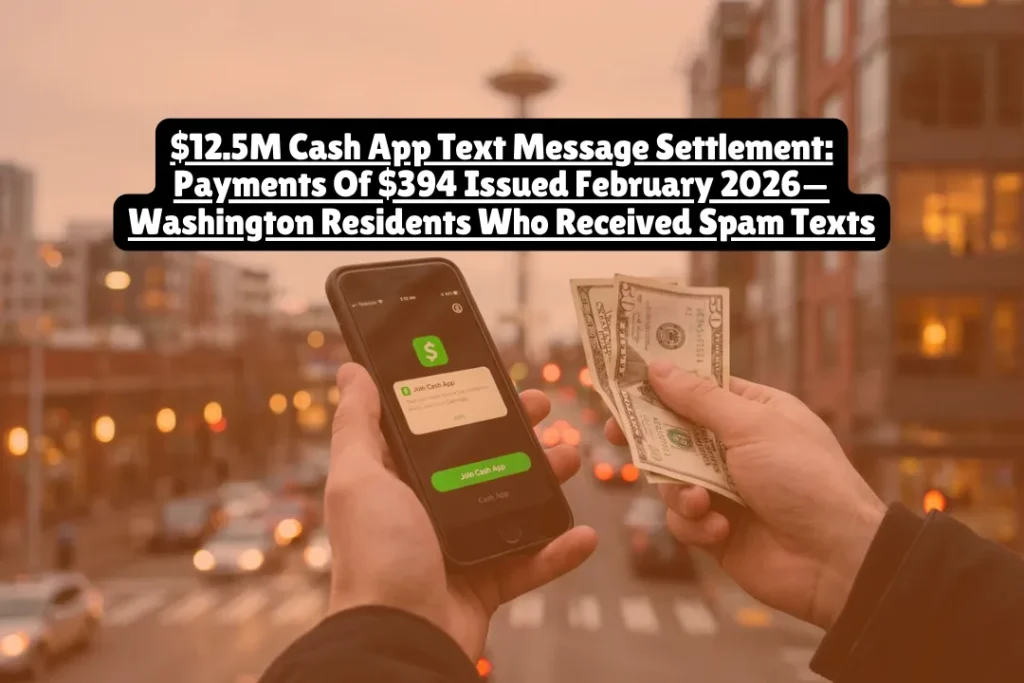
According to court filings, Cash App’s “Invite Friends” referral program incentivized users to send pre-filled text invitations to contacts in their phones. An example text read: “Hey! I’ve been using Cash App to send money and spend using the Cash Card. Try it using my code and you’ll get $5. FVRJ1PH https://cash.app/app/FVRJ1PH.”
The lawsuit alleged these messages were commercial advertisements sent without recipients’ clear and affirmative consent, violating Washington law. Under CEMA, recipients are entitled to $500 for each text sent in violation of the law, with potential treble damages under the CPA.
Block denied all wrongdoing and maintained it fully complied with state and federal laws. The company agreed to settle to avoid the risk and expense of continued litigation, without admitting any violations.
Who Was Eligible For The Settlement
You qualified if you received a Cash App referral program text message between November 14, 2019 and August 7, 2025, were a Washington resident at the time you received the text, and did not clearly and affirmatively consent in advance to receive such messages.
Block’s data indicated Cash App users sent referral program texts to approximately 1,975,187 Washington phone numbers during the class period. Settlement notices went out to affected individuals via email and postcards in August 2025.
Excluded from the settlement were Block employees, directors, officers, counsel, their immediate families, and anyone who timely excluded themselves from the class.
How Much Money Claimants Received
Originally estimated at $88 to $147 per person, approved claimants actually received $394.36 each—significantly higher than projected. The settlement administrator began issuing payments on February 2, 2026.
The higher-than-expected payment amount resulted from fewer valid claims filed than anticipated. When claim volumes are lower in class action settlements, the per-person payout increases because the net settlement fund is divided among fewer recipients.
The $12.5 million total settlement fund covered all compensation, attorney fees ($3.1 million), class representative award ($10,000 to Kimberly Bottoms), and administration costs. After these deductions, the remaining funds were divided equally among all approved claimants who submitted valid claim forms.
Similar to the Cash App Class Action Lawsuit Settlement Deadline PASSED, Two Major Payouts Coming In 2025 – Are You Eligible For Up To $2,500?, Cash App faced multiple consumer protection settlements in 2025-2026, highlighting ongoing concerns about the company’s practices.
Timeline Of The Settlement And Payment Distribution
Class representative Kimberly Bottoms filed the original lawsuit on November 21, 2023 in Washington State Superior Court. Block removed the case to federal court in the Western District of Washington on December 21, 2023.
On January 25, 2024, Block moved to dismiss the lawsuit, claiming the complaint failed to state a viable legal claim. Judge Marsha J. Pechman denied the motion on May 2, 2024, allowing the case to proceed through discovery.
The parties reached a $12.5 million settlement agreement in July 2025. Settlement notices began going out in August 2025, with the claim deadline set for October 27, 2025.
The final approval hearing occurred on December 2, 2025, before Judge Pechman, who deemed the settlement “fair, reasonable, and adequate and in the best interests of the Settlement Class.” Payment distribution began on February 2, 2026.
Claimants received payments through their elected method—paper checks, Venmo, PayPal, or other electronic payment options they selected when filing their claim forms.
What Washington Law Says About Text Message Marketing
Washington’s Commercial Electronic Mail Act prohibits companies and individuals from sending spam emails or texts to state residents without their consent. The legislature broadened the law in 2003 to include text messages, with the prohibition covering third parties who “initiate or assist” in transmitting those texts.
The law imposes strict liability—meaning recipients don’t need to prove actual damages to recover statutory penalties. Each violation entitles the recipient to $500, or actual damages, whichever is greater. The Washington Consumer Protection Act allows courts to triple damages for willful violations.
Unlike federal TCPA (Telephone Consumer Protection Act) violations which only prohibit certain types of automated calling and texting, Washington’s CEMA applies broadly to any unsolicited commercial electronic messages sent to state residents.
What Most People Don’t Know About Text Message Settlements
Approximately 96% of class action settlement funds go unclaimed because affected individuals either miss deadlines, don’t realize they qualify, or dismiss the notices as scams. The Cash App settlement followed this pattern—only about 5% of the estimated 1,975,187 class members filed valid claims.
This dramatically increased per-person payments from the estimated $88-$147 range to $394.36. Class members who dismissed the email or postcard notices as potential scams missed out on nearly $400 in compensation.
Text message class actions have become increasingly common as companies expand mobile marketing. Recent settlements include the Get Up To $1500 Per Text From Shein Class Action Lawsuits Exposed $700K Settlement addressing TCPA violations where affected consumers could claim up to $1,500 per illegal text message.
Steps To Verify Your Payment Status
If you filed a claim before the October 27, 2025 deadline, you can verify your payment status at www.BottomsTextSettlement.com. Enter the phone number you provided on your claim form to check approval status and payment method.
Payments were issued via the delivery method selected on claim forms—electronic payments through Venmo, PayPal, or direct deposit typically arrived within 3-5 business days of the February 2 distribution date. Paper checks were mailed and may take 7-10 business days for delivery.
For questions about payment status, contact the settlement administrator at [email protected] or call 1-877-540-7545. Have your claim ID ready when calling.
If your claim was denied or you received a deficiency notice before the deadline, those issues should have been resolved during the claim review period that ended in late 2025.
Common Misconceptions About The Settlement
Many Washington residents assumed the settlement only covered people who actually signed up for Cash App after receiving referral texts. This is false—you qualified simply by receiving the unsolicited message, regardless of whether you downloaded the app or used the referral code.
Some people thought they needed to prove the texts caused them harm or inconvenience. Under Washington’s CEMA, no actual damages are required—receipt of the unsolicited commercial text itself constitutes a violation entitling you to statutory damages.
Others believed filing a claim would affect their ability to use Cash App or would result in account closure. Settlement participation has no impact on account status, and Block cannot retaliate against class members for exercising their legal rights.
How To Protect Yourself From Future Unwanted Texts
Register your cell phone number on the National Do Not Call Registry at DoNotCall.gov. While this primarily covers telemarketing calls, it creates evidence of your intent not to receive unsolicited commercial communications.
When downloading apps, carefully review permissions before agreeing to allow access to your contacts. Many apps request contact access ostensibly for legitimate purposes but use that data for marketing programs like Cash App’s referral system.
Respond “STOP” to any unwanted marketing texts. Federal law requires companies to honor opt-out requests within 10 business days. Keep screenshots documenting your opt-out requests in case violations continue.
Check your state’s consumer protection laws. Some states like Washington have stronger protections than federal TCPA regulations, potentially entitling you to higher damages for violations.
What Happens To Unclaimed Settlement Funds
For settlement payments deemed undeliverable or uncashed by claimants, the settlement agreement specified two possible distributions. First, if sufficient residual funds remained to justify administrative costs, a second pro rata distribution would be made to class members who successfully cashed their initial payments.
Second, any remaining unclaimed funds would be distributed to the Legal Foundation of Washington, a nonprofit organization that provides civil legal aid to low-income Washington residents. This cy pres distribution ensures settlement money benefits Washington consumers even if not directly claimed by affected class members.
Frequently Asked Questions
What is the $12.5M Cash App Text Message Settlement about?
The settlement resolves allegations that Block Inc., Cash App’s parent company, violated Washington consumer protection laws by assisting users in sending unsolicited commercial text messages through the “Invite Friends” referral program. Block denied wrongdoing but paid $12.5 million to settle the claims.
How many people were affected by the Cash App text messages?
Approximately 1,975,187 Washington phone numbers received Cash App referral program text messages between November 14, 2019 and August 7, 2025. However, only about 5% of eligible class members filed valid claims before the October 27, 2025 deadline.
What types of text messages were involved?
The settlement covered Cash App “Invite Friends” referral texts that typically said something like: “Hey! I’ve been using Cash App to send money and spend using the Cash Card. Try it using my code and you’ll get $5.” These texts invited recipients to download Cash App using a referral code but were sent without recipients’ clear consent.
Have payments been issued?
Yes. The settlement administrator began issuing payments of $394.36 to approved claimants on February 2, 2026. Payments were sent via the method each claimant selected on their claim form—paper check, Venmo, PayPal, or other electronic payment options.
Can I still file a claim?
No. The claim deadline was October 27, 2025. The settlement received final court approval on December 2, 2025, and payment distribution began on February 2, 2026. No further claims can be accepted.
How do I check my payment status?
Visit www.BottomsTextSettlement.com and enter the phone number you provided on your claim form. You can also contact the settlement administrator at [email protected] or call 1-877-540-7545 with your claim ID.
Why was the payment amount higher than estimated?
Original estimates projected $88 to $147 per person based on an assumption that up to 5% of the 1,975,187 class members would file claims. Actual claim volume was lower than projected, resulting in higher per-person payments of $394.36 when the net settlement fund was divided among approved claimants.
What if my payment was undeliverable or I didn’t receive it?
Contact the settlement administrator immediately at [email protected] or 1-877-540-7545. Provide your claim ID and updated contact information. Unclaimed funds will eventually be redistributed to class members who successfully received their payments or donated to the Legal Foundation of Washington.
Disclaimer: This article provides general information about the Cash App text message settlement and should not be considered legal advice. Settlement details are based on publicly available court documents and official settlement notices. For questions about your specific payment status, contact the settlement administrator or consult a qualified attorney.
Stay informed, stay protected. — AllAboutLawyer.com
Last Updated: February 7, 2026
About the Author

Sarah Klein, JD, is a licensed attorney and legal content strategist with over 12 years of experience across civil, criminal, family, and regulatory law. At All About Lawyer, she covers a wide range of legal topics — from high-profile lawsuits and courtroom stories to state traffic laws and everyday legal questions — all with a focus on accuracy, clarity, and public understanding.
Her writing blends real legal insight with plain-English explanations, helping readers stay informed and legally aware.
Read more about Sarah